
Solar Inverter vs Battery Inverter vs Hybrid Inverter: Explained
If you've started researching home batteries, you've probably seen the terms solar inverter, battery inverter, and hybrid inverter thrown around — sometimes interchangeably, sometimes confusingly. Here's a plain-English guide to what each one does and why it matters for your system.
Why Inverters Matter
Solar panels produce DC (direct current) electricity. Your home appliances run on AC (alternating current). An inverter converts one to the other. That's the core function. Where it gets more complex is when you add battery storage — now you need to manage bidirectional power flows, and potentially separate or combined conversion stages.
Standard Solar Inverter (String Inverter)
The most common inverter type in Australian solar installations. A string inverter is a single box mounted on your wall (typically near the meter box or in the garage) that converts DC from your solar panels to AC for household use or grid export.
What it does well: Reliable, well-understood, cost-effective, widely serviced in Australia.
What it doesn't do: Manage battery storage. A standard solar inverter cannot directly charge or discharge a battery. You either need to add an AC-coupled battery (which has its own inverter), or replace the solar inverter with a hybrid inverter.
Common brands in Australia: Fronius, SMA, Goodwe, Sungrow (string models), ABB, Delta.
Microinverters
A variation on the inverter concept: instead of one central inverter, microinverters are small units attached to each individual solar panel. Enphase is the dominant brand in Australia.
Microinverters are DC-to-AC at the panel level. They work excellently with AC-coupled batteries like the Enphase IQ Battery. They're more expensive than string inverters but eliminate shade impact issues and provide panel-level monitoring.
Battery Inverter
A battery inverter is a bidirectional inverter specifically for battery storage. It converts AC from the grid or your existing solar inverter to DC for storing in the battery, and then converts DC back to AC when the battery discharges.
Some batteries (like the Powerwall 3 and Enphase IQ Battery) have the battery inverter built into the battery unit itself. Others (like the BYD Battery-Box) are paired with a separate inverter unit. Either way, the battery inverter is what enables the battery to interact with your home's AC electrical system.
When you see it separately: Some larger or commercial battery systems use standalone battery inverters from brands like Victron, SMA, or Fronius. In residential systems, the battery inverter is usually integrated.
Hybrid Inverter
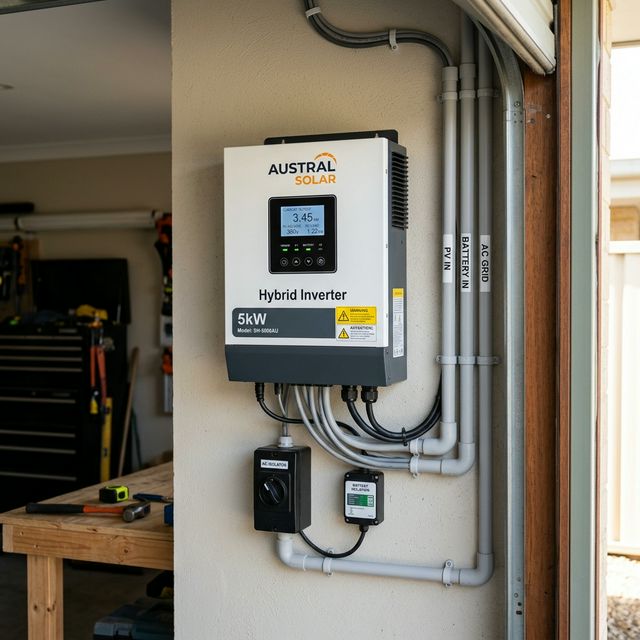
A hybrid inverter combines the functions of a solar inverter and a battery inverter in one unit. It:
- Converts DC from solar panels to AC for your home (solar inverter function)
- Charges and discharges a connected DC battery (battery inverter function)
- Manages the priority of power flows: solar first, then battery, then grid
Hybrid inverters are the preferred solution for new solar + battery installations. They're more efficient (one DC-to-AC conversion instead of two), cleaner (one box instead of multiple), and typically enable better battery management.
Common hybrid inverter brands in Australia: Sungrow SH series, Fronius Gen24, SolarEdge StorEdge, GoodWe ET series, Huawei SUN2000, Alpha ESS hybrid models.
Which Configuration Is Right for You?
New Solar + Battery Install
Use a hybrid inverter with a DC-coupled battery. This is the cleanest, most efficient setup. Your installer will design the system around a compatible hybrid inverter + battery combination.
Retrofitting a Battery to an Existing Solar System (Inverter in Good Condition)
Use an AC-coupled battery — either a Powerwall 3, Enphase IQ Battery, or similar. Your existing solar inverter stays; the battery unit adds its own AC-coupled inverter. Less efficient than DC coupling but practical and often more cost-effective than replacing a working inverter.
Retrofitting a Battery to an Aging Solar System
If your solar inverter is 8+ years old or approaching end-of-life, consider replacing it with a hybrid inverter as part of the battery installation. You're spending more upfront but getting better long-term performance and a cleaner system.
The Quick Decision Guide
| Situation | Inverter Recommendation |
|---|---|
| New solar + battery | Hybrid inverter |
| Existing solar, inverter 0–7 years old | Keep it, add AC-coupled battery |
| Existing solar, inverter 8+ years old or failing | Replace with hybrid inverter + DC battery |
| Enphase microinverter system | Add Enphase IQ Battery (AC-coupled) |
Comments (0)
No comments yet. Be the first to share your thoughts!