
Solar Battery Payback Period: How Long Until You Break Even?

The most common question we get at PowerSmarter: "How long until this thing pays for itself?" It's the right question. And the honest answer depends heavily on where you live, which rebates you can access, and what your electricity bill currently looks like.
Here's the real picture — not the best-case scenario that every salesperson leads with.
How the Maths Works
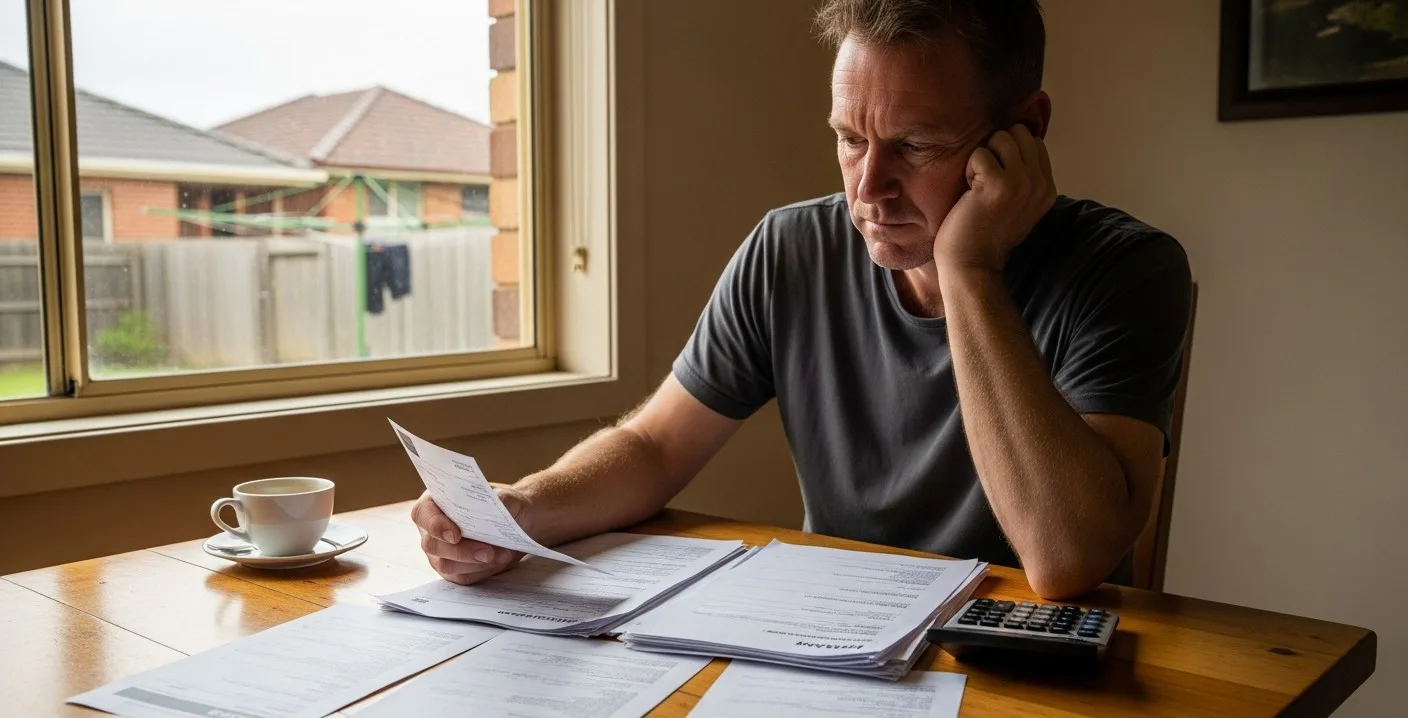
A home battery saves you money in one fundamental way: it lets you use your own solar generation at night instead of buying electricity from the grid. The economic gain per kWh is the spread between what you'd pay for grid electricity (currently 28–38 cents/kWh across most of Australia) versus what you'd receive as a feed-in tariff by exporting it (2–8 cents/kWh in most states).
That spread — roughly 20–35 cents per kWh depending on your state and tariff — is what your battery is "earning" every time it dispatches stored solar instead of pulling from the grid.
For a 10kWh battery that fully cycles every day:
- 10 kWh × $0.25 spread × 365 days = $912/year
In practice, most households see 70–85% utilisation (the battery doesn't perfectly cycle every single day). Real-world annual savings for a 10kWh system with a 6.6kW solar setup typically land between $900 and $1,600/year.
Payback Periods: The Numbers That Actually Matter
Battery prices have come down significantly over the past 18 months, and the CHBP rebate (launched July 2025) has transformed the economics for most households. Here's where the payback maths currently sits:
Without Any Rebates
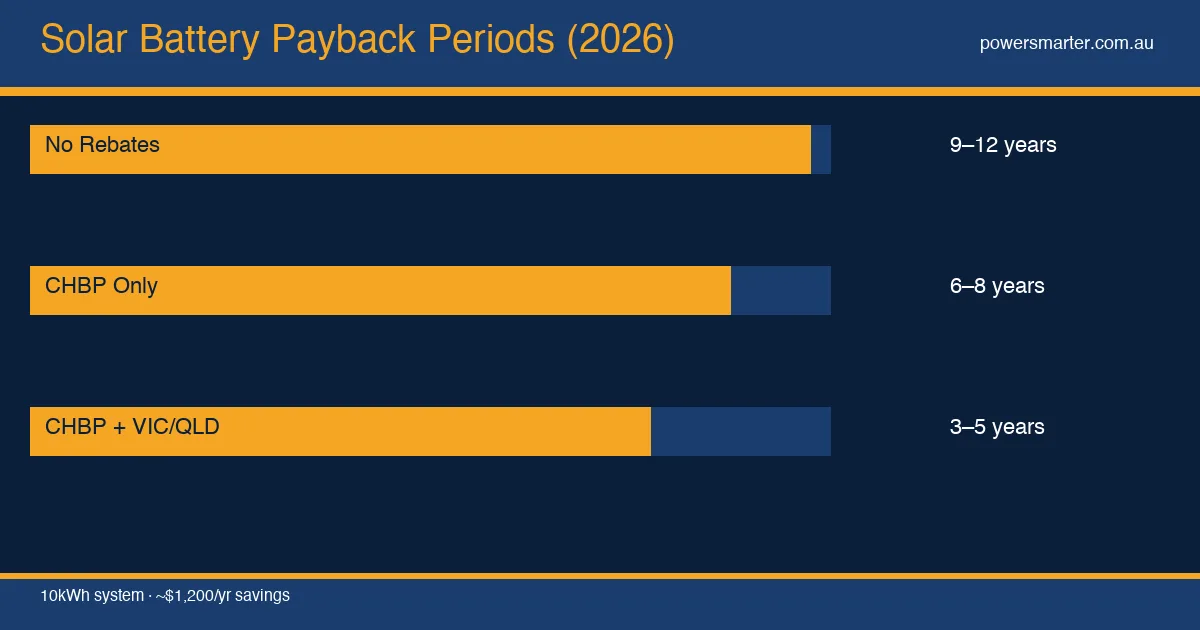
A 10kWh battery installed without any government assistance costs $10,000–$14,000 depending on brand and state. At $1,200/year savings, that's a 9–12 year payback. Most battery warranties are 10 years. This scenario is tight — not impossible, but not compelling either.
With CHBP Only (Federal Rebate)
The Commonwealth Home Battery Program pays $372/kWh for the first 50kWh of usable capacity. On a 10kWh battery, that's up to $3,720 off the installed price — bringing a $12,000 install down to roughly $8,300. Payback: 6–8 years. Now we're inside the warranty period, and the financial case is reasonable.
CHBP + Victorian Solar Homes Battery Rebate
Eligible Victorian households (combined income under $210,000) can stack the state rebate on top. Total rebate value can reach $6,000–$8,500, taking net cost down to $4,000–$6,000 for a quality 10kWh system. Payback: 3–5 years. This is where it becomes a genuinely strong financial decision.
CHBP + QLD Battery Booster
Queensland's Battery Booster program offers up to $3,000 for eligible households. Combined with CHBP, you're looking at $5,000–$7,000 in rebates. Net cost after rebates: $5,500–$8,000. Payback: 4–6 years.
CHBP + NSW PDRS Incentives
NSW's Peak Demand Reduction Scheme creates additional value for battery owners through peak demand credits. This doesn't reduce upfront cost directly, but it increases effective annual savings, nudging the payback period 6–8 months shorter than CHBP alone.
What Makes Your Payback Faster or Slower
These variables have the biggest impact on your individual payback calculation:
Your Electricity Tariff
If you're on a time-of-use plan with evening peak rates of 40–55 cents/kWh, the economics are dramatically better. Every kWh you dispatch from the battery at peak time is saving you at the top rate. Households on flat tariffs at 28–30 cents/kWh see slower payback.
Your Solar System Size
A battery only saves money if it's consistently getting charged. A 6.6kW solar system generates enough surplus to fully charge a 10kWh battery on most days, even accounting for cloudy weather. Smaller systems (3kW or less) may not consistently fill the battery, reducing annual savings.
Your Household Energy Use Pattern
Households that use most of their power in the evenings and mornings get maximum benefit from storage. If you're home during the day using solar directly, the battery is less critical but still adds value through overnight coverage.
Battery Size vs Your Needs
Oversizing a battery doesn't improve payback — a 13.5kWh battery in a household that only needs 8kWh of overnight coverage will spend half its capacity idle. Getting the sizing right matters. (See our battery sizing guide for how to calculate this for your home.)
The Numbers in 2026: Better Than They've Ever Been
Nine months after the CHBP launched, we can now say with confidence: the financial case for home batteries has improved substantially. The combination of:
- CHBP reducing upfront costs by $2,000–$5,000+
- Battery hardware prices continuing to fall
- Electricity prices that have risen steadily since 2025
- Feed-in tariffs that have continued declining, making self-consumption more valuable
...means payback periods for rebate-eligible households are meaningfully shorter than they were 24 months ago.
The households where it's still borderline: those without rebate access, on flat tariffs with decent feed-in rates, or with solar systems too small to consistently charge a battery.
One Honest Caveat
Payback period calculations assume your electricity bill stays roughly the same. In reality, network charges and wholesale costs tend to increase over time — which means the savings from your battery may increase year-on-year, shortening the effective payback. Running a conservative estimate (current prices, no increases) gives you a floor. The likely outcome is somewhat better.
Get a proper quote that includes a savings estimate based on your actual bill data. Any installer worth their accreditation should be able to model your specific situation rather than handing you a generic calculation.
Comments (0)
No comments yet. Be the first to share your thoughts!