
What Is the CHBP? Australia's Home Battery Rebate Explained

The Commonwealth Home Battery Program (CHBP) is the Australian federal government's home battery rebate — the biggest single policy change in Australia's residential storage market. If you're considering a home battery, this is the first thing to understand. Here's exactly what it is, who qualifies, and what it means for your decision.
What Is the CHBP?
The Commonwealth Home Battery Program provides a direct financial rebate to Australian homeowners who install an eligible home battery storage system. It's a federally funded program administered through participating installers.
Key details:
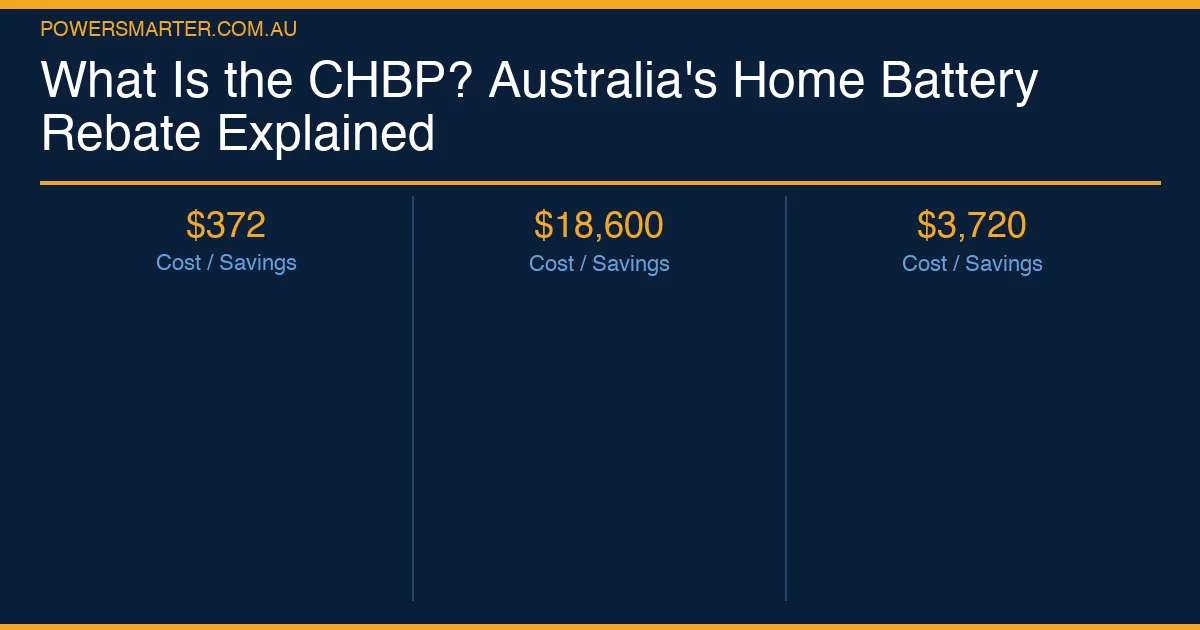
- Rebate amount: $372 per kilowatt-hour (kWh) of usable battery capacity
- Maximum eligible capacity: 50 kWh (so maximum rebate is $18,600 for a very large system)
- For typical households: $3,720 for a 10 kWh battery, $5,022 for a 13.5 kWh battery
- Income test: None — open to all eligible property owners
- Launch date: July 1, 2025
How Is the Rebate Applied?
The CHBP rebate is applied at the point of sale — your installer claims it on your behalf, and it appears as a direct reduction on your installation invoice. You don't need to apply for it separately or wait for a government reimbursement. When you receive an itemised quote from a CHBP-eligible installer, the rebate should appear as a line item deducted from the total cost.
Who Qualifies?
To access the CHBP, you need to meet these criteria:
- Property type: Eligible residential property (owner-occupied)
- Solar panels: Solar panels must be installed on the property (either existing or installed at the same time as the battery)
- Location: Property must be connected to the electricity grid (off-grid installations have different eligibility — confirm with your installer)
- Installer accreditation: The installer must be accredited through Solar Accreditation Australia (SAA)
- Eligible battery: The battery must be on the Clean Energy Council's approved battery storage products list
Why Solar Is Required
The CHBP requires that you have solar panels, because the program is specifically designed to support solar + storage systems — not standalone battery installations. A battery without solar generates power only through grid arbitrage, which is different from the self-consumption + storage model the program is intended to incentivise.
If you don't currently have solar, you can install solar and battery simultaneously and access CHBP for the battery component. The solar system is separately eligible for STC (Small-Scale Technology Certificate) rebates.
What Batteries Are Eligible?
The battery must be on the CEC's approved battery storage products list. This list is updated periodically and includes all major brands sold in Australia — Tesla Powerwall, BYD Battery-Box, Sungrow SBR, Alpha ESS, Enphase IQ Battery, sonnenBatterie, and many others.
Before signing any quote, confirm with your installer that the specific battery model (including model variant) is currently on the CEC approved list. Battery models are added and removed periodically.
What Installers Must Have
For the CHBP to apply, your installer must:
- Hold current SAA accreditation as a battery installer
- Be registered with the CHBP program
- Submit the rebate claim through the program portal on your behalf
You can verify installer SAA accreditation on the Solar Accreditation Australia website. Ask your installer for their accreditation number and check it. Legitimate installers provide this without hesitation.
Is There a Waitlist?
The CHBP has a capped funding pool. Unlike an ongoing entitlement, the program can run out of funding. As demand builds (and it has been building strongly since the July 2025 launch), the funding pool depletes. When it's exhausted, no further rebates are available unless the government allocates additional funding.
As of March 2026 — nine months into the program — the CHBP remains active and accessible. However, acting promptly makes sense given the finite nature of the program and the financial year deadline on June 30.
Does CHBP Stack with State Rebates?
Yes, in most states. Victorian Solar Homes battery rebate, Queensland Battery Booster, Western Australian Household Battery Storage Scheme, and NSW PDRS benefits all stack with CHBP. See our stacking guide for state-specific details.
The Bottom Line
The CHBP is the most significant policy support for residential battery storage Australia has seen. For a typical 10 kWh battery, it reduces your upfront cost by $3,720 — turning what was a borderline financial decision into a clearly positive one for most households. Understanding and claiming it correctly is the first step in any battery installation process.
Comments (0)
No comments yet. Be the first to share your thoughts!