
Solar + Battery for Holiday Homes: Is It Worth It?
The Holiday Home Calculation Is Different
A home battery makes financial sense when you have high electricity consumption, a solar system generating excess power, and time-of-use pricing that rewards self-consumption. The standard residential economics depend on the battery being used regularly — ideally cycled once daily.
A holiday home, by definition, is empty for significant stretches of the year. That changes the calculation. It's not automatically a bad investment, but you need to be honest about the numbers rather than applying suburban logic to a coastal shack.
The Low-Occupancy Problem
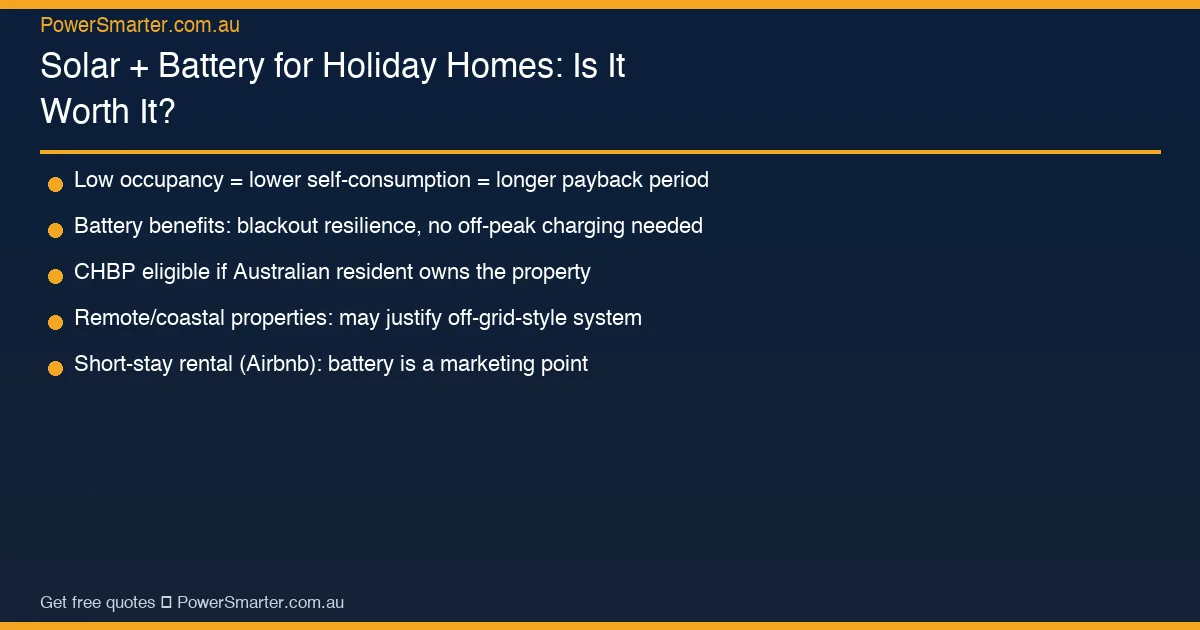
A battery that's only being cycled during holiday periods — say, a property used 6–8 weeks per year — is sitting idle most of the time. Idle batteries don't earn savings. The battery is still ageing (calendar degradation affects batteries regardless of use), still carries the same upfront cost, but is doing a fraction of the work it would in a full-time residence.
A rough example: a 10kWh battery in a full-time suburban home might cycle 300+ times per year, generating meaningful bill savings each cycle. The same battery in a holiday home used 50 nights per year might cycle 50–80 times. That's a fraction of the utilisation, which proportionally extends the payback period.
If you're paying $8,000 net (after CHBP) for a battery system, and it's saving you $400/year in electricity costs at your holiday property rather than the $1,200+ it might save at a full-time residence — your payback extends from 7 years to 20 years. That's not attractive.
When It Does Make Sense
There are scenarios where solar and battery at a holiday property genuinely stacks up.
Short-stay rental income: If you're renting the property on Airbnb, Stayz, or similar platforms for 100+ nights per year, the occupancy profile starts looking more like a full-time property. Importantly, energy efficiency and sustainability features are increasingly valued by short-stay renters — "solar powered" and "off-grid capable" are genuine marketing points in the holiday rental market.
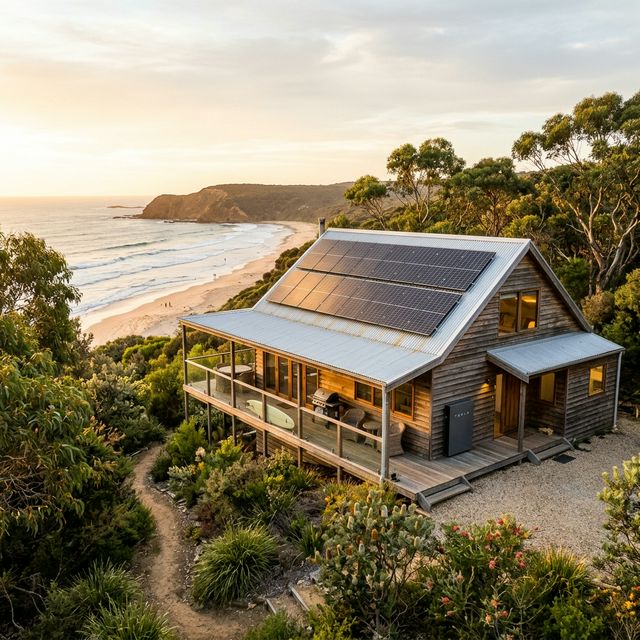
Remote or semi-remote properties: Holiday houses in areas with unreliable grid power (coastal areas prone to storm outages, or properties at the end of long distribution lines) benefit from battery backup in ways that are hard to quantify financially but very real experientially. Being able to maintain power during a storm event while guests are staying is worth something beyond pure financial payback.
High electricity tariffs: Some holiday areas have higher network charges and tariffs than metropolitan areas. If you're paying 35–45 cents/kWh at your holiday property, the per-kWh savings from self-consumption are higher, which improves the economics.
Off-grid properties: If the property genuinely has no grid connection or a very expensive one, solar + battery (potentially with a backup generator for extended overcast periods) is the logical baseline infrastructure, not a discretionary upgrade. The CHBP includes off-grid eligibility for properties more than 1km from the grid or where connection costs exceed $30,000.
The Solar-Only Option
For low-occupancy holiday properties, solar panels without a battery might actually be the smarter first step. Panels generate revenue via feed-in tariff even when you're not there, they require essentially no management, and they meaningfully reduce electricity bills during the periods when you are using the property.
Adding a battery later is possible (with the right inverter setup), so you're not locked out of that option if you start with panels only. And the CHBP may still be available in future years — the program doesn't have a hard closing date announced yet.
CHBP Eligibility for Holiday Homes
You can claim CHBP if you're an Australian resident who owns the property. It doesn't have to be your primary residence. This is worth confirming with your installer, as the program does require specific documentation, but holiday home owners are not excluded on eligibility grounds.
What to Actually Do
If your holiday property is used frequently (particularly if you rent it out), get a proper quote and run the numbers with realistic occupancy assumptions. A good installer will model savings based on actual usage patterns, not a generic residential household.
If it's a rarely-used bolt-hole, be honest with yourself: solar panels might make sense, a battery probably doesn't (yet). The economics will improve over time as electricity prices rise and battery costs potentially fall further.
And if you're buying a holiday property and energy self-sufficiency is important to you for lifestyle reasons — off-grid readiness, blackout resilience, environmental values — that's a legitimate reason to invest beyond what pure financial payback justifies. Just go in with eyes open about the timeline.
Comments (0)
No comments yet. Be the first to share your thoughts!