
Solar and Battery Bundle Pricing: What Australians Actually Pay in 2026
Buying solar and a battery together — as a bundle — has become the most common installation scenario for new buyers in 2026. Bundled installs often (though not always) offer better value than staged installations, the CHBP covers the battery component regardless, and the system can be optimised from day one rather than retrofit later.
Here's what Australian households are actually paying for combined solar + battery systems in 2026, and how to ensure you're comparing quotes on equal terms.
What's Included in a "Complete" Solar + Battery Bundle
Before diving into prices, it's important to understand what a properly scoped bundle includes:
- Solar panels: Quality Tier 1 panels (Jinko, LONGi, REC, Sunpower, Canadian Solar, etc.) with 25-year performance warranty
- Solar inverter or hybrid inverter: Fronius, SolarEdge, Sungrow, GoodWe — quality inverter with 5–10 year warranty
- Battery unit: BYD, Sungrow SBR, Alpha ESS, Tesla Powerwall, or similar
- Racking and mounting: Suitable for your roof type (tile, metal, flat)
- Electrical work: Cabling, switchboard connections, safety switches
- DNSP application: Grid connection notification or approval
- Metering: Smart meter if not already installed
- Commissioning and testing
- Monitoring setup
- Rebates: STCs and CHBP should be listed as discounts in the quote
A quote that doesn't include some of these items isn't necessarily a worse quote — but you need to know what's excluded so you can compare like-for-like.
Price Ranges by System Size (Post All Rebates, 2026)
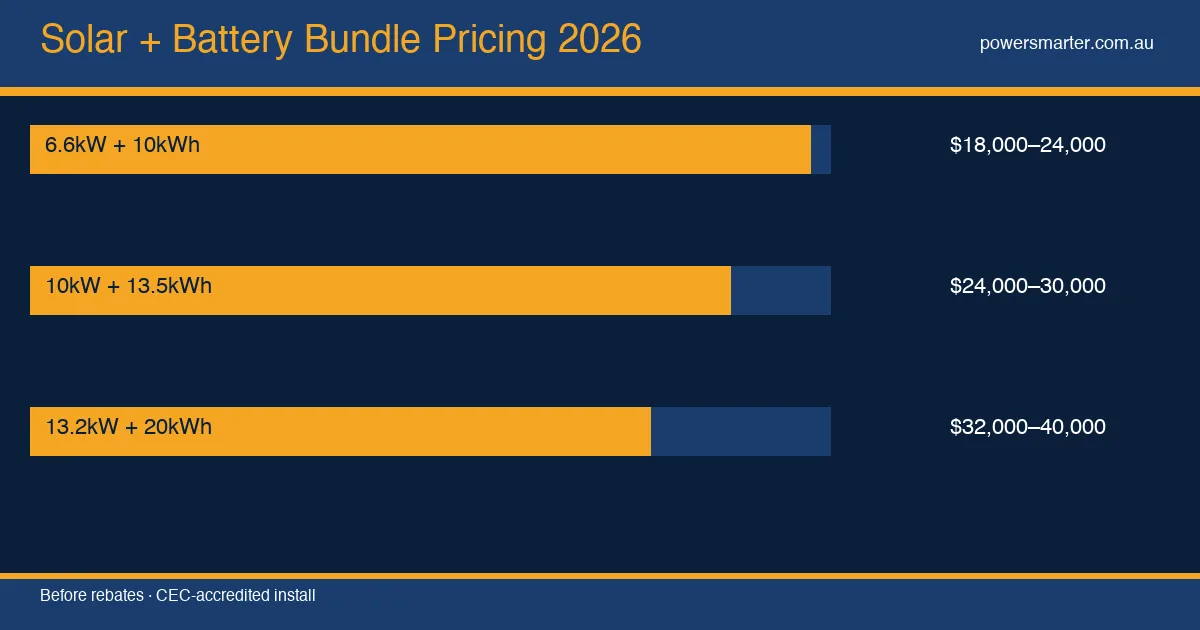
Entry-Level: 6.6kW Solar + 6kWh Battery
This suits a 1–2 person household or a budget-conscious buyer wanting to get started:
- Gross price: $13,000–$18,000
- STCs discount: -$1,500–$2,200
- CHBP rebate (6kWh × $372): -$2,232
- Net price: $8,000–$14,000
Standard Family: 6.6–10kW Solar + 10kWh Battery
The most common configuration for a 3–4 person household:
- Gross price: $17,000–$26,000
- STCs discount: -$1,500–$3,000
- CHBP rebate (10kWh × $372): -$3,720
- Net price: $11,000–$21,000
The wide range reflects brand choice significantly — a Sungrow + Sungrow SBR package at the lower end vs Tesla Powerwall 3 complete system at the upper end.
High Capacity: 13.3kW Solar + 13.5–20kWh Battery
For larger homes, high energy users, or EV owners wanting to run most energy through solar:
- Gross price: $28,000–$45,000
- STCs discount: -$2,500–$4,500
- CHBP rebate (up to 20kWh × $372): -$5,016–$7,440
- Net price: $18,000–$34,000
The Impact of State Rebates on Bundle Pricing
If you're in a state with additional battery rebates, the net cost drops further:
| State | Additional Rebate | Impact on Standard Bundle (10kWh) |
|---|---|---|
| Victoria | Up to $2,950 | Net bundle: $8,000–$18,000 |
| Queensland | Up to $3,000 | Net bundle: $8,000–$18,000 |
| NSW (PDRS) | $300–$600 | Net bundle: $10,400–$20,700 |
| WA (HBSS if available) | $1,000–$2,500 | Net bundle: $9,500–$19,000 |
Understanding STCs in Your Bundle Quote
Small-Scale Technology Certificates (STCs) are a federal rebate for solar panels. They're separate from CHBP (which covers the battery component). Importantly:
- STCs apply to the solar panels only, not the battery
- The STC discount on your quote should be itemised separately from the CHBP battery rebate
- STC values decrease on 1 January each year — they decreased in January 2026 and will decrease again in January 2027. There's a small incentive to install before each new year's reduction.
- The STC Clearing House price is fixed at $40/certificate (ex-GST), though market prices fluctuate slightly around this
Any installer applying STCs correctly will show them as a clear discount in your quote. Be cautious of quotes that bundle STCs and CHBP together as a single "government rebate" line — you can't verify whether both are being properly applied.
How to Compare Bundle Quotes Fairly
When you receive multiple quotes, normalise them across these dimensions:
- Net price after all rebates — what you actually pay out of pocket
- Total kWh of battery capacity — don't compare a 6kWh system to a 10kWh system on price alone
- Solar system size (kW) — more panels = more generation = better battery performance
- Panel brand tier — Tier 1 quality panels matter for 25-year performance
- Battery brand and warranty — compare capacity guarantees, not just years
- Inverter brand and warranty — the inverter is often the first component to need replacement
- Inclusions — is DNSP application, smart meter, and commissioning included?
A spreadsheet with these columns for each quote helps enormously. The cheapest quote is rarely the best value when you compare on all these dimensions.
Common Pricing Red Flags
- "Premium" panels with no brand name: Ask for the specific panel brand and model. Anonymous "premium" panels are usually anything but.
- Rebates presented as cash savings rather than discounts: The STCs and CHBP should reduce your invoice, not be presented as a separate cheque arriving later.
- No itemisation: A quote that shows only a total figure without separating hardware, labour, and rebates is hiding something.
- Unrealistically low prices: If a quote is $5,000 below market for a similar system, check carefully what's been removed from scope — or what-quality hardware has been substituted.
Comments (0)
No comments yet. Be the first to share your thoughts!