
LG RESU Prime Review: Is LG Still Worth Buying in 2026?
A few years ago, LG RESU was one of the most recommended home batteries in Australia. Clean design, reliable performance, LG brand credibility. The market has changed significantly since then — and so has LG Energy Solution's focus on residential storage. This is a review that requires more honesty than most, because the answer isn't as clear-cut as it used to be.
The LG RESU Prime Range
LG Energy Solution's current Australian residential offering is the RESU Prime series:
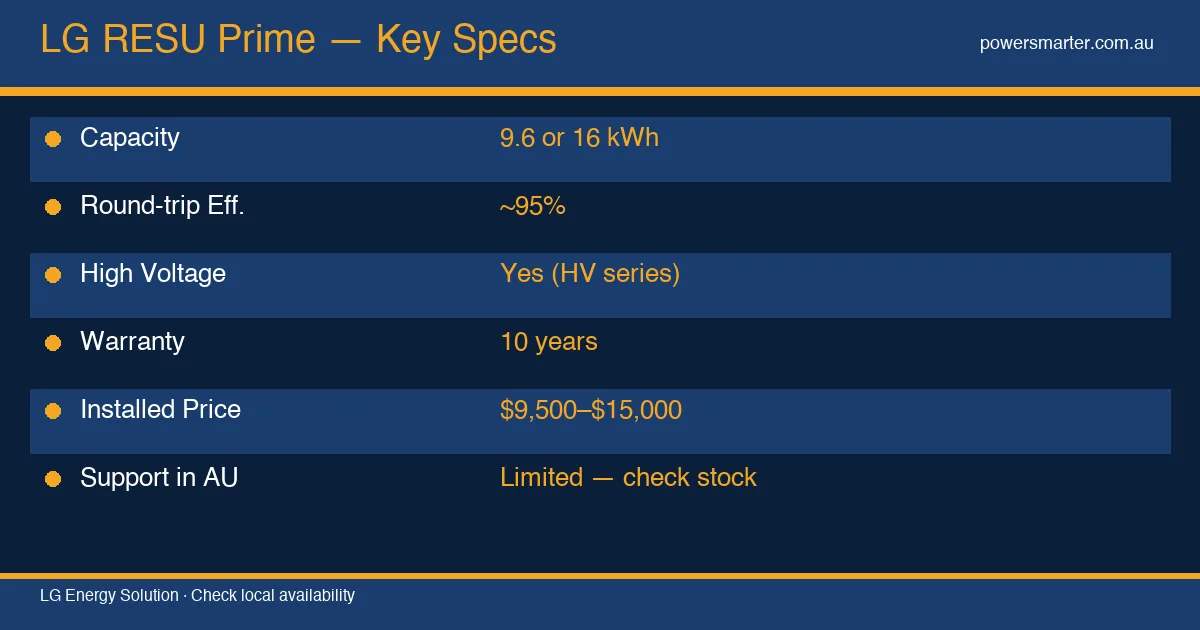
- RESU10H Prime: 9.6kWh usable, LFP chemistry
- RESU16H Prime: 14.4kWh usable, LFP chemistry
- Chemistry: LFP (moved from NMC in the Prime generation — a safety improvement)
- Warranty: 10 years, 70% capacity retention
- Design: Stackable — two RESU10H units can be paired
- Compatibility: Works with SolarEdge, Fronius, SMA, and select other inverters
The Market Reality in 2026
Here's the part that needs to be said plainly: LG Energy Solution has significantly reduced its focus on the Australian residential storage market in the past 18 months. This manifests in several ways:
- Availability: The RESU Prime is available, but installer enthusiasm and stocking levels have declined relative to 2022–2023 peaks. Finding experienced LG RESU installers in some regions has become harder.
- Warranty service timelines: Feedback from installers on warranty response times has been more mixed than in earlier years. LG's warranty is still valid and backed — but the responsiveness of the Australian support operation has varied.
- Product roadmap uncertainty: LG Energy Solution has publicly focused its residential ambitions on new markets. The LG RESU Prime will be supported through its warranty period, but long-term product development commitment is unclear.
None of this means existing LG RESU units are problematic — they're well-designed products. But for a new purchase in 2026, you're buying into a brand with less installer enthusiasm and less clear forward momentum than BYD, Sungrow, or Tesla.
Australian Pricing (Post-CHBP, 2026)
| Model | Gross Installed Cost | CHBP Rebate | Net Cost |
|---|---|---|---|
| RESU10H Prime (9.6kWh) | $9,000–$12,000 | -$3,571 | $5,429–$8,429 |
| RESU16H Prime (14.4kWh) | $13,000–$17,000 | -$5,357 | $7,643–$11,643 |
Pricing sits in a similar range to BYD HVS — neither a premium nor a significant discount. Given the market trajectory concerns, BYD or Sungrow would likely be our first recommendation at these price points.
Technical Performance: Still Solid
To be fair to the product itself: RESU Prime units installed in Australian homes are performing well. The LFP chemistry change from earlier NMC generations addressed the degradation concerns that affected some earlier units. Homeowners with RESU installations report:
- Reliable cycling performance consistent with LFP expectations
- Good inverter compatibility with SolarEdge in particular
- Clean monitoring through compatible inverter apps
- Quiet operation and neat physical installation
The product itself works as advertised. The market support considerations are separate from the product quality question.
SolarEdge Compatibility: The Main Use Case
One scenario where RESU Prime is still compelling: households with existing SolarEdge inverters looking to add battery storage. SolarEdge's DC-coupled battery integration with the RESU works extremely well — the SolarEdge StorEdge system has a long established track record, and the monitoring through the SolarEdge platform is solid.
If you have SolarEdge solar and your installer recommends RESU for compatibility reasons, it's a reasonable choice. For new installs without SolarEdge, we'd lean toward BYD or Sungrow for better forward certainty.
Who Should (and Shouldn't) Buy LG RESU Prime
RESU Prime may make sense if:
- You have existing SolarEdge inverters and want DC-coupled integration
- Your installer has strong LG RESU experience and access
- The specific configuration suits your needs (9.6kWh or 14.4kWh exactly)
- Price is competitive with alternatives in your quote comparison
Choose an alternative if:
- You're starting fresh without an existing SolarEdge system
- Long-term brand support certainty is important to you
- Maximising value for money at equivalent capacity
- Your local installer network doesn't have strong LG RESU expertise
The Honest Verdict
LG RESU Prime is a decent product with a brand that has reduced its residential storage focus. We wouldn't actively recommend avoiding it — but we also wouldn't recommend seeking it out over BYD, Sungrow, or Tesla in 2026. If it comes up in a quote comparison at a competitive price with a strong local installer, it's worth considering. As a first-choice brand for a new installation, there are better options with clearer market commitment.
Comments (0)
No comments yet. Be the first to share your thoughts!