
Home Battery ROI Calculator: Is Your Property a Good Candidate?

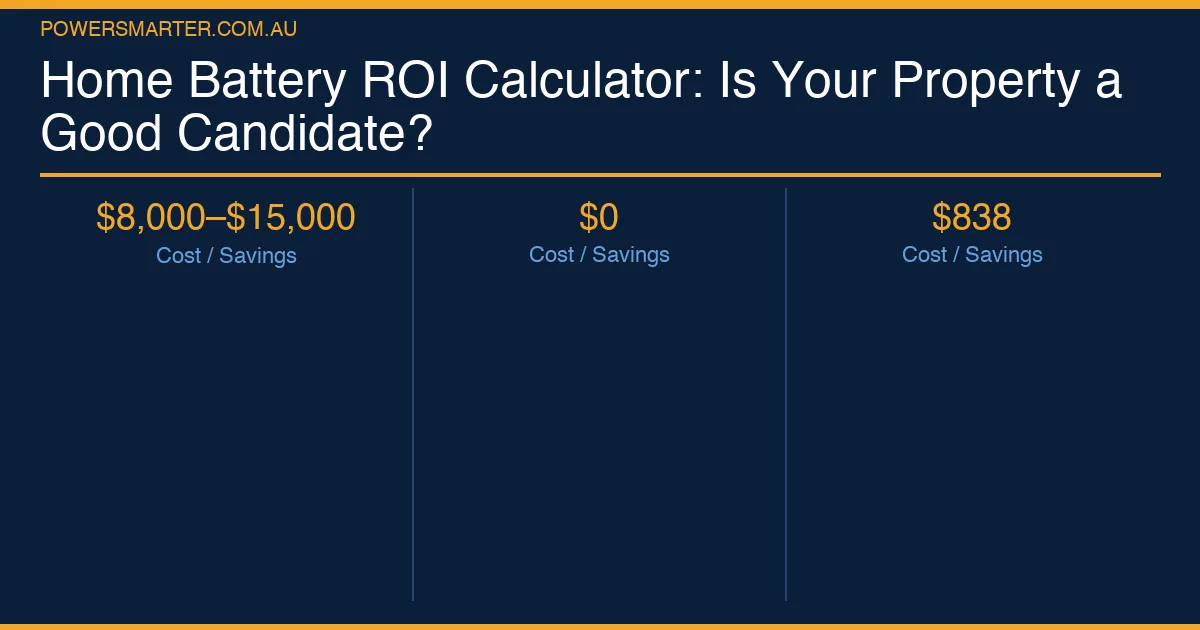
Before you spend $8,000–$15,000 on a home battery, you want to know: will this actually pay off? The answer is almost always "it depends" — but the good news is the key inputs are knowable, and most homeowners can do a rough calculation in 10 minutes.
Here's how to assess whether your property is a strong candidate for battery storage.
The Four Inputs That Drive Your ROI

Battery ROI comes down to four things: what you pay for grid electricity, what you get paid to export solar, how much solar you generate, and how much power you use at night. Everything else is secondary.
1. Your Grid Electricity Rate
The higher your electricity rate, the more valuable every kWh your battery dispatches. In 2026, Australian electricity rates look roughly like this:
- NSW: 28–35 cents/kWh (flat), 40–55 cents/kWh at evening peak (TOU)
- VIC: 26–34 cents/kWh (flat), 38–52 cents/kWh at peak (TOU)
- QLD: 28–32 cents/kWh (flat rates dominant)
- SA: 38–46 cents/kWh — highest in Australia
- WA: 29–33 cents/kWh
South Australian households have the strongest financial case for batteries simply because they're paying the most for grid electricity. SA also tends to have very low feed-in tariffs, which amplifies the benefit of self-consumption.
2. Your Feed-In Tariff (FiT)
The lower your FiT, the more your battery earns by storing solar instead of exporting it. Current rates across Australia range from a derisory 2 cents/kWh (some SA plans) to around 10 cents/kWh (some QLD and VIC plans).
If you're still on a legacy FiT of 20 cents/kWh or higher, a battery may be less financially compelling — you're being well-compensated for export. But those rates are disappearing fast.
3. Your Solar Generation vs Your Daytime Usage
A battery only earns money if there's surplus solar to store. If your household is home all day using solar directly, there may be less surplus available for the battery than you think.
As a rough benchmark: a 6.6 kW solar system on a typical Australian roof generates 25–30 kWh per day in summer, 15–20 kWh in winter. If your household uses 15 kWh/day and half is during daylight hours, your surplus is roughly 8–15 kWh per day — enough to fill most 10 kWh batteries consistently.
4. Your Evening/Overnight Power Consumption
If your household uses 20 kWh overnight, a 10 kWh battery will cover about half of that. If you use 8 kWh overnight, a 10 kWh battery can potentially cover all of it (minus battery efficiency losses). Right-sizing matters here — oversizing means idle capacity; undersizing means you still import a lot.
Doing the Rough Maths
Here's a simple framework:
- Usable battery savings per year = (kWh stored daily × spread) × 365
- Spread = grid electricity rate − feed-in tariff rate
- Net system cost = installed price − CHBP rebate (− any state rebate)
- Payback period = net cost ÷ annual savings
Example:
- 10 kWh battery, fully cycled daily (conservative: 85% utilisation = 8.5 kWh)
- Grid rate: 32 cents, FiT: 5 cents → Spread: 27 cents
- Annual savings: 8.5 × $0.27 × 365 = $838/year
- Installed cost: $12,000. CHBP: −$3,720. Net: $8,280
- Payback: $8,280 ÷ $838 = 9.9 years
Add a state rebate (e.g., VIC's up to $2,250) and payback drops to around 7 years.
Switch to a TOU plan where evening peak is 45 cents: spread jumps to 40 cents, savings hit $1,241/year, payback falls to 5 years.
Properties That Are Strong Battery Candidates
- Solar system of at least 6.6 kW (ideally more)
- Electricity rate above 28 cents/kWh — especially TOU plans with high peak rates
- Feed-in tariff below 10 cents/kWh
- Household evening consumption of 6–15 kWh
- Eligibility for CHBP (and state rebate if available)
- Owner-occupied home (not renting)
Properties Where the Maths Is Tighter
- Small solar system (under 5 kW) — may not generate enough surplus to fill a battery
- Legacy high FiT still active (15–20 cents/kWh)
- Very low overnight consumption (under 5 kWh)
- No eligibility for any government rebate
The Right Way to Get a Precise Estimate
The calculation above is a useful benchmark, but a real quote from an installer will use your actual interval meter data (available from your retailer or via the AGL/Amber/Origin app) to model your specific situation. That's far more accurate than any generic calculator.
When you get quotes through PowerSmarter, our vetted installers review your actual usage data before providing a savings estimate. Generic calculators are starting points; real proposals using your data are what you should base a decision on.
Comments (0)
No comments yet. Be the first to share your thoughts!