
Home Batteries FAQ (Australia)
The Questions Everyone Asks (But Not Always Gets Straight Answers On)
Home battery storage generates a lot of questions. Some are simple, some are surprisingly complicated, and a few involve answers that depend heavily on your specific situation. Here are the most common ones, answered as honestly as possible.
Getting Started
How much does a home battery cost in Australia?
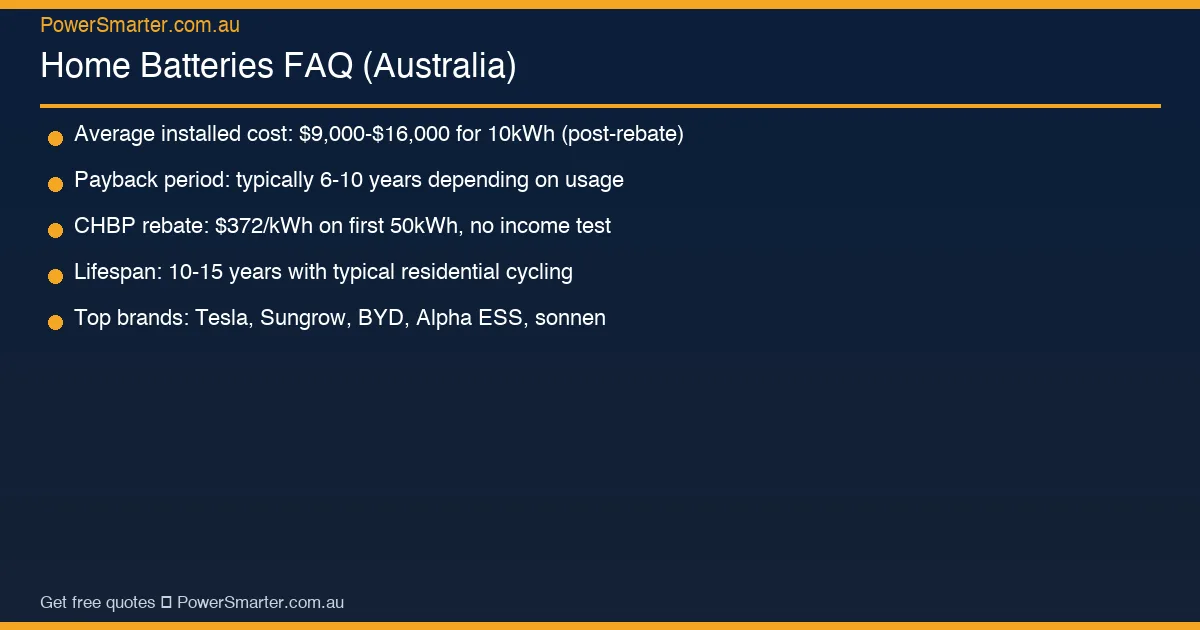
For a quality 10kWh system installed by a reputable installer, expect $11,000–$15,000 before rebates. After the CHBP rebate ($3,720 for a 10kWh system), you're looking at $7,280–$11,280 out of pocket. Prices vary significantly by brand, installer, location, and system complexity.
What is the CHBP and do I qualify?
The Commonwealth Home Battery Program provides $372 per kWh of usable capacity (on the first 50kWh) to eligible Australian households, businesses, and communities. There's no income test — anyone can apply. The rebate is processed through your installer. You don't need existing solar to qualify, though having solar improves the economics.
Do I need solar panels to get a battery?
No. You can install a battery without solar and use it to charge overnight on cheap off-peak electricity, then discharge during expensive peak times. However, the economics are much better with solar — the battery is doing more work and you're self-consuming more of your generated power.
What size battery do I need?
A rough starting point: your daily electricity use in kWh minus what you consume during daylight hours (when solar is generating) equals the storage you need. For a typical Australian household using 20kWh/day with solar covering 8–10kWh during the day, a 10–13.5kWh battery is a reasonable fit. Your installer should model this for your specific situation.
Technology and Performance
How long does a home battery last?
Most quality lithium iron phosphate (LFP) batteries are warranted for 10 years at 80% capacity retention. Real-world lifespan is typically 12–15 years with normal residential cycling. The degradation is gradual — you won't notice day-to-day changes, just a slow reduction in usable capacity over many years.
What's the difference between usable capacity and nameplate capacity?
A 10kWh nameplate battery doesn't give you 10kWh of actual storage. Most batteries operate at 90–100% depth of discharge (DoD), so a 10kWh unit with 90% DoD gives you 9kWh of usable storage. Always compare usable kWh when comparing systems, not just nameplate figures.
Will my battery work during a blackout?
Only if it's specifically configured for backup operation. Most batteries require a switchover device (sometimes called a gateway or backup interface) to operate in island mode when the grid goes down. This may or may not be included in your standard installation — confirm before signing. Partial-home backup (critical circuits only) is cheaper than whole-home backup.
How safe is a home battery?
Modern LFP batteries are considerably safer than older lithium chemistries. They don't thermally runaway in the same way NMC batteries can. Australian installations must comply with AS/NZS 5139, which specifies placement, ventilation, and safety requirements. A compliant installation by an SAA-accredited installer is genuinely safe.
Does temperature affect battery performance?
Yes. Most batteries operate optimally between 10°C and 45°C. Extreme cold (below 0°C) reduces charge acceptance and available capacity. Extreme heat (above 45°C) accelerates degradation. In most Australian climates this isn't a major issue, but installation location matters — avoid direct sun exposure on west-facing walls in hot climates like Darwin or Alice Springs.
What does DoD mean and why does it matter?
Depth of discharge (DoD) is the percentage of a battery's capacity you can actually use. A 10kWh battery with 100% DoD gives you 10kWh of usable storage; at 80% DoD, only 8kWh. Higher DoD means more usable storage from the same nameplate capacity. Most modern home batteries are rated at 90–100% DoD.
Rebates and Money
Can I stack CHBP with state rebates?
Yes, in most cases. VIC, NSW, SA, and WA all have state-level incentives that can be combined with CHBP. The stacking rules vary by program — your installer should be across the current combination options for your state.
How long until a battery pays for itself?
With CHBP and state rebates, typical payback periods are 6–10 years. The key variables are your electricity tariff (higher is better for battery economics), your solar system size, your self-consumption behaviour, and whether you're on a time-of-use plan. A proper savings estimate requires modelling your specific situation.
Does a battery add to my property value?
Evidence on this is mixed. Some valuation studies suggest solar panels add to property values; battery data is thinner. Practically speaking, a battery is more likely to be perceived as a positive feature by prospective buyers than a neutral one — but don't buy a battery as a property investment. The economics should stand on energy savings alone.
What about the STC rebate?
Small-scale technology certificates (STCs) apply to solar panels, not batteries on their own. If you're buying solar + battery together, the solar portion will generate STCs that reduce the upfront cost. The dollar value per STC is currently $40 (fixed Clearing House price), and the number of STCs depends on your system size and location.
Installation and Practical Questions
How long does installation take?
A single battery installation with a compatible existing solar system typically takes 4–8 hours for the installation crew. From quote acceptance to switch-on, allow 4–12 weeks for equipment lead times, grid approvals, and scheduling.
Where can a battery be installed?
Garages, external walls (with weather protection), and internal utility rooms are the most common locations. AS/NZS 5139 specifies clearances and ventilation requirements. Batteries cannot be installed in living areas, above certain habitable floor areas, or in enclosed spaces without adequate ventilation.
Do I need a smart meter?
Many modern battery systems require a smart meter for optimal function and for CHBP compliance. Your installer should check and include a meter upgrade in the quote if needed. In most states, smart meters are now standard — but check if yours was installed before 2017.
What accreditation should my installer have?
For CHBP eligibility, your installer must be accredited by Solar Accreditation Australia (SAA) — the organisation that took over installer accreditation from CEC in May 2024. Check accreditation at saaustralia.com.au before accepting a quote.
Can I do it myself (DIY)?
No. Battery storage installations must be done by a licensed and SAA-accredited installer under Australian law. Attempting DIY installation is illegal, voids warranties, invalidates insurance, and poses genuine safety risks. The one thing you can DIY is monitoring your system's performance through the manufacturer app.
Living with a Battery
What monitoring app will I get?
Depends on the brand. Tesla has the Powerwall app; Sungrow uses iSolarCloud; BYD has their platform; Alpha ESS has AlphaCloud. Most provide real-time generation, consumption, battery state of charge, and export data. Some include scheduling features for time-of-use optimisation.
Should I join a VPP?
Virtual Power Plants can provide additional income ($1–$5/day on high-demand days) by allowing your battery to be dispatched by the VPP operator. Trade-off: some VPP programs reduce your battery's availability for household backup. Research the specific program and exit clauses before committing.
What maintenance does a battery need?
Very little. Check the manufacturer app monthly, ensure firmware updates are applied (usually automatic), and make sure the area around the battery is clear and ventilated. Annual inspection by your installer is good practice but not mandatory. The battery doesn't require servicing in the way a car does.
What happens at end of life?
Most manufacturers have take-back programs for end-of-life batteries. Australia's B-cycle scheme also handles lithium battery recycling. Ask your installer about end-of-life arrangements when you're purchasing — reputable brands will have a clear answer.
Comments (0)
No comments yet. Be the first to share your thoughts!