
Feed-In Tariff vs Battery Storage: Which Earns You More in 2026?
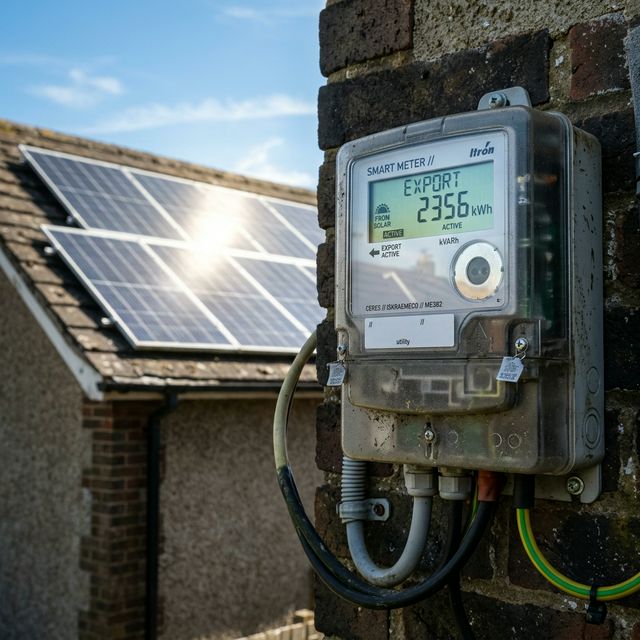
When solar panels generate more electricity than your home uses, you have a choice: export the surplus to the grid and receive a feed-in tariff (FiT), or store it in a battery and use it later. In 2019, this was a genuine debate. In 2026, the maths has shifted decisively.
The Feed-In Tariff Collapse
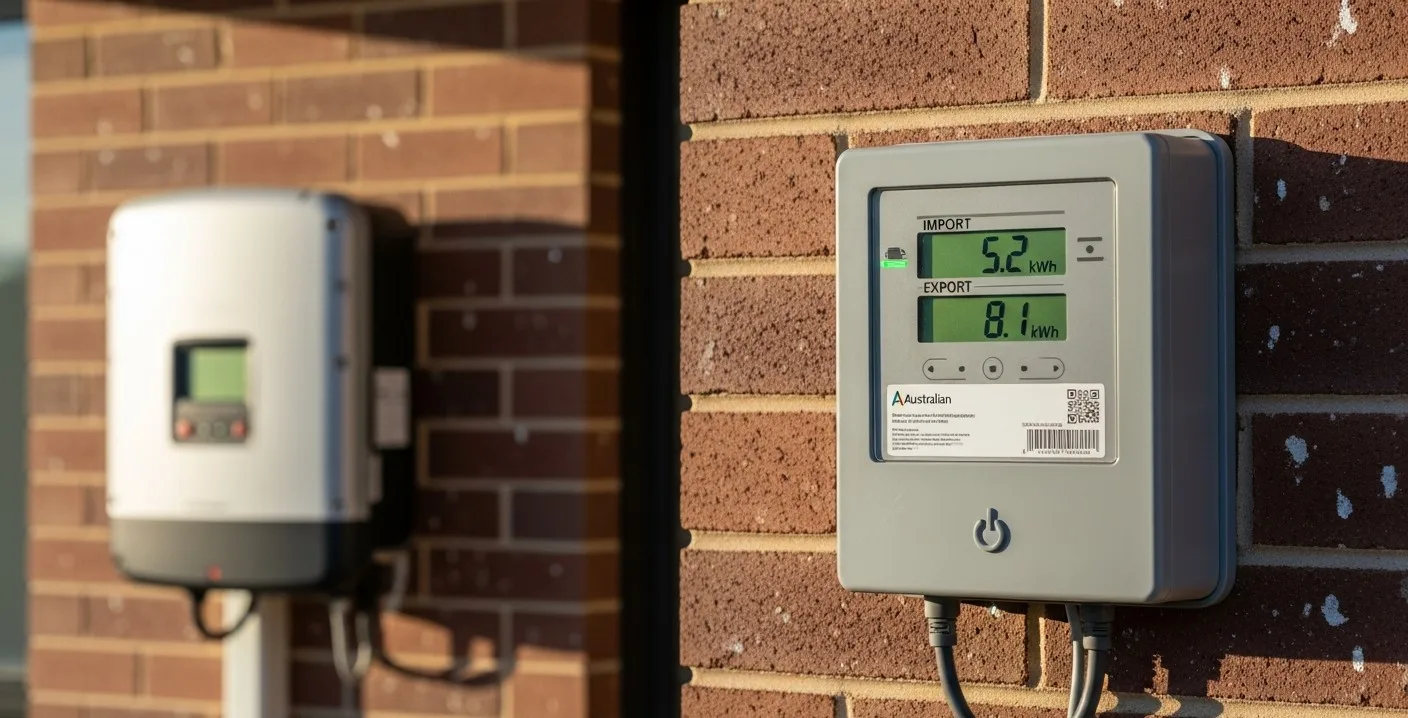
Feed-in tariffs have dropped dramatically over the past six years. Here's where FiT rates sit across major states in early 2026:
| State | Minimum Guaranteed FiT | Best Available FiT (retailer) |
|---|---|---|
| NSW | No minimum | 5–12c/kWh |
| VIC | ~4.9c/kWh (distributor minimum) | 7–12c/kWh |
| QLD | No minimum (Energex) | 5–10c/kWh |
| SA | No minimum | 3–8c/kWh |
| WA (Synergy) | 7.1–10c/kWh (REBS) | 7.1–10c/kWh |
For most households, the effective FiT for exported solar sits between 3 and 12 cents per kWh. In some cases, the "best" retail plan offers a bit more for specific periods, but the general trend is downward.
The Import Rate Reality
Meanwhile, what you pay to import electricity from the grid:
| State | Typical Flat Rate | TOU Peak Rate |
|---|---|---|
| NSW | 30–37c/kWh | 40–55c/kWh |
| VIC | 29–36c/kWh | 35–50c/kWh |
| QLD | 28–34c/kWh | 35–48c/kWh |
| SA | 32–42c/kWh | 40–55c/kWh |
| WA (Synergy) | 30–33c/kWh | Flat rate |
The Core Calculation
The financial case for a battery rests on this simple comparison: every kWh you store in a battery and use at night is worth the grid import rate you avoid. Every kWh you export earns you the FiT rate.
Current spreads:
- NSW flat tariff: avoid 33c/kWh by storing vs earn 8c/kWh by exporting = 25c/kWh advantage for storage
- NSW TOU peak: avoid 50c/kWh by storing vs earn 8c/kWh = 42c/kWh advantage for storage
- SA flat tariff: avoid 37c/kWh vs earn 5c/kWh = 32c/kWh advantage for storage
- WA (Synergy): avoid 31c/kWh vs earn 8c/kWh = 23c/kWh advantage for storage
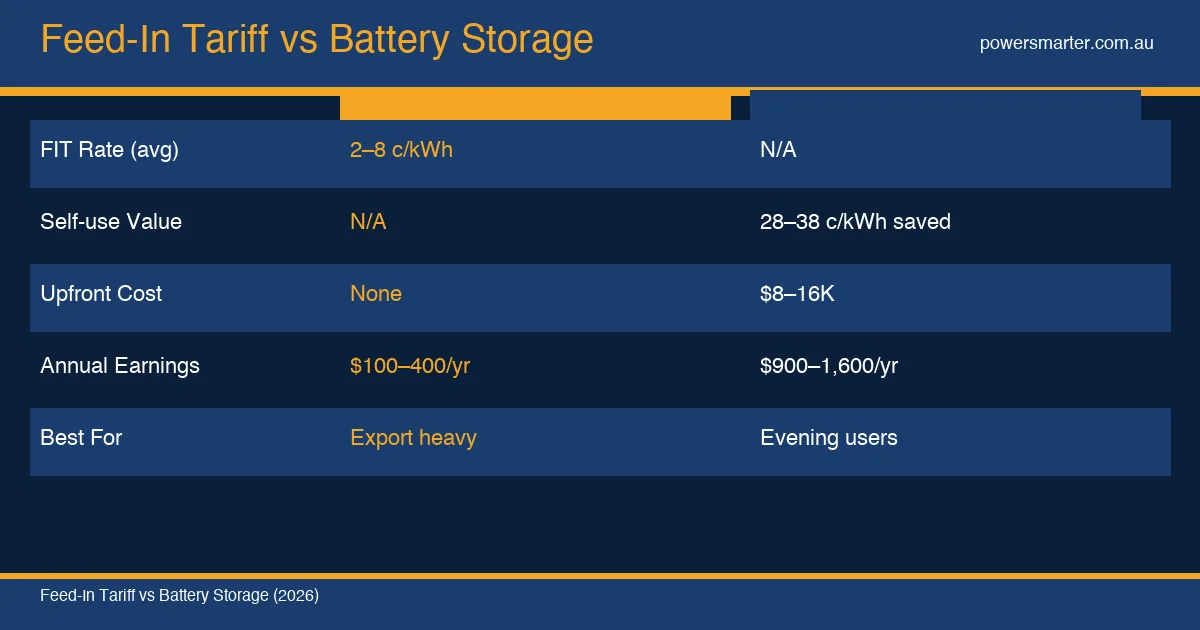
In every major Australian state, storing solar and self-consuming it is worth significantly more than exporting it, per kWh. The FiT vs storage debate was closer when FiTs were 15–20c/kWh in 2018–2019. At current rates, there's no comparison.
But Wait: The Battery Costs Money
This is where the analysis requires nuance. Yes, every kWh of self-consumed storage is worth more than every kWh exported. But a battery costs $6,000–$12,000 after CHBP rebate. You need to generate enough stored kWh to recover that cost.
Let's model a specific scenario:
Household profile: 6.6kW solar, 22 kWh/day usage, currently exporting 10 kWh/day on average, NSW flat tariff at 33c, FiT at 8c.
Current export value: 10 kWh × 8c × 365 days = $292/year
Battery scenario (10kWh): Battery captures 8 kWh of that export daily.
- Value of captured solar (avoided grid import at 33c): 8 × $0.33 × 365 = $965/year
- Remaining export (2 kWh at 8c): 2 × $0.08 × 365 = $58/year
- Total annual value from battery-captured solar: $965 + $58 = $1,023 vs $292 with no battery
- Net annual benefit of adding battery: $1,023 − $292 = $731/year from the export-to-storage shift
- Plus savings on evening grid imports the battery handles: typically another $400–$700/year
Total annual battery benefit: approximately $1,100–$1,400/year in this scenario. Against a $8,000 net battery cost (CHBP applied): payback of 6–7 years.
When the Case Is Strongest
The FiT vs battery trade-off is most favourable for battery storage when:
- You're exporting a lot: Households exporting 60%+ of solar generation have maximum opportunity to capture value
- Your FiT is very low: 3–5c/kWh in SA or QLD makes the comparison stark
- You're on TOU pricing: Evening peak avoidance dramatically increases battery value
- You have CHBP (and state rebate): Lower net cost = faster payback
The case is weaker when:
- You already have a very high FiT from an older grandfathered plan (some NSW/QLD customers locked in 20c+ FiTs years ago — don't give these up for a battery)
- You export very little (battery has nothing meaningful to capture)
- Your electricity usage is primarily during solar hours (daytime workers at home)
The Grandfathered FiT Exception
If you're still receiving a premium feed-in tariff from an older plan — some QLD customers locked in 44c/kWh, some NSW customers 20c+ — the calculation changes entirely. Don't add a battery if it affects your ability to export under a premium grandfathered tariff. Preserving that rate is worth far more than storing the energy instead.
Check your electricity bill to see your exact FiT rate before assuming storage beats export.
The Bottom Line
For the vast majority of Australian solar households without premium grandfathered FiT rates: storing surplus solar in a battery is worth 3–6 times more per kWh than exporting it. The debate effectively ended as FiTs fell below 10c/kWh while retail rates climbed above 30c. In 2026, the question isn't whether to store — it's which battery at what cost delivers the fastest payback for your specific situation.
Comments (0)
No comments yet. Be the first to share your thoughts!