
AC-Coupled vs DC-Coupled Batteries: What's the Difference?
If you're adding a battery to existing solar, you'll quickly run into the terms AC-coupled and DC-coupled. Most homeowners' eyes glaze over at this point — but understanding the difference actually matters for your decision. It affects compatibility, efficiency, and cost.
The Basics: Where Does the Battery Connect?

Solar panels generate DC (direct current) electricity. Your home uses AC (alternating current). An inverter converts DC to AC.
The difference between AC and DC coupling is where in this chain the battery connects:
DC-Coupled Battery
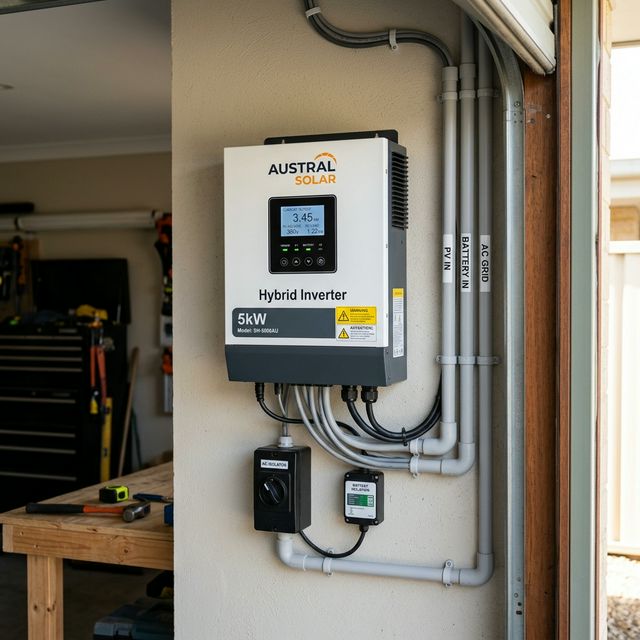
The battery connects between the solar panels and the inverter — on the DC side. Solar energy flows directly into the battery without being converted first. A hybrid inverter then manages both the solar and the battery, converting DC to AC for your home when needed.
Efficiency advantage: DC coupling only converts DC to AC once (when the battery discharges). AC coupling converts twice — DC to AC, then back to DC for storage, then to AC again for use. Each conversion loses a few percent to heat. DC coupling is typically 3–5% more efficient overall.
AC-Coupled Battery
The battery connects on the AC side — after your existing inverter. The battery has its own built-in inverter that handles charging and discharging. This means your existing solar inverter keeps doing its job, and the battery operates alongside it independently.
Retrofit advantage: AC coupling works with almost any existing solar inverter. You don't need to replace your inverter to add a battery. This is why AC coupling is often the only practical option for retrofitting storage to an older solar system.
Which Is Better for New Installs?
For a new solar + battery installation from scratch: DC-coupled is generally preferred. You install one hybrid inverter that handles both solar and battery, and you get higher efficiency. Brands like Sungrow, Fronius, SolarEdge, and Huawei all offer hybrid inverters designed for this setup.
Which Is Better for Retrofits?
If you already have solar with a standard string inverter (the common scenario for Australian homeowners who installed solar in the last 10 years): AC coupling is often the most practical path. You add an AC-coupled battery alongside your existing inverter without replacing it.
Common AC-coupled batteries in Australia include:
- Tesla Powerwall 3 (has integrated inverter — works as AC-coupled retrofit)
- Enphase IQ Battery (AC-coupled, works particularly well with Enphase microinverters)
- sonnenBatterie (AC-coupled)
When DC Coupling Makes Sense for a Retrofit
If your existing solar inverter is approaching end-of-life (10+ years old, or showing faults), it can make sense to replace it with a hybrid inverter as part of a DC-coupled battery installation. You're paying for an inverter you'd need to replace soon anyway, and you get better efficiency. Your installer should assess this during the quoting process.
The 5kW Solar Limit Issue
Older solar systems are often capped at 5kW inverter output due to legacy network connection agreements. DC-coupled systems may require renegotiating this with your DNSP (distributor) if the hybrid inverter has a higher rating. AC-coupled systems typically avoid this issue because the battery has its own separate inverter and doesn't change the solar inverter's connection.
Backup Power: Does Coupling Type Matter?
Both AC and DC-coupled systems can provide backup power during blackouts. However, DC-coupled systems with a hybrid inverter are often better at continuing to use solar during a grid outage, because the inverter manages both sources directly. Some AC-coupled configurations need specific setup to use solar during an outage. Confirm this with your installer if backup power is a priority.
Summary: How to Decide
| Scenario | Best Choice |
|---|---|
| New solar + battery install | DC-coupled (hybrid inverter) |
| Existing solar, relatively new inverter | AC-coupled battery retrofit |
| Existing solar, old/failing inverter | DC-coupled (replace with hybrid inverter) |
| Enphase microinverter system | AC-coupled (Enphase IQ Battery preferred) |
| Priority on backup solar during outages | DC-coupled preferred |
The right call depends heavily on your specific system, inverter age, and budget. Your installer should walk through this analysis with you as part of the quoting process — it's not a detail to gloss over.
Comments (0)
No comments yet. Be the first to share your thoughts!