
VPP Comparison for Homeowners: Earnings, Rules, Exit Clauses

Virtual Power Plants (VPPs) are one of the most interesting financial opportunities for home battery owners — but also one of the most confusing. Different programs have different payment structures, different obligations, and importantly, different exit conditions. Here's a practical comparison of the major programs available in Australia in 2026.
How VPPs Work (Quick Recap)

A VPP aggregates many home batteries and dispatches them as a collective during periods of high grid demand or price spikes. The network operator or VPP aggregator draws down small amounts from each battery — typically 0.5–2 kWh per event — and pays participants for making their capacity available.
From your perspective: your battery does something that would have happened anyway (discharging), but at a scheduled time chosen by the VPP operator, and you receive payment for it.
Major VPP Programs in Australia (2026)
Tesla Energy Plan (Tesla VPP)
Who's eligible: Powerwall owners in SA (most established), with some coverage in NSW and VIC
Structure: You sign up to the Tesla Energy Plan retail electricity plan. Tesla manages VPP dispatch within that plan.
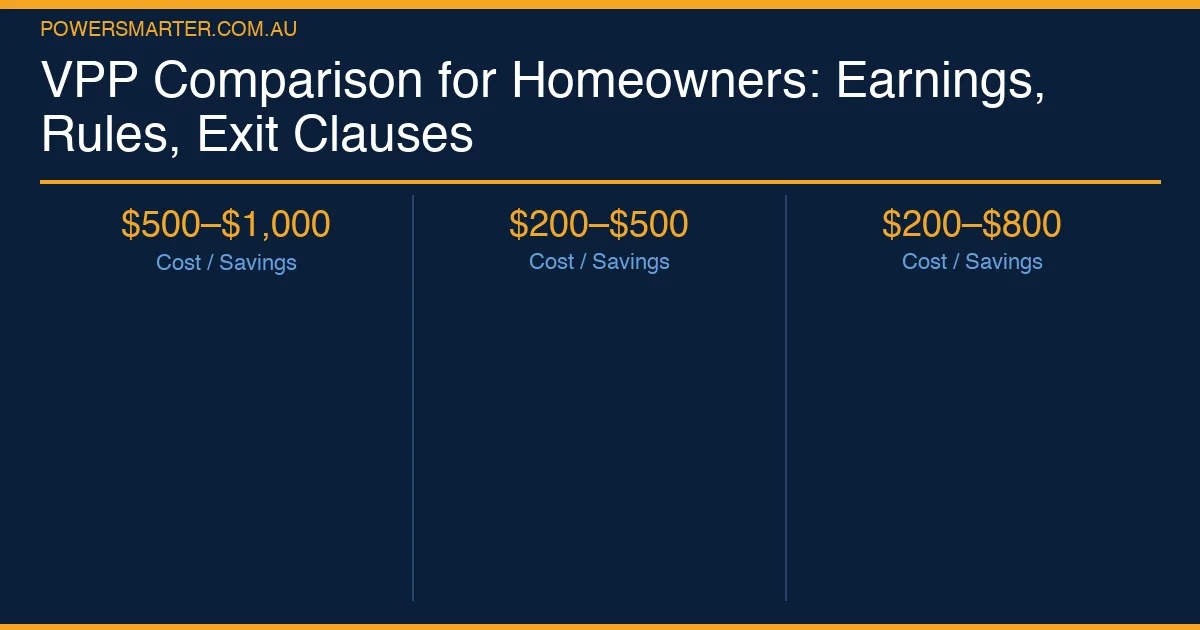
Payments: Typically through credits on your electricity bill, structured as competitive retail rate + VPP credits. Tesla reports average savings of $500–$1,000/year for active SA participants, but this includes both the competitive electricity rate and VPP components.
Obligations: Tesla may dispatch your battery for grid support events. You maintain a minimum reserve for backup use.
Exit: You can exit the Tesla Energy Plan with standard retailer notice period (typically 10 days). Doesn't affect your battery.
AGL VPP (AGL Virtual Power Plant)
Who's eligible: Customers with compatible batteries across multiple states. Batteries including Powerwall, sonnen, Redback.
Structure: You join AGL as your electricity retailer and enrol in the VPP program.
Payments: AGL offers a bill credit per kWh dispatched in VPP events, plus competitive retail rates. Reported earnings: $200–$500/year for typical participants.
Obligations: Battery available for dispatch events during peak demand periods. Minimum charge reserve maintained.
Exit: Standard retailer switching process.
Origin VPP / Origin Loop
Who's eligible: Origin energy retail customers with compatible batteries in eligible areas
Structure: Loop platform manages energy dispatch and optimisation
Payments: Credits for VPP participation events, combined with optimised tariff plan
Note: Since Origin's acquisition of SolarQuotes (October 2024), Origin has expanded its home energy product suite. Evaluate the full plan offer carefully, including standard electricity rates, not just VPP payments.
Amber Electric + VPP
Who's eligible: Amber customers with compatible batteries (mostly Powerwall)
Structure: Amber passes through wholesale electricity prices in real time. Battery owners can program their battery to respond to wholesale price signals automatically.
Payments: Not a traditional VPP payment — instead, Amber lets your battery charge at very low wholesale prices and discharge when wholesale prices are high. Battery owners can earn significant value through price arbitrage rather than explicit VPP event payments.
Best for: Tech-savvy battery owners who want maximum control and are comfortable with price volatility
Exit: Monthly subscription, easy exit
sonnen community (sonnenFlat-adjacent)
Who's eligible: sonnenBatterie owners in eligible areas
Structure: Community-based energy sharing model
Payments: Often structured as flat-rate monthly energy access rather than per-event payments
Note: sonnen's community models are the most innovative but also most limited in geographic coverage in Australia currently
Key Things to Evaluate in Any VPP
1. What Are Actual Net Earnings?
VPP programs often bundle the VPP payment with a competitive electricity plan. What matters is your total net bill: standard electricity import rate + export rate + VPP credits. Compare this to your current plan + no VPP. The VPP might look attractive, but if the underlying electricity rate is higher than competitors, the net benefit is smaller than advertised.
2. How Many Events Per Year?
VPP dispatch events vary widely: from a handful annually to dozens. More events = potentially more income, but also more battery cycling and slightly more wear on the hardware. This is generally acceptable but worth understanding.
3. Backup Reserve Rules
Most programs respect a minimum backup reserve you set — they won't dispatch your battery below that level. But confirm the mechanics: if a VPP event occurs when you'd normally want maximum backup (storm approaching), how does the system prioritise?
4. Exit Clauses
Standard electricity retailer switching applies for most programs — you can leave with the standard notice period (10 business days in most states). Watch for any extended commitment terms or exit fees beyond standard retail switching.
The Bottom Line
VPP income is real but typically secondary to self-consumption savings. Think of it as a $200–$800/year bonus on top of your main battery savings, not a primary investment thesis. The programs with the strongest overall value are those that combine a genuinely competitive electricity plan with VPP income — evaluate the whole package, not just the VPP payment headline.
Comments (0)
No comments yet. Be the first to share your thoughts!