
STC Rebate and Home Batteries: How Small-Scale Technology Certificates Work

Every solar quote in Australia includes an STC discount. Most buyers accept it without understanding what it is. That's fine — but understanding it helps you verify you're getting the right amount and avoid a few common scenarios where the discount is applied incorrectly.
What Are STCs?
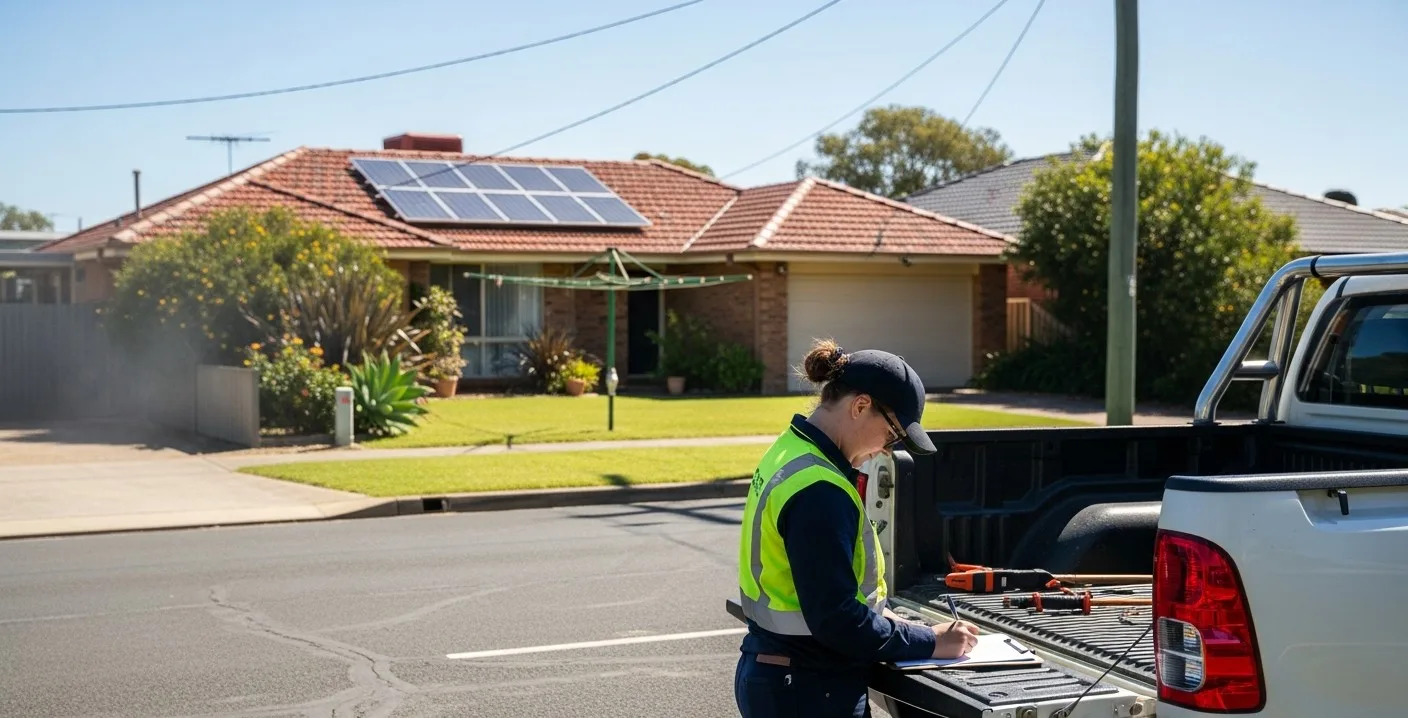
Small-Scale Technology Certificates (STCs) are the federal government's main incentive mechanism for residential and small commercial solar and eligible storage installations. They're generated when an eligible solar or hot water system is installed, and they represent the system's projected renewable energy generation over its remaining deeming period.
STCs are part of the Small-scale Renewable Energy Scheme (SRES), managed by the Clean Energy Regulator (CER). The scheme is legislated to run until 31 December 2030, after which it ends.
How STCs Are Valued
The value of STCs fluctuates in a market — they can be traded through brokers or the STC Clearing House. The STC Clearing House sets a fixed price of $40 per certificate (excluding GST). In practice, the market price tends to sit slightly below this due to transaction costs and timing, but $38–$40/certificate is the effective value you should be receiving.
The Annual Step-Down: Why Acting Sooner Matters
Here's the critical mechanism that reduces STC value over time: the number of STCs generated by a solar system decreases by one zone-year for each calendar year from 2017 onwards. This is called the "deeming period" reduction.
In practical terms:
- In 2023, a 6.6kW solar system in Zone 3 (most of Australia's populated areas) generated approximately 106 STCs
- In 2026, the same system generates approximately 72–82 STCs (fewer years remaining to 2030)
- In 2029, only 1 year's worth of STCs remain
STCs decrease on 1 January each year. There's a small incentive to install before 1 January to capture the higher STC count — though the saving (typically $300–$600 for a residential system) is not usually large enough to drive major timing decisions on its own.
What Solar STCs Are Worth in 2026
As a rough guide for 2026 installations:
- 6.6kW solar system: Approximately $1,500–$2,200 in STC value depending on location and precise zone
- 10kW solar system: Approximately $2,300–$3,400
- 13.3kW solar system: Approximately $3,000–$4,500
Your installer should show the STC credit as a line item in your quote — it should be applied as a discount, not a separate payment.
Do STCs Apply to Batteries?
This is where clarity matters: STCs apply to solar panels, not directly to battery storage systems.
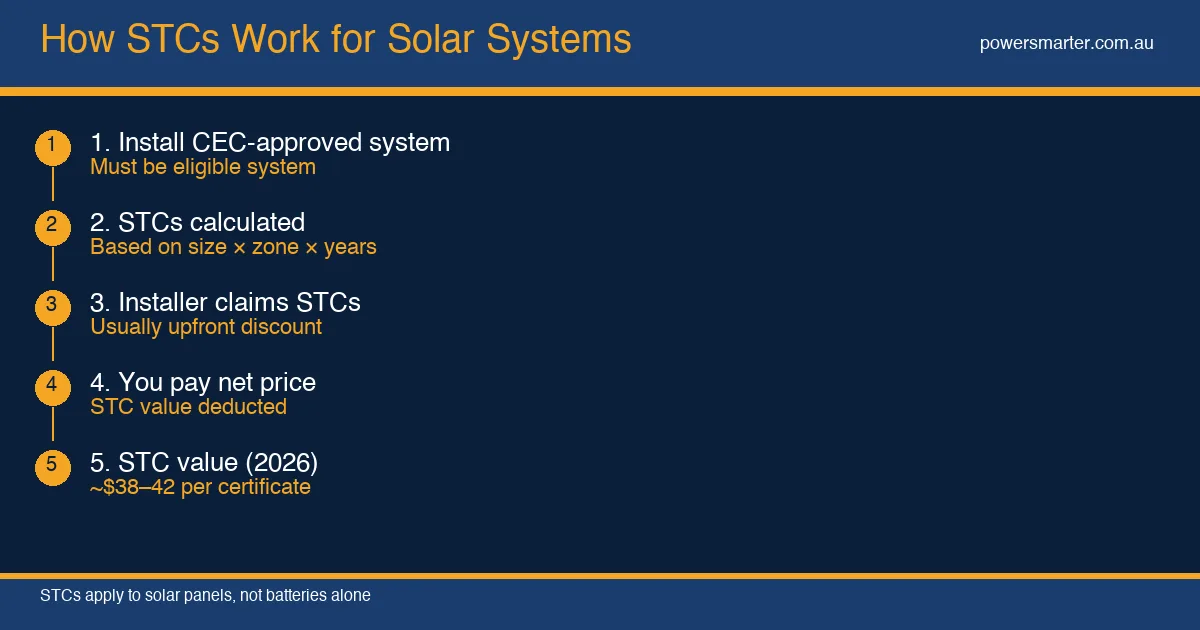
Battery storage systems are covered by a separate mechanism — the CHBP (Commonwealth Home Battery Program), which pays $372/kWh of usable capacity. STCs and CHBP are distinct programs and can both be claimed on a single solar + battery installation:
- STCs: Apply to the solar panel component
- CHBP: Applies to the battery storage component
A combined solar + battery quote should clearly show both discounts separately. If they're bundled together as "government rebates," ask for them to be itemised.
The Exception: Heat Pump Hot Water STCs
While batteries don't directly generate STCs, heat pump hot water systems do qualify for a related incentive. They generate STCs under the hot water component of the SRES. A residential heat pump hot water system may generate 15–30 STCs depending on size and location — worth $600–$1,200 in installer discounts.
How STCs Are Claimed
In almost all residential installations, the process is transparent:
- Your installer assigns the STCs to a STC agent (typically a broker or the installer themselves)
- The STC agent pays the installer the STC value upfront
- The installer passes this as a discount on your quoted price
- After installation, the STC agent registers the certificates with the CER
You don't need to do anything — but you should ensure the STC discount appears in your quote as a clear line item.
Red Flags: Not Receiving Full STC Value
Installers are legally required to apply the STC value you're entitled to. In practice, most do. But watch for these situations:
- Quote doesn't itemise STCs: Ask for it to be broken out. You can verify the approximate STC count using the CER's STC calculator on cer.gov.au.
- "We don't deal with STCs" claims: Legitimate for a handful of small installation companies, but rare and suspicious. Most quality installers are STC-registered agents.
- STC value seems very low: Compare the quoted STC value against the CER calculator for your system size and postcode.
The SRES Is Ending in 2030
The STC scheme — and the SRES that underpins it — is legislated to end on 31 December 2030. This means:
- STC generation rates will decline each year until they reach zero
- Installations after 31 December 2030 will not receive any STC discount
- The CHBP (battery rebate) is a separate program and not subject to the 2030 SRES sunset
For buyers planning solar in the 2026–2030 window: getting in earlier captures more STC value. For buyers planning after 2030: the STC discount won't be available, but the CHBP battery rebate should remain (subject to government review).
Comments (0)
No comments yet. Be the first to share your thoughts!