
NT Home Battery Options 2025–26
Battery Storage in the Territory: A Different Calculation
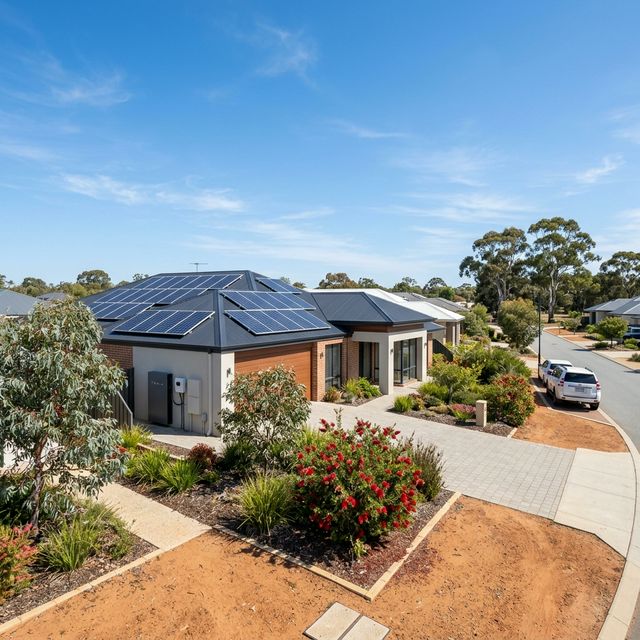
Home battery storage in the Northern Territory is a genuinely different proposition to anywhere else in Australia. The climate, the geography, the grid infrastructure, and the installer landscape all present challenges that don't really exist in Sydney or Melbourne. But the potential benefits are also real — and in some cases, more compelling than they are down south.
Let's work through the specifics, because a lot of the generic battery information you'll find online doesn't apply in Darwin, Katherine, or Alice Springs.
The Climate Problem (and How to Manage It)
Most home batteries are designed with a temperate operating range in mind. Lithium iron phosphate (LFP) batteries — which cover the majority of CHBP-eligible products — perform optimally between about 10°C and 45°C. Darwin's ambient temperatures regularly push 35°C+ for months at a time, and a battery in direct sun on a west-facing wall can see case temperatures well above 45°C.
This matters because heat accelerates battery degradation. A system that might last 15 years in Melbourne could see significantly reduced lifespan in Darwin if poorly placed.
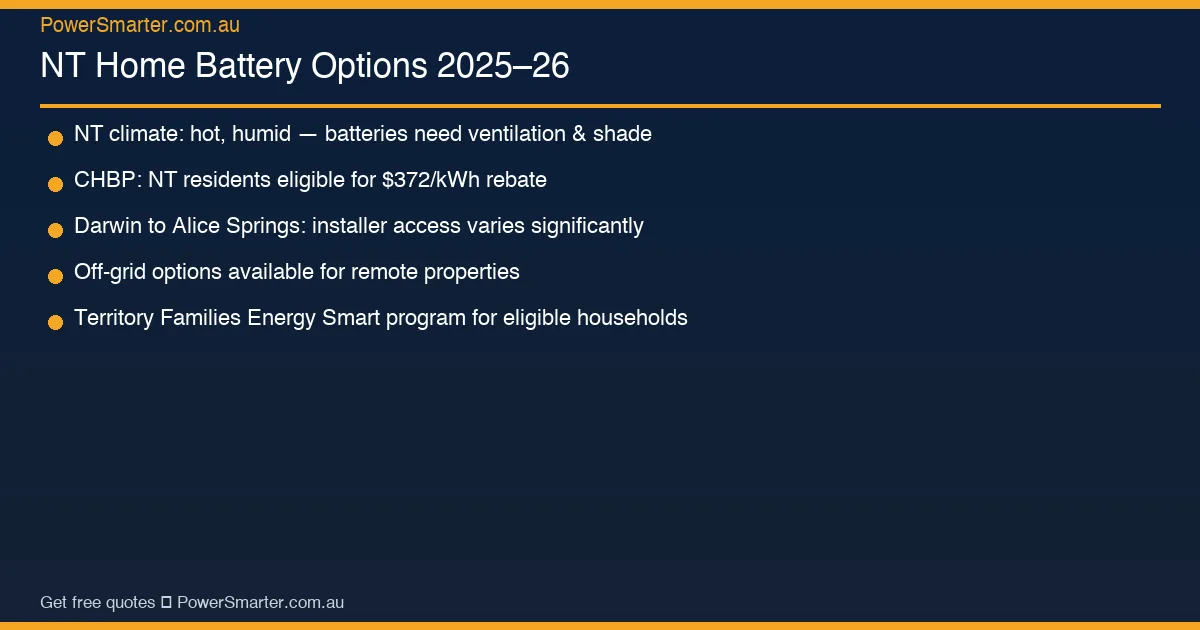
The solution isn't to avoid batteries — it's installation location. Batteries installed in a well-ventilated indoor location (garage, laundry, internal wall) or in a shaded external spot will manage temperatures far better than sun-exposed outdoor installations. Any reputable NT installer should understand this and design accordingly. If your quote doesn't specify installation location and ventilation, ask.
What Rebates Are Available?
NT residents can access the Commonwealth Home Battery Program (CHBP) on the same terms as any other Australian. That's $372/kWh on the first 50kWh of usable capacity — so a 10kWh battery nets you $3,720 back, a 13.5kWh Powerwall 3 gives $5,022 back.
There's no NT-specific battery rebate equivalent to what Victoria and NSW offer, which is a gap that affects NT residents' purchasing economics. This is something that advocacy groups have raised with the Territory government, but as of early 2026 no additional NT program exists.
The Territory Families Energy Smart program provides assistance to eligible low-income households, but this is energy efficiency support rather than battery storage specifically. It's worth checking eligibility if cost is a significant barrier — contact Territory Families or call the Energy Consumer Australia hotline.
The Installer Access Issue
This is the honest difficulty. Darwin has a reasonable number of SAA-accredited solar and battery installers, and competition means pricing is more reasonable than it used to be. Katherine, Tennant Creek, and Alice Springs are different stories.
In regional NT, installer availability is limited. The installers who do operate in these areas often carry higher travel costs into their quotes, and system support after installation can be more complicated if something goes wrong. This is a real consideration that needs to be factored into the economics.
If you're in a regional centre, ask specifically about post-installation support arrangements. What happens if the system develops a fault 18 months in? Who comes to look at it, and what's the expected response time? A quote from a Darwin-based installer who travels to your town might seem good value, but factor in what support looks like over the system's 10-15 year life.
Off-Grid in the NT: A Different Conversation
For properties more than 1km from the grid, or where grid connection costs exceed $30,000, the CHBP includes off-grid system eligibility. This is significant for NT, where remote property owners who've been running generators for years can access meaningful rebates to shift to solar + battery.
Off-grid system design in the NT requires specific expertise. The combination of high solar irradiance (Darwin gets around 5.5 peak sun hours daily), high air conditioning loads, and the need for extended battery capacity (for overcast periods) creates system sizing requirements that differ from mainland urban installations.
If you're researching an off-grid system in remote NT, look for installers with specific remote area experience rather than suburban retrofit specialists. The design considerations are meaningfully different.
The Economics in the NT Context
Power prices in the NT are generally higher than east coast states. Darwin residential customers typically pay around 30–35 cents/kWh (varying by retailer and plan). This actually improves battery payback times compared to states with lower electricity prices.
High air conditioning loads in tropical climates also mean higher self-consumption potential — your battery storage is being drawn down and recharged more frequently throughout the year. That's positive for utilisation rates, though it also puts more cycle demands on the battery.
Do the numbers carefully for your specific household. The combination of higher electricity prices and strong solar irradiance can make battery storage economically attractive in Darwin, even accounting for higher installation costs. The math is less favourable in Alice Springs, where solar irradiance is excellent but installer access and logistics costs can push system prices higher.
What to Do Next
Get at least two quotes from different installers. Ask each one specifically about installation location for heat management, post-installation support arrangements, and their experience with NT-specific conditions. The cheapest quote is not always the best value over a 10-year ownership period.
Check CHBP eligibility — the program is available to NT residents with no income limit and no requirement for existing solar (though having solar improves the economics). If you're in a remote area, ask about the off-grid pathway specifically.
Comments (0)
No comments yet. Be the first to share your thoughts!