
Home Battery Grants and Rebates in Australia: The Complete 2026 List

If you're buying a home battery in Australia in 2026, you should know every rebate and incentive available before signing a quote — because the gap between claiming everything you're entitled to and claiming nothing can be $6,000–$8,000 on a single installation.
Here's the complete list, by level of government.
Federal Programs (Available to All Australians)

Commonwealth Home Battery Program (CHBP)
The CHBP is the most significant battery incentive currently available. Launched 1 July 2025:
- Rebate amount: $372 per kWh of usable battery capacity
- Maximum coverage: First 50kWh of usable capacity (max rebate $18,600)
- Income test: None — open to all Australian households, renters (via landlord), landlords, and small businesses
- Program budget: No announced budget cap
- How to claim: Your SAA-accredited installer applies the rebate at point of sale; you pay the reduced price
- Battery requirement: Must be on the CEC Approved Battery List
- Installer requirement: Must be accredited by Solar Accreditation Australia (SAA) — saaustralia.com.au
- Off-grid eligibility: Properties more than 1km from the grid or facing connection costs over $30,000 are eligible
- Managed by: Clean Energy Regulator (CER)
Typical rebate amounts:
- 6kWh battery: $2,232
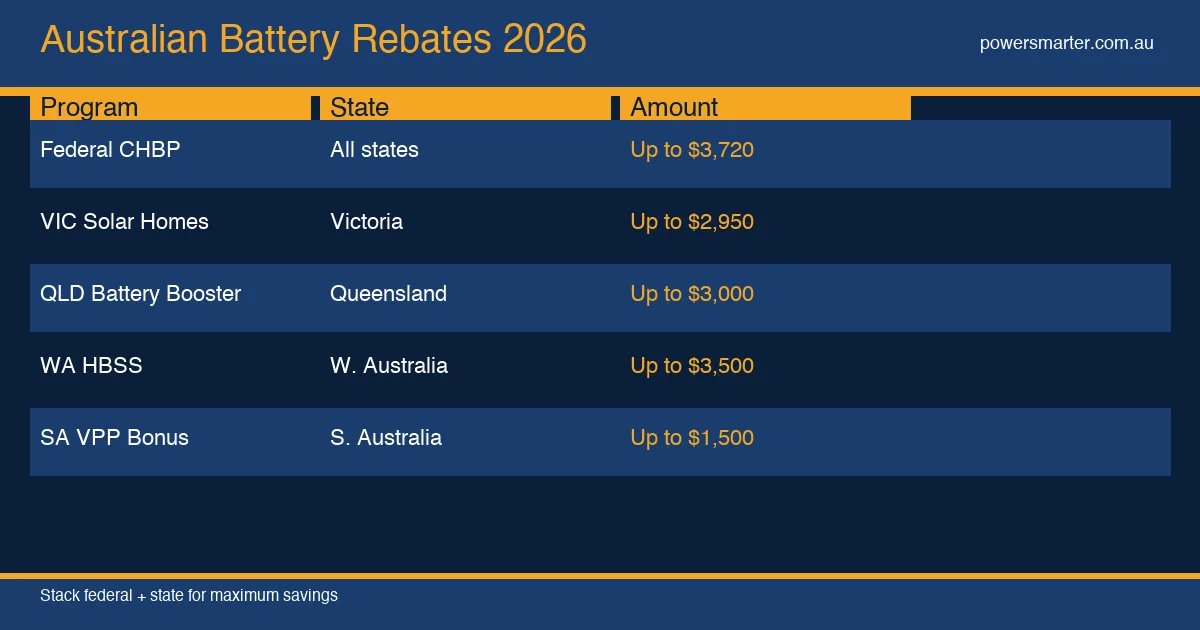
- 10kWh battery: $3,720
- 13.5kWh battery: $5,022
- 20kWh battery: $7,440
Small-Scale Technology Certificates (STCs) — Solar Component
STCs apply to solar panels (not directly to batteries), but they're relevant as part of a combined solar + battery install:
- Value: Approximately $1,500–$4,500 for a residential solar system in 2026 (decreasing annually until 2030)
- Income test: None
- How to claim: Installer applies as a discount in your quote
- Managed by: Clean Energy Regulator (CER)
State and Territory Programs
Victoria — Solar Homes Battery Rebate
- Rebate amount: Up to approximately $2,950 (confirm current rate at solar.vic.gov.au)
- Income eligibility: Combined household income under $210,000
- Property type: Owner-occupiers and landlords (with tenant consent)
- Requires existing solar: No — can apply with new combined install
- Can stack with CHBP: Yes
- How to access: Solar Victoria portal; installer typically assists
- Additional VIC incentive: Victorian Energy Efficiency Certificates (VEECs) for heat pump hot water — $500–$2,000 off
Queensland — Battery Booster Program
- Rebate amount: Up to $3,000
- Income eligibility: Check current threshold at Queensland Government energy website
- Requires existing solar: Generally yes
- Can stack with CHBP: Yes
- Note: Program has experienced waitlist periods — check current availability before planning around it
- How to access: energysaverplus.daf.qld.gov.au
New South Wales — PDRS (Peak Demand Reduction Scheme)
- Type: Market-based incentive (not a direct grant)
- Value: $300–$600 as installer discount depending on PRC market value
- Income test: None
- How to access: Ask your installer if they're an accredited PDRS provider; value passed through as discount
- Can stack with CHBP: Yes
- Note: NSW does not have a direct cash state battery rebate as of early 2026
Western Australia — Household Battery Storage Scheme (HBSS)
- Rebate amount: Up to $1,000–$2,500 (varies by program round)
- Property type: Owner-occupied residential in SWIS area
- Can stack with CHBP: Yes (confirm current WA CHBP availability at cer.gov.au)
- Status: Has been offered in rounds; check current status at wa.gov.au energy programs
- Note: WA's separate electricity market means some federal programs have applied differently
South Australia — Current State Programs
- Status: SA's Home Battery Scheme (HBS) closed in 2021 after exhausting budget
- Current SA programs: No direct state cash rebate equivalent as of early 2026
- Federal CHBP available: Yes — all SA residents
- VPP programs: SA has the most active VPP market in Australia (Tesla, AGL, SA Power Networks) — adds $200–$600/year
- Check: sa.gov.au energy for any new announced programs
ACT — Sustainable Household Scheme
- Program: Zero-interest loans for sustainable home upgrades (not direct grants)
- Battery loans: ACT residents can access zero-interest loans for battery storage as part of eligible packages
- Loan amounts: Up to $15,000 for eligible upgrades
- Can stack with CHBP: Yes
- How to access: actenvironmentgrants.com.au — Sustainable Household Scheme portal
- Note: This is a loan, not a grant — no upfront cash subsidy, but zero interest significantly improves the finance economics
Tasmania
- Status: No dedicated state battery rebate program as of early 2026
- Federal CHBP available: Yes
- Check: Tasmanian Government energy website for current programs
- Note: Tasmania's majority hydro generation means grid dynamics are different; battery economics are still solid for self-consumption but VPP opportunities are more limited
Northern Territory
- Remote-area programs: Various NT Government programs exist for remote/off-grid communities, but standard residential rebate programs are limited
- Federal CHBP: Available where CHBP applies to NT conditions — confirm eligibility
- Check: NT Government energy website for current residential programs
How to Maximise Your Total Rebate
The most important action: don't assume any rebate is available or unavailable without checking current status directly with the program. Rebates are subject to budget constraints, waitlists, and program reviews. What was available six months ago may be oversubscribed; what wasn't available may have been announced.
The reliable constants:
- CHBP is available to all Australians — no income test, no budget cap
- STCs apply to all solar installations until 2030
Before signing any quote, confirm:
- Your installer is SAA-accredited (for CHBP)
- The battery is on the CEC Approved Battery List (for CHBP)
- All applicable rebates are itemised in your quote
- Any state rebates you're expecting are confirmed open and you're eligible
Acting Before 30 June 2026
The CHBP rate of $372/kWh was set at launch and is subject to review. Acting before the end of the current financial year (30 June 2026) ensures you lock in the current rate. June is historically the busiest period for solar and battery installations — installer calendars fill up in May. If you're planning for a June install, get quotes and book in April.
Comments (0)
No comments yet. Be the first to share your thoughts!