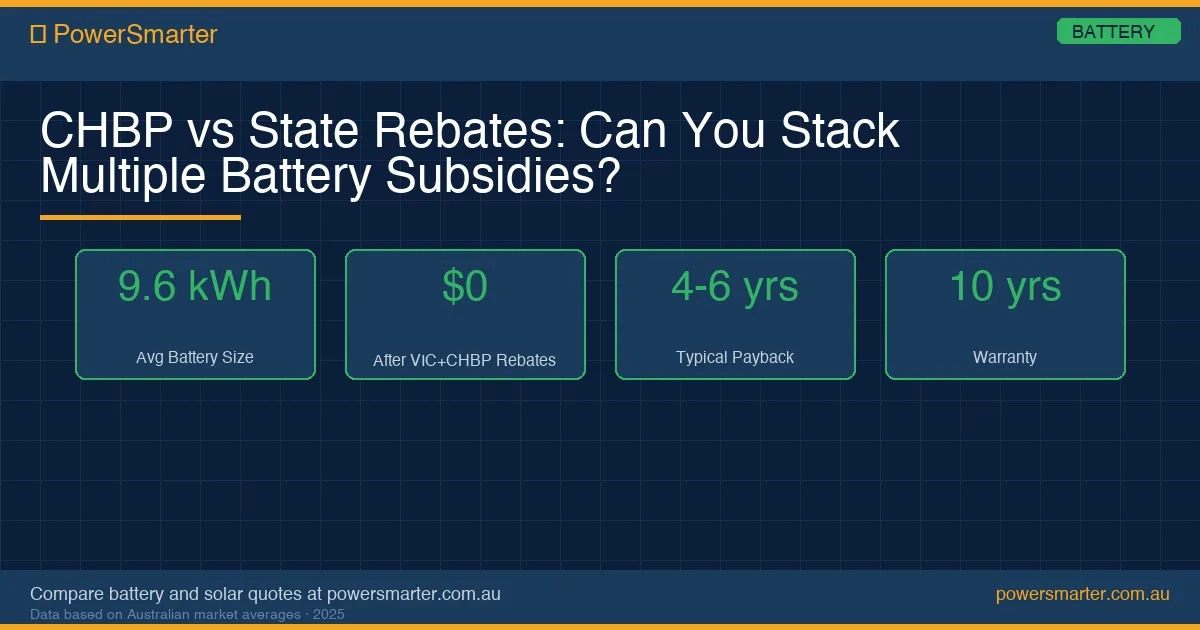
CHBP vs State Rebates: Can You Stack Multiple Battery Subsidies?
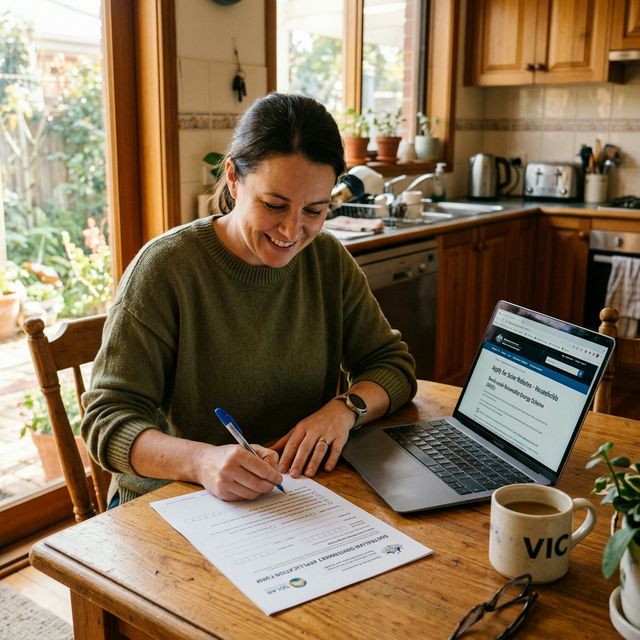
The Commonwealth Home Battery Program (CHBP) is the most significant battery rebate Australia has seen. But it's not the only one. Several states run their own battery incentive programs — and many homeowners don't realise they can potentially combine both.
Here's the practical stacking guide.
The CHBP: What It Gives You
The federal CHBP pays $372 per kWh of eligible battery capacity, capped at the first 50 kWh. There's no income test — any Australian homeowner with an eligible property can access it.
For a Tesla Powerwall 3 (13.5 kWh): CHBP pays $5,022
For a 10 kWh system: CHBP pays $3,720
The rebate is applied at the point of installation — your installer claims it directly, and it reduces your upfront invoice. You don't wait for a government cheque.
State Programs That Can Stack
Victoria: Solar Homes Program Battery Rebate
Victoria offers a battery rebate through its Solar Homes Program. In 2026, eligible Victorian households (owner-occupied, combined household income under $210,000) can receive up to $2,250 toward a battery installation.
Can you stack CHBP + VIC Solar Homes? Yes. Victoria's program explicitly allows stacking with the federal CHBP. Combined rebate value: up to $7,272 on a 13.5 kWh system.
Queensland: Battery Booster Program
Queensland's Battery Booster offered rebates of up to $3,000 for eligible households. Check the current status of this program — as of March 2026, access has been variable depending on available funding rounds.
Can you stack CHBP + QLD Battery Booster? Yes, in most cases. QLD's program has allowed stacking, though terms have evolved. Confirm current rules with a QLD-based installer or the Queensland government website.
NSW: No Direct Battery Rebate, But PDRS Benefits
NSW doesn't offer a direct upfront battery rebate, but the Peak Demand Reduction Scheme (PDRS) creates tradeable certificates (PRC certificates) for battery installations that reduce peak demand. These are typically realised through your installer as a discount equivalent to several hundred to a few thousand dollars, depending on the system size and time of installation.
The PDRS benefit stacks with CHBP with no conflict.
Western Australia: Household Battery Storage Scheme (HBSS)
WA's HBSS program has historically offered up to $7,500 in rebates for eligible households. Check current availability as funding tranches open and close periodically.
CHBP + HBSS stacking: Possible in most cases, but total rebate may be capped. Confirm with a WA-based accredited installer and check the Synergy/Horizon Power program terms.
South Australia: Focus on VPP Integration
SA no longer runs a direct battery rebate program (the Home Battery Scheme wound down). However, SA households can combine CHBP with Virtual Power Plant (VPP) programs that pay ongoing income for network participation. This isn't a rebate stack, but it's additional income that improves total ROI.
What About STC Rebates?
Small-Scale Technology Certificates (STCs) apply to solar panels, not batteries directly. However, if you're installing solar and a battery together, the STCs apply to the solar component of the system and stack with CHBP on the battery side — there's no conflict.
Stacking Rules: What to Watch For
Income Tests
The CHBP has no income test — it's available to all homeowners. But some state programs (e.g., VIC Solar Homes) have income thresholds. If you're above the threshold for a state program, you can still get CHBP alone.
Installer Accreditation
Both CHBP and most state programs require your installer to be accredited through Solar Accreditation Australia (SAA). This is typically the same accreditation, so using one SAA-accredited installer generally ticks the box for both programs.
Program Caps and Waitlists
State programs often have limited annual funding. VIC's Solar Homes Program has had waitlist periods. If you're counting on a state rebate, start the process early — being CHBP eligible doesn't guarantee a state rebate spot.
Maximising Your Total Rebate
Here's the hierarchy of who can get the most:
- Victorian households under income threshold: CHBP + Solar Homes = up to $7,272
- QLD households in an active Battery Booster round: CHBP + Battery Booster = up to $8,022
- WA households in an active HBSS round: CHBP + HBSS = potentially up to $12,000+
- NSW households: CHBP + PDRS value = $3,720+ depending on PDRS certificate value
- SA households: CHBP + VPP income over time
- All other states/territories: CHBP alone ($3,720+ depending on battery size)
The most important first step: confirm your CHBP eligibility, then ask your installer about any state program you might also qualify for. A good installer will know exactly how to maximise your rebates in your specific situation.
Comments (0)
No comments yet. Be the first to share your thoughts!