
Australia's Battery Rebate Is About to Change — What Homeowners Need to Know Before May 1

If you've been sitting on the fence about installing a home battery, here's a date worth putting in your calendar: 1 May 2026.
That's when the federal government's Cheaper Home Batteries Program (CHBP) shifts from a flat per-kilowatt-hour rebate to a tiered system — and for most households looking at a medium to large battery, the change means a noticeably smaller discount at the point of sale.
It's not the end of the program. But it is a meaningful reduction, and the industry has been unusually direct about the urgency. The Clean Energy Regulator and the Smart Energy Council both put out alerts in March urging installers to flag the deadline to their customers.
What Is the CHBP and How Does It Work?
The Cheaper Home Batteries Program — administered by the Clean Energy Regulator under DCCEEW — is an expansion of the existing Small-scale Renewable Energy Scheme (SRES). Rather than a cash payment you apply for separately, the rebate flows through your installer. They create Small-scale Technology Certificates (STCs) based on your battery's capacity, trade those certificates, and pass the value to you as an upfront discount off the quoted price.
You don't apply for anything. You just see a lower invoice total.
The program is uncapped and not means-tested — any Australian household, small business, or community facility installing an eligible battery (5 kWh to 100 kWh) can access it. The battery must be connected to a solar system (existing or new), installed by an accredited professional using Clean Energy Council-approved products, and VPP-capable if it's grid-connected.
What's the Current Rebate Worth?
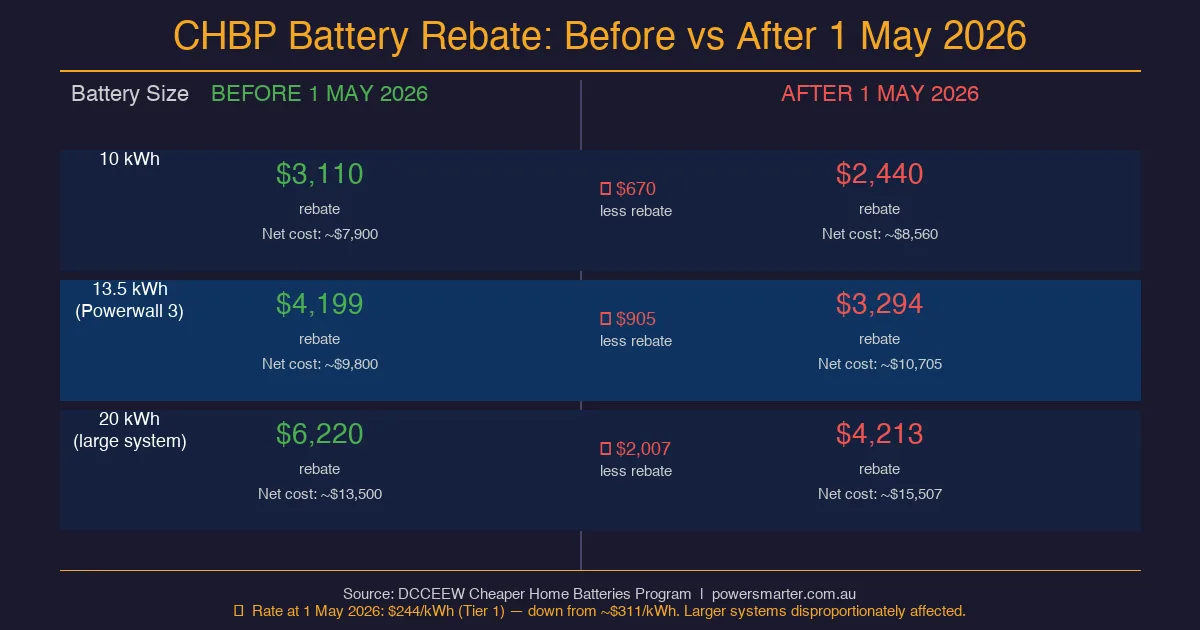
Through to 30 April 2026, the STC multiplier sits at 8.4 per kWh of usable capacity. After fees and admin, this works out to roughly $311 per kWh — meaning:
- A 10 kWh battery attracts roughly $3,110 in rebate
- A 13.5 kWh Powerwall 3 attracts roughly $4,199
- A 20 kWh system attracts roughly $6,220
That's applied as a straight discount off the purchase price — no tiers, no caps on the per-kWh rate (up to the 50 kWh usable capacity limit).
What Changes on 1 May 2026?
Two things happen simultaneously on 1 May. First, the STC multiplier drops from 8.4 to 6.8 per kWh. Second — and this is the bigger shift for larger systems — a tiered structure kicks in:
- First 14 kWh of usable capacity: receives 100% of the rebate rate (~$244/kWh)
- 14–28 kWh: receives only 60% of the rate (~$146/kWh)
- 28–50 kWh: receives only 15% of the rate (~$37/kWh)
The intent, according to the government, is to ensure the discount remains around 30% across a range of battery sizes — but in practice, households with larger systems take a disproportionate hit.
The Real Dollar Difference
Let's run the numbers on three common battery sizes:
10 kWh battery
Before May 1: ~$3,110 rebate
After May 1: ~$2,440 rebate
Difference: $670 less
13.5 kWh (Tesla Powerwall 3)
Before May 1: ~$4,199 rebate
After May 1: ~$3,294 rebate
Difference: ~$905 less
20 kWh (larger system)
Before May 1: ~$6,220 rebate
After May 1: ~$4,213 rebate
Difference: ~$2,007 less
For really large systems — say 28 kWh and above — the tiering bites hard. Industry estimates suggest the difference between a pre-May and post-May installation could be $3,000 to $9,000 for systems in that range. That's not trivial.
Does This Make Batteries a Worse Deal After May?
Not necessarily. The program will still knock a meaningful amount off your upfront cost, and battery prices have been coming down steadily regardless. The government's stated goal is to maintain roughly a 30% effective discount across the range of popular battery sizes.
But if you're planning a medium-to-large system and the installation was already on your radar for mid-2026, pulling the timeline forward could save you real money. That's not a sales line — it's just arithmetic.
Worth noting: the rebate is based on the date of installation, not the date you sign a contract. If you book in March and the installer can't get to you until May, you get the May rate. That's the detail some homeowners miss when they're told to "lock in" a booking.
Will the Program Continue Beyond 2026?
Yes. The CHBP is funded and legislated through to the end of 2030. The rebate per kWh will continue to step down every six months or annually after 2026, in line with falling battery prices. By 2029–2030, the subsidy will be modest — the expectation being that battery economics will stack up on their own by then.
The program was announced with a $2.3 billion budget, though that's structured to decrease over time as take-up grows and per-kWh costs fall.
Should You Rush?
The honest answer: it depends on your situation.
If you have a solid quote already, the panels are on the roof, and you were going to install a battery in the next few months anyway — yes, trying to get it done before April 30 is probably worth the hassle. The savings are real and, for larger systems, significant.
If you're still in the research phase, comparing quotes, or figuring out what size battery makes sense for your household, don't let the deadline rush you into a decision you haven't thought through properly. A badly chosen battery installed before May is worse than a well-chosen one installed in June.
And if you've been waiting for battery prices to fall further before pulling the trigger — they already have, substantially. The combination of reduced manufacturing costs and the rebate (even post-May) puts home batteries within reach for a lot more households than they were two years ago.
Quick Checklist Before May 1
- Get at least two quotes from CEC-accredited installers
- Confirm the battery is on the CEC approved product list
- Check that the install date (not the booking date) will be before May 1
- Verify the installer will apply the STC discount at point of sale
- If you're in WA, check whether you can stack the state rebate on top
The deadline is close. But so is the opportunity.
Comments (0)
No comments yet. Be the first to share your thoughts!