Do You Actually Qualify for Australia's New Battery Rebate? Here's How to Check
Let me save you some time.
Before you call three installers, sign up for a waitlist, or tell your neighbours about this great new rebate — just run through this checklist first. The CHBP has several eligibility conditions, and if you miss one, the rebate doesn't apply. That's frustrating to discover after you've committed.
The Income Test
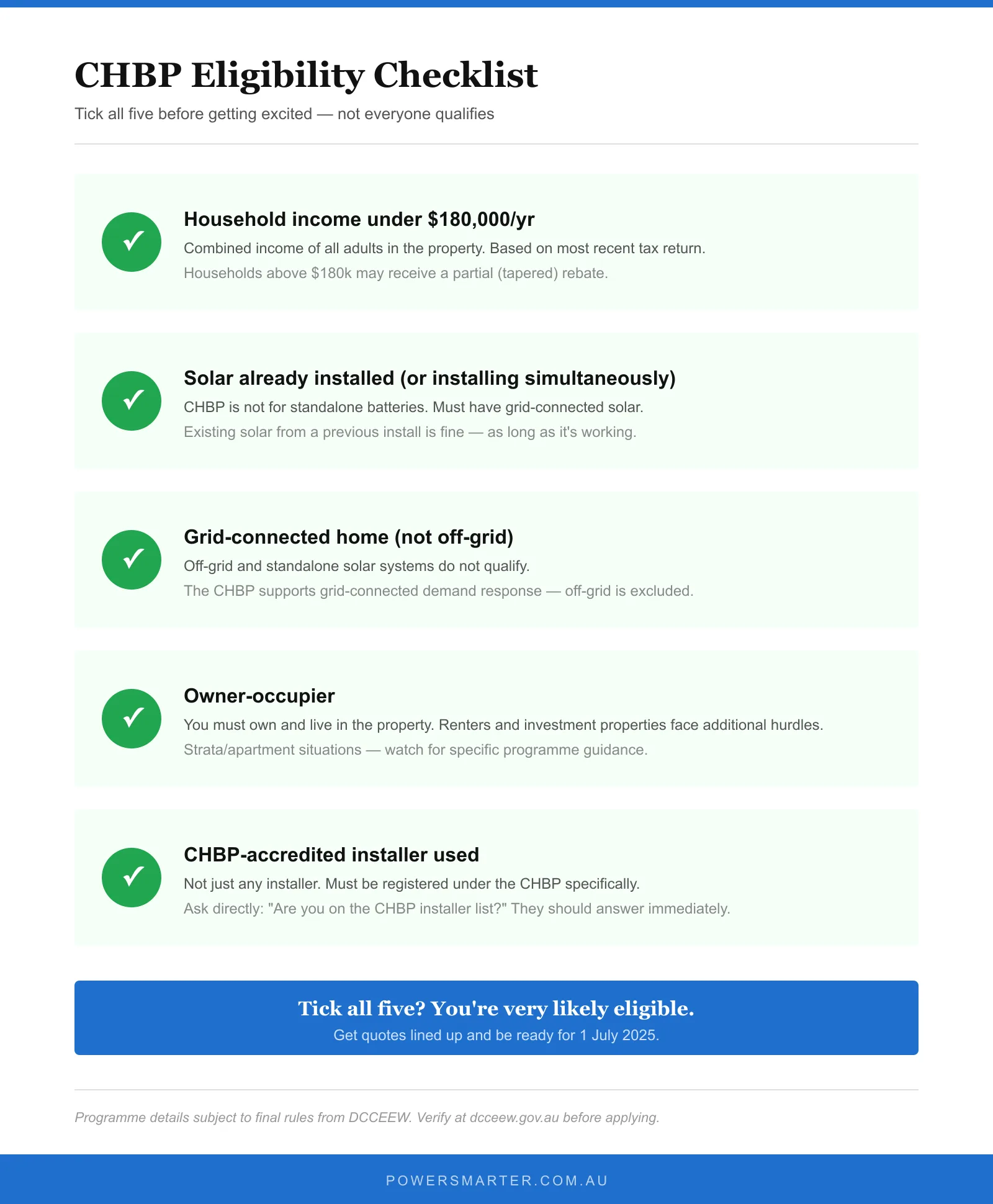
The CHBP is means-tested. Your combined household income needs to be under $180,000 per year to receive the full rebate.
What "household" means here matters. It's based on the adults living at the property — so if you and your partner both work, it's your combined incomes that count. The threshold is assessed against your most recent tax return (or notice of assessment).
Households earning above $180,000 are currently expected to receive a reduced (partial) rebate, though the taper structure hasn't been fully published yet. My expectation is that the rebate phases out rather than cuts off entirely — but until the full programme rules drop, I'd treat $180k as the line you want to be under for the full benefit.
If you're close to the threshold, it's worth knowing the exact figures for your situation before assuming either way.
You Need Solar. Already Installed, or Installing Simultaneously.
This is the one that catches people out.
The CHBP is not for standalone batteries. You need a grid-connected rooftop solar system — either already on your roof, or being installed at the same time as the battery.
If you're renting a house with no solar on the roof and want to install a battery: doesn't qualify.
If you've got solar but it's community solar (like a shared array in an apartment complex): likely doesn't qualify, though check the specific circumstances.
If you bought the house last year and the previous owners installed solar — great, you should be fine, as long as the system is connected and functioning.
The logic here is straightforward: the rebate is meant to help households store solar energy rather than export it for 4 cents a unit. Without solar, there's nothing to store.
It Has to Be a Grid-Connected System
Off-grid setups don't qualify. The CHBP is specifically for grid-connected households. This makes sense from a grid-management perspective — the programme partly exists to help with demand response, which only works if the battery is connected to the grid.
If you're on a rural property that runs entirely off a standalone solar-and-battery system with no grid connection, this rebate isn't for you. (That's frustrating, but there it is.)
The Installer Must Be CHBP-Accredited
You can't use just any electrician or solar installer. Under the CHBP, the installer needs to be accredited under the programme — which means they'll be registered with the Clean Energy Regulator and trained in the specific requirements.
This is actually good news in disguise: it filters out dodgy operators. But it does mean you need to specifically confirm with any installer you're considering that they are (or will be) CHBP-accredited from 1 July. If they're not sure, or they say it "doesn't matter," find someone else.
The Clean Energy Regulator will maintain a list of accredited installers — we'll link to that once it's live.
Your Property Type
Owner-occupiers are the primary target for this scheme. If you own your home and live in it, you're in the right category.
Renters: Technically challenging. You don't control what gets installed on the roof, and the landlord would need to be involved — but the landlord may not get the full benefit since they don't live there. This is a real gap in the policy, and one that frustrates me a bit honestly. We'll see if there are any workarounds in the final rules.
Landlords/investment properties: The current signals suggest the rebate is aimed at owner-occupiers rather than investors, but again — the full programme rules will clarify this.
Apartments: Strata properties are complicated. A battery on a shared rooftop serving multiple apartments is a different beast from a standalone house. If you're in an apartment block, watch for specific guidance on this; it may be possible, but complex.
The Battery Itself Must Meet Standards
Not every battery on the market will be eligible. The system needs to meet the programme's technical specifications — primarily around minimum capacity, performance standards, and safety certifications. Reputable brands (Tesla Powerwall, BYD, Sungrow, Alpha ESS, etc.) will almost certainly qualify. Random no-brand imports from eBay probably won't.
Your accredited installer should only be offering you eligible products anyway, but it's worth asking explicitly: "Is this battery model approved under the CHBP?"
So, Where Does That Leave You?
Run through this quickly:
- ✅ Household income under $180k?
- ✅ Solar already installed, or installing it at the same time?
- ✅ Grid-connected home (not off-grid)?
- ✅ Owner-occupier?
- ✅ Willing to use a CHBP-accredited installer?
If you're ticking all five, you're very likely eligible. Get some quotes lined up and be ready for 1 July.
If you've hit a "no" on one or more of those, it's still worth talking to an installer — there may be state-level rebates or STC discounts that apply regardless of CHBP eligibility.
Got questions about home batteries or solar? Use our free quote comparison tool to get matched with accredited local installers — no spam, no sales calls unless you want them.
Comments (0)
No comments yet. Be the first to share your thoughts!