
CHBP Battery Rebate Tiers Kick In May 1 — What the Deadline Means in Dollars
Three weeks. That's what stands between you and a higher battery rebate under the federal government's Cheaper Home Batteries Program (CHBP). On May 1, 2026, the way rebates are calculated changes — and if you're considering a battery larger than 14 kWh, the difference in your pocket is real.
This isn't a scare tactic. The program isn't ending, and batteries are still a smart investment after May 1. But the numbers shift, and for some system sizes, they shift meaningfully. Here's what you need to know.
What's Changing on May 1?
The CHBP works through Small-scale Technology Certificates (STCs). When you install an eligible battery, it generates a certain number of STCs based on its usable capacity. Your installer typically trades those STCs on your behalf and passes the value back to you as an upfront discount — that's the "rebate" you see on a quote.
Two things change simultaneously on May 1:
1. The STC factor drops. Right now, each kWh of usable battery capacity earns 8.4 STCs. From May 1, that drops to 6.8 STCs per kWh. With STCs trading at around $37 each, that's the difference between roughly $311/kWh and $252/kWh — even before the tiers kick in.
2. A tiered structure begins. From May 1, the rebate isn't flat across your entire battery size. It's highest for the first 14 kWh of usable capacity, then tapers sharply for anything above that:
- 0–14 kWh: Full STC factor applies ($252/kWh)
- 14–28 kWh: Additional capacity gets 60% of the factor (~$151/kWh)
- 28–50 kWh: Additional capacity gets just 15% of the factor (~$38/kWh)
The intent is to keep the 30% discount meaningful for smaller systems while reducing the incentive for oversized batteries. Whether you agree with that logic or not, the result is a noticeably smaller rebate for anything above 14 kWh.
What the Numbers Look Like in Dollars
Let's make this concrete. Three common battery sizes, before and after May 1:
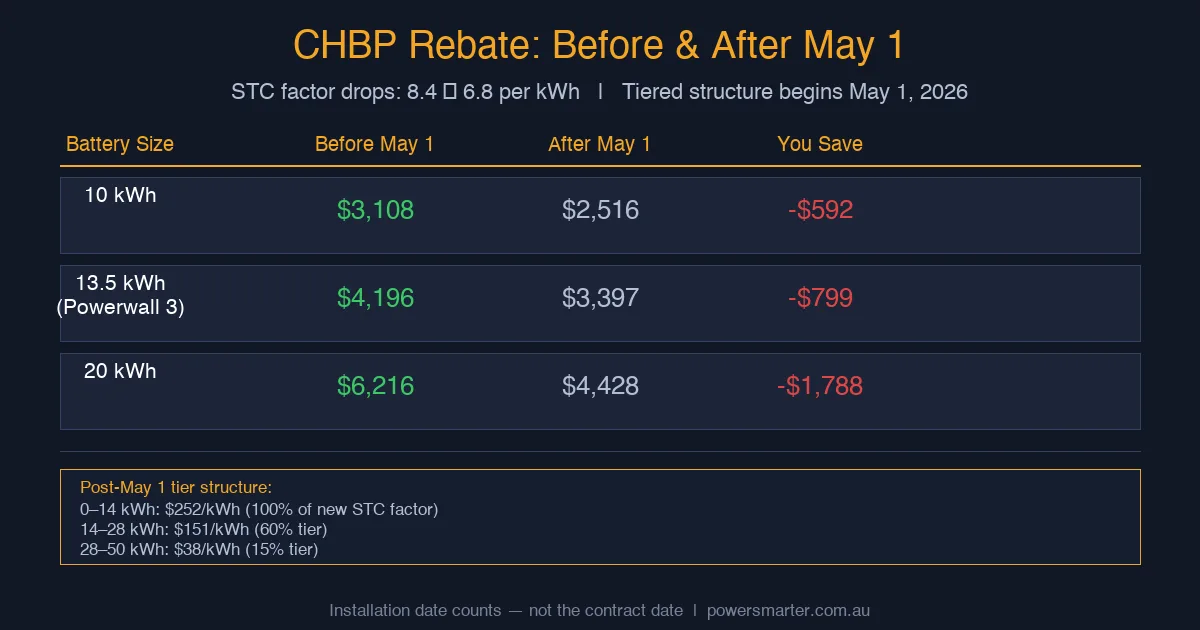
10 kWh battery — Before: ~$3,108 rebate. After: ~$2,516. Difference: $592 less.
13.5 kWh (Tesla Powerwall 3) — Before: ~$4,196. After: ~$3,397. Difference: $799 less.
20 kWh system — Before: ~$6,216. After: ~$4,428. Difference: $1,788 less.
For a 10 kWh system, you're looking at about $600 difference. Annoying, but not catastrophic. For a 20 kWh system, you're potentially leaving nearly $1,800 on the table. That's enough to matter.
Note: These figures use the approximate STC clearing house price of $37/STC. The actual value fluctuates slightly, and your installer's margin affects the discount you see at point of sale. But the direction and scale of the change is accurate.
The Key Gotcha: It's the Installation Date That Counts
This is where people get caught out. The rebate that applies to your installation is determined by when the battery is physically installed and commissioned — not when you sign the contract, not when you pay the deposit, and not when you place the equipment order.
So if you sign a contract on April 25 but the installer can't fit you in until May 3, you're on the new rates. Simple as that.
Installers are also limited to two battery installations per day per team under Clean Energy Regulator rules. As the end of April approaches, quality installers will fill up fast. We've seen this pattern before with STC step-downs — the last two weeks before a change date are chaos. The installers with strong safety records get booked first; the ones who'll promise anything to win your business often have suspicious availability.
A Worked Example: The 16 kWh Question
Say you're looking at a 16 kWh battery — a reasonable size for a household with moderate consumption and existing solar.
Before May 1: 16 kWh × $311/kWh = roughly $4,976 rebate.
From May 1: 14 kWh × $252/kWh = $3,528, plus 2 kWh × $151/kWh = $302. Total: $3,830.
That's a difference of about $1,146 for the same battery. The system costs the same to buy and install — you just get less back from the government.
Should You Rush to Beat the Deadline?
Only if it makes sense for your situation — and only if you can do it properly.
If you've already been researching batteries and have a shortlist ready, now's the time to move. Get quotes this week (not next week), specifically ask each installer what their earliest available installation date is, and confirm in writing that the installation will be commissioned before April 30.
If you're starting from scratch — haven't compared battery brands, haven't checked your solar inverter compatibility, haven't thought about what size suits your actual daily usage — rushing into a $10,000+ purchase to save $800 isn't the right call. A poorly matched battery or a corner-cutting install will cost you far more over a 10-year lifespan than the rebate difference.
A few practical steps if you want to try to beat the deadline:
- Get at least two quotes this week. Not this month — this week. Installer calendars are filling.
- Ask for the installation date in writing. Not "we'll try to fit you in before May." An actual committed date.
- Check your inverter. If you have an existing solar system, confirm your inverter is compatible with the battery you're considering. An inverter upgrade could add weeks to the timeline.
- Verify the installer is SAA-accredited. The Clean Energy Regulator takes this seriously, and non-compliant installs can be disqualified from STCs entirely.
What Happens If You Miss the Deadline?
Honestly? The battery is still worth it.
A 10 kWh battery installed in May still gets you around $2,500 off the purchase price. With electricity prices in most states sitting well above 30 cents per kWh peak, and feed-in tariffs down to 5–7 cents in many areas, storing your own solar makes more financial sense than it did two years ago.
The CHBP isn't winding down — the government expanded the program from $2.3 billion to an estimated $7.2 billion in December 2025, with a target of more than 2 million installations by 2030. The STC factor will continue to decline gradually (the next step-down is scheduled for later in 2026), so there's no magic moment when batteries become unaffordable. Each step-down is modest in isolation.
If you're on the fence about battery size — say, between 10 kWh and 20 kWh — the new tier structure does give you a reason to think carefully. A 10 kWh system gets nearly the same proportional rebate before and after May 1, so the deadline pressure is less intense. For someone eyeing a 20+ kWh system, the math is more compelling to act now.
The Bottom Line
May 1 is three weeks away. If you're seriously considering a battery — especially one above 14 kWh — this is the fortnight to get organised. The rebate difference ranges from a few hundred dollars for smaller systems to close to $1,800 for a 20 kWh setup.
Don't let the deadline push you into a bad decision. But if the numbers stack up and you've done your homework, there's a straightforward reason to move faster rather than slower right now.
Remember: it's the installation date that determines your rebate tier — not when you sign. Keep that front of mind when you're comparing quotes and confirming timelines with your installer.
Comments (0)
No comments yet. Be the first to share your thoughts!