
Every Battery Rebate and Grant Available in Australia Right Now (2025)
I spent a fair bit of time last week going through federal and state government websites so you don't have to. Fair warning: some of this is still being finalised (the CHBP only launched five days ago), but here's the most accurate picture I can put together right now.
The short version: there's more available than most people realise.
The Federal Stuff
Cheaper Home Batteries Programme (CHBP)
The headline announcement from 21 May. Starting 1 July 2025, households with existing solar (or installing solar at the same time) can claim a rebate of approximately $372 per kWh of usable battery capacity.
Income threshold: under $180,000 combined household income for the full rebate.
So a 10kWh battery = roughly $3,720 off. A 13.5kWh Powerwall = roughly $5,022 off. These are real numbers, not rounding errors.
Small-scale Technology Certificates (STCs)
This one's been around for years and a lot of people still don't fully understand it. When you install a solar system with a battery that has an integrated inverter, you may be eligible to create STCs — small certificates that represent the renewable energy the system will generate over its lifetime. Your installer typically buys these certificates off you upfront (instantly) and passes the saving on as a point-of-sale discount.
The STC value per certificate fluctuates based on the spot market — currently sitting around $38–40 each. A solar-plus-battery system in Queensland might generate 80+ STCs, worth well over $3,000.
Critically: the STC discount reduces each year. The scheme steps down annually until it ends in 2030. So the rebate available in 2025 is genuinely higher than what you'd get in 2026 or 2027.
State by State
Victoria
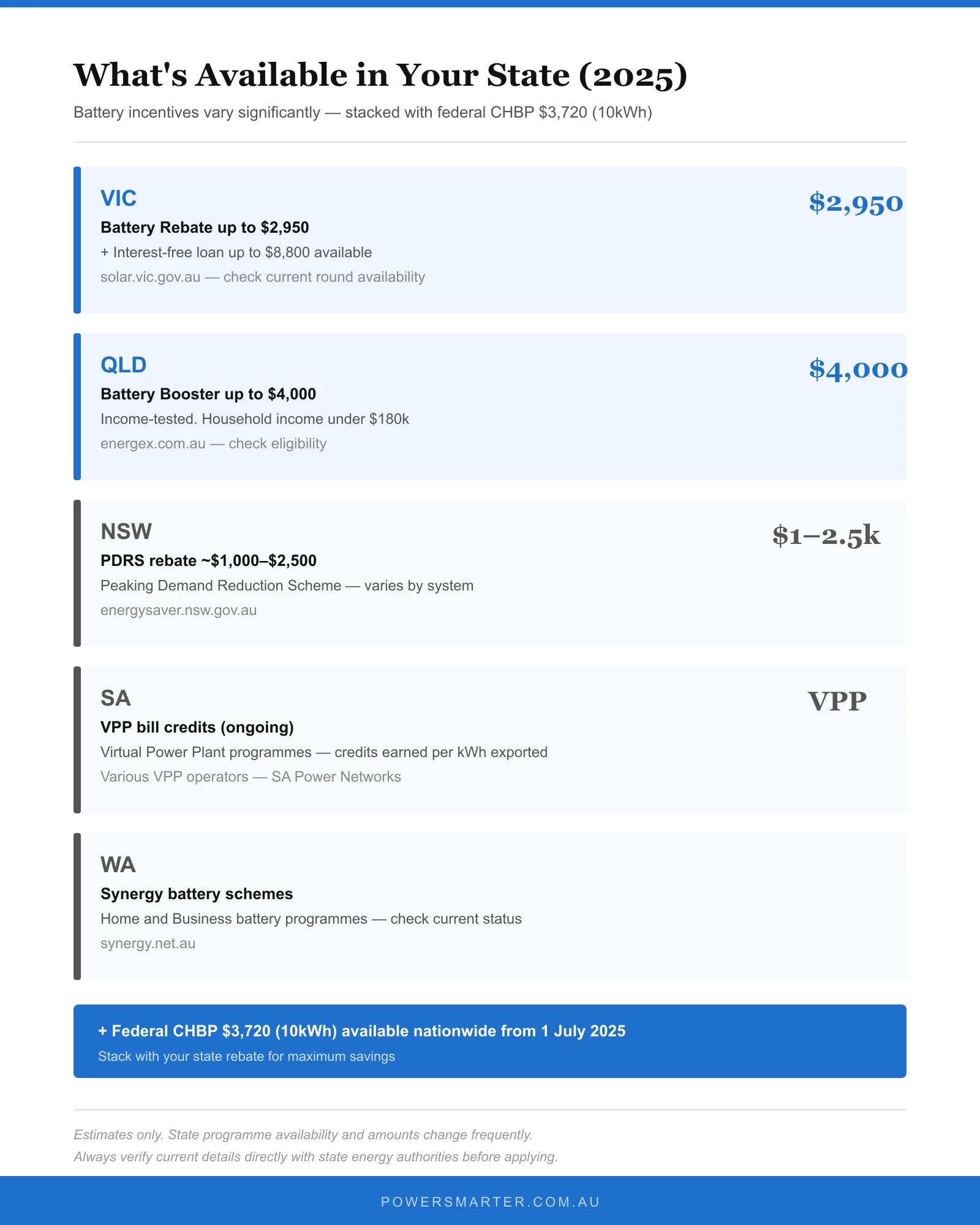
Victoria runs the Solar Homes Programme, which has been through several iterations. As of mid-2025:
- Solar battery loan: Interest-free loan of up to $8,800 for eligible households to install a battery. You repay it over time (up to 4 years) via a charge added to your electricity bill.
- Battery rebate: A direct rebate of up to $2,950 is also available for eligible Victorians. Eligibility is means-tested (similar household income caps to the CHBP).
- VIC residents may be able to combine the battery rebate with the CHBP — but the rules on stacking are still being clarified.
Solar Victoria's website (solar.vic.gov.au) has a waitlist/application system — spots fill up quickly when they open new rounds.
New South Wales
NSW has been less generous with direct battery rebates historically, but there are a couple of options:
- Peak Demand Reduction Scheme (PDRS): Provides certificates (PRCs) for installing batteries that can be used in demand response. Installers typically factor this into their quotes, but it's worth asking.
- Empowering Homes Programme (Hunter region): Free solar-and-battery systems for eligible low-income households in the Hunter Valley. Worth checking if you're in that region.
NSW households can stack the CHBP on top of PDRS certificates, which is a reasonable combination.
Queensland
Queensland has had the Battery Booster programme, offering rebates of up to $4,000 on home battery installations. The programme has had funding rounds in previous years and may have additional allocations in the 2025–26 budget — worth checking energyq.com.au or the state government's energy pages for current status.
CHBP plus Battery Booster is a legitimate combination if both programmes are open simultaneously.
South Australia
SA has been a leader in home battery uptake, partly because of the Home Battery Scheme which provided generous subsidies in earlier years. The core rebate portion has largely wound back, but:
- The Virtual Power Plant programs through SA Power Networks and various retailers offer ongoing incentives for battery owners to participate in grid services — this translates to bill credits.
- Low-income households may still access subsidies through the Energy Efficiency Scheme.
Western Australia
WA is a bit of an outlier because the state is not connected to the National Electricity Market (NEM). Synergy runs some specific programmes for WA residents, including battery-related incentives. The CHBP should apply to WA residents as it's federal, but the interaction with WA-specific schemes is worth clarifying with your installer.
Tasmania, ACT, NT
Tasmania and the ACT have had various energy efficiency programmes — the ACT's Sustainable Household Scheme offers zero-interest loans for batteries. Northern Territory residents have fewer options, though the federal CHBP will apply.
A Quick-Reference Summary
| Programme | Who It's For | Approx. Value | Stackable? |
|---|---|---|---|
| CHBP (federal) | Most households under $180k income | $3,700–$5,000+ | Yes (with state schemes) |
| STCs | Solar-plus-battery installs | $1,000–$4,000+ | Yes |
| VIC Battery Rebate | VIC eligible households | Up to $2,950 | Yes (with CHBP) |
| QLD Battery Booster | QLD residents (check availability) | Up to $4,000 | Yes (with CHBP) |
| NSW PDRS | NSW households | $500–$2,000 (varies) | Yes |
| SA VPP incentives | SA battery owners | Ongoing bill credits | Yes |
The asterisk on all of this: programme availability, funding levels, and eligibility rules change. Always verify current status directly with the relevant state authority before making a purchase decision.
Got questions about home batteries or solar? Use our free quote comparison tool to get matched with accredited local installers — no spam, no sales calls unless you want them.
Comments (0)
No comments yet. Be the first to share your thoughts!