
Whole-Home Electrification Checklist: Where to Start

Getting off gas and onto all-electric is one of the best long-term energy decisions an Australian homeowner can make — but it can feel overwhelming if you try to do everything at once. This checklist gives you a stepwise approach: what to do first, second, and last, and why the order matters.
Why Sequencing Matters
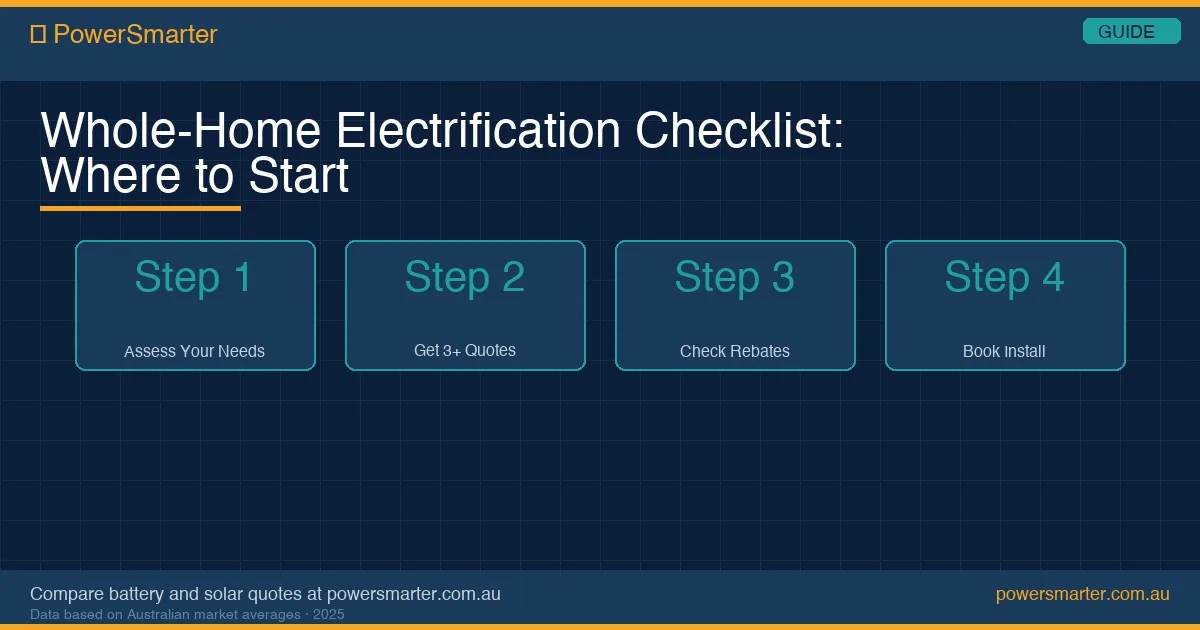
Home electrification upgrades interact. Doing them in the wrong order can mean paying twice, or buying equipment that's oversized or undersized because you changed your load profile later. The right sequence generally goes from reducing loads → electrifying the biggest loads → adding generation → adding storage → adding smart control.
Step 1: Reduce Loads First (Before Spending on Generation)
The cheapest energy is the energy you don't use. Before installing solar or batteries, reducing your consumption makes your generation assets go further.
Priority actions:
- Switch to LED lighting if you haven't already. Cost: $200–$500 for a whole house. Annual saving: $100–$300. ROI in weeks to months.
- Roof insulation upgrade if you're in a climate with significant heating/cooling demand. Reduces HVAC load substantially.
- Hot water thermostat — if you have an electric resistance hot water heater, lower the temperature setpoint to the minimum safe level.
- Standby power elimination — cheap smart power boards eliminate standby waste from entertainment units, desktop computers, etc.
Step 2: Solar Panels — The Foundation
Solar is the energy source that powers everything else in an electrified home. Install solar early — it generates savings from day one, it sizes the basis for future battery selection, and it enables the solar-powered operation of heat pumps and EV charging.
Sizing: aim for at least 6.6 kW, ideally larger if your roof and network connection allow. If you know an EV is coming, plan for it in the solar sizing now.
Step 3: Hot Water Electrification (Heat Pump Hot Water)
Hot water is typically 20–25% of Australian household energy use. If you're on gas hot water, switching to a heat pump hot water system is one of the highest-ROI electrification upgrades available.
- A heat pump hot water system uses approximately 1/3 the electricity of a conventional electric resistance heater for the same hot water output
- Configured to heat during solar hours (typically 10am–4pm), it can run almost entirely on solar generation
- Available state rebates in VIC, QLD, NSW, and SA can reduce upfront cost significantly
Do this before the battery: a heat pump running on solar is already optimised. The battery can then cover other evening loads.
Step 4: Space Heating and Cooling (Reverse-Cycle AC)
If you're heating with gas ducted heating, a wood heater, or old AC: upgrade to reverse-cycle air conditioning. Modern reverse-cycle systems are the most efficient heating technology available for Australian climates — 3–4 times more efficient than electric resistance heating, and all-electric.
If you're in Victoria or SA with significant winter heating loads: this is the most impactful step in your gas exit strategy after hot water.
Step 5: Kitchen Electrification (Induction Cooktop)
Removing gas cooking eliminates the gas supply charge permanently. While cooking energy is a relatively small cost, the supply charge elimination improves the economics of fully disconnecting the gas meter.
Step 6: Home Battery
With solar installed and major loads electrified, a battery now serves a larger, well-understood load. Battery sizing becomes clearer when you know your actual consumption from the newly electrified appliances.
The CHBP rebate applies here — get your battery now while the program has good funding available.
Step 7: EV Charging
Add a dedicated EV charger once you've committed to an electric vehicle or when the purchase is imminent. Coordinate with your solar sizing — if you're getting an EV, size solar larger than minimum to provide charging capacity.
Step 8: Smart Energy Management
Once your system is installed, optimise with smart controls: battery scheduling, hot water timer optimisation, EV charging solar diversion, and if budget allows, a home energy management system (HEMS) that coordinates all loads automatically.
Step 9: Gas Meter Disconnection
Once all gas appliances are replaced, arrange gas meter disconnection. This eliminates the supply charge permanently. The process involves notifying your gas retailer, arranging disconnection with the network operator, and paying a meter abolishment fee ($200–$600 typically). After this point, your home is fully electric — no gas bills ever again.
The Realistic Timeline
Most households complete whole-home electrification over 3–5 years. A staged approach spreads the capital cost and lets each upgrade generate savings that fund the next one.
- Year 1: LED + insulation + solar
- Year 1–2: Heat pump hot water + battery (CHBP now while available)
- Year 2–3: Induction cooktop, space heating/cooling upgrade
- Year 3–4: EV + dedicated charger
- Year 4–5: Gas disconnection + smart management
Comments (0)
No comments yet. Be the first to share your thoughts!