
Solar, Battery, EV, Heat Pump: What's the Best Order?


The Full-Electrification Roadmap
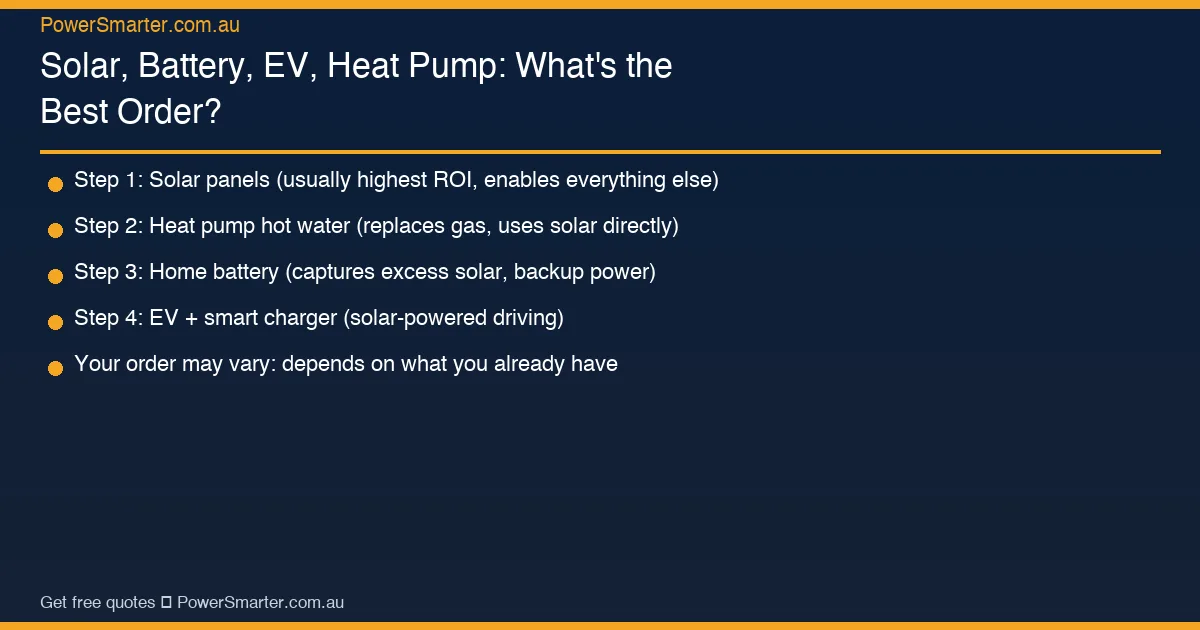
At some point, someone told you about the holy trinity of home electrification: solar panels, a battery, and an EV. Then someone else mentioned heat pumps. Now you're looking at a potential $60,000–$100,000 upgrade program for your home and wondering both where to start and whether you're crazy.
You're not crazy. The economics do stack up, particularly when spread over time and combined with available rebates. But the order matters — both for financial efficiency and for practical reasons like compatibility and system design.
Here's a framework for thinking through the sequence that works for most Australian households. Adjust for your specific situation.
Start With Solar (If You Don't Have It)
Solar panels are almost always the first piece, and for good reason. They're the generator that makes everything else work. Without solar, a battery is just a grid arbitrage device (which can work, but with much worse economics). Without solar, your EV is grid-charged rather than sun-charged. Without solar, your heat pump is drawing expensive grid power rather than cheap midday generation.
The STC rebate on solar (worth $2,000–$4,000+ on a typical 6.6kW system depending on your zone) reduces upfront costs significantly. A quality 6.6kW system installed in most Australian capital cities currently runs $4,000–$8,000 after STCs. That's often under $1,000/year in payback over a 10-year period while generating genuine bill savings from day one.
If you're installing solar with a battery already in mind, get a hybrid inverter — it'll save you the cost of an inverter replacement when you add the battery later.
Then Heat Pump Hot Water
Hot water heating is one of the biggest costs in a typical Australian home, often accounting for 25–30% of the electricity bill (or more if you're still on gas). A heat pump hot water system uses approximately one-quarter the electricity of a traditional resistive electric heater to produce the same amount of hot water.
The reason heat pump comes before battery in this sequence: you don't need a battery to get the full benefit of a heat pump. Set it to heat during midday (when solar is generating at peak output) and you're consuming your own solar power directly — no battery required. This "solar direct" mode works extremely well and the payback period is often under 5 years, sometimes closer to 3.
Various state rebates apply to heat pump hot water — in VIC, SA, and other states, rebates of $300–$1,000 are available depending on your existing system and circumstances.
Then Battery Storage
Once you have solar panels generating excess power and a heat pump soaking up midday generation, a battery captures whatever's left. The CHBP provides $372/kWh rebate on up to 50kWh, making this the best time financially to install a battery since the program launched.
With solar + heat pump already in place, you're sizing the battery for what actually isn't being consumed — evening household loads primarily. For many households with good solar coverage and a heat pump, a 10kWh battery is more than adequate.
The battery also provides blackout resilience, which is increasingly relevant as weather events drive more grid disruptions. And if you later add an EV, the battery provides a buffer that allows more flexible charging scheduling.
Then EV (or EV Charger)
An EV comes last in this sequence not because it's least important, but because the supporting infrastructure — solar to charge from, battery to buffer supply, heat pump reducing other energy costs — makes the economics work better. An EV charged entirely from grid electricity at standard tariffs costs considerably more to run than one charged from solar excess or overnight off-peak rates with a battery buffer.
Smart EV chargers that respond to solar production (sometimes called solar divert or solar matching mode) are now available at reasonable cost. Combined with a properly sized solar system, they can shift most of your EV charging to solar hours automatically.
When you do add an EV, factor in any relevant state government subsidies. NSW, VIC, and SA have offered EV stamp duty concessions and rebates, though these programs change over time.
What If You Already Have Some of These?
If you already have solar, the sequence shifts. Get heat pump hot water next if you're on gas or older electric resistance. Then battery. The EV timing depends on your budget and driving situation.
If you already have solar + battery, adding an EV is a relatively clean win. Just make sure your solar system is sized adequately — an EV adding 10–15kWh/day of charging demand might require more panels than a system designed pre-EV.
If you already have an EV, adding solar is arguably even more important than for non-EV owners. You have a built-in large electricity demand that solar can directly offset.
The Budget Reality
Very few households can do all four upgrades simultaneously. The full package — 6.6kW solar ($5,000–$7,000 after STCs), heat pump hot water ($3,000–$5,000 after rebates), 10kWh battery ($7,000–$11,000 after CHBP), and EV charger ($1,500–$3,000) — runs $16,500–$26,000. That's a serious capital outlay.
The staged approach shown here typically takes 3–7 years across the whole journey for households doing it on a normal salary without dedicated savings. Each stage pays for itself (or contributes to doing so) before the next stage begins.
If you want to do it all at once, green loans and solar finance are available from several Australian lenders. The key is making sure the combined repayment is less than your energy savings — which is achievable for many households when done with proper design rather than just checking boxes.
Comments (0)
No comments yet. Be the first to share your thoughts!