
Smart EV Charging: How to Charge on Solar + Off-Peak
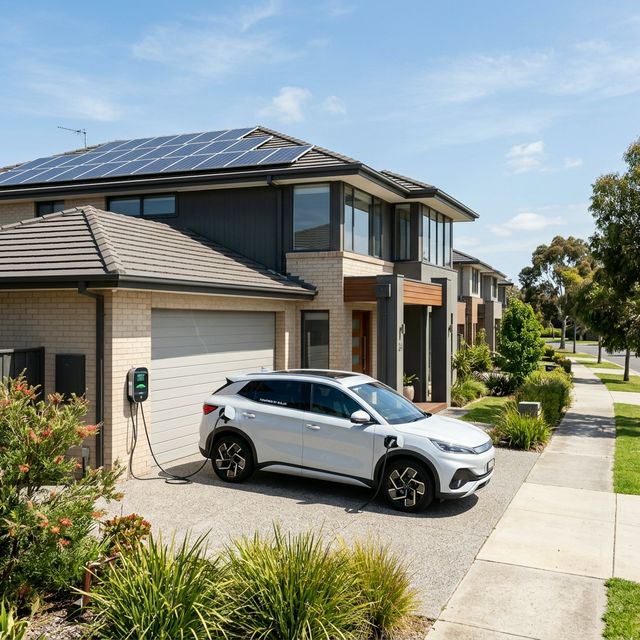
Electric vehicle running costs depend enormously on when and how you charge. Done right, solar charging can bring your effective fuel cost down to near-zero. Done poorly, you could be charging at peak rates and paying more per kilometre than a petrol car. Here's how to do it right.
The Three Charging Scenarios
Scenario 1: Daytime Solar Charging (Best)
Your car is plugged in during the day and charges directly from solar generation. Cost: effectively zero (you're using solar you'd otherwise export at 5–8 cents/kWh). Equivalent fuel saving: you're replacing petrol at ~$1.80/L with solar-charged electricity at near-zero cost.
For this to work well:
- Your car is parked at home during the day (work from home, shift worker, retired)
- You have a smart EV charger with solar diversion capability
- Your solar system is large enough to generate surplus for charging (6.6 kW minimum, ideally more)
Scenario 2: Off-Peak Grid Charging (Good)
You plug in overnight and set the car or charger to charge only during off-peak hours (typically 11pm–7am). Cost: 15–22 cents/kWh depending on your plan — significantly cheaper than peak rates.
At 17 cents/kWh and 18kWh/100km consumption: $3.06 per 100km. A petrol car at 10L/100km and $1.80/L: $18/100km. The EV advantage is dramatic even without solar.
Scenario 3: Peak Rate Charging (Worst — Avoid)
Plugging in immediately when you get home at 6pm and charging through the evening peak. At 45 cents/kWh peak rates: $8.10/100km. Still cheaper than petrol but unnecessarily expensive. This is what smart charging is designed to avoid.
Smart Charger Features That Matter
Solar Diversion Mode
The killer feature for solar + EV owners. In solar diversion mode, the charger monitors how much surplus solar your home is generating and adjusts the charging rate to match. When surplus is 2 kW, charge at 2 kW. When surplus is 7 kW, charge at 7 kW.
This maximises solar self-consumption and minimises grid import. Chargers with solar diversion include:
- Zappi (MyEnergi): The gold standard for solar diversion. Eco mode matches available solar surplus dynamically.
- Wallbox Quasar 2: Bidirectional charger with solar diversion
- Tesla Wall Connector: Works well with Tesla Powerwall via the Tesla app
- GoodWe/Sungrow integrated charging: Some hybrid inverter brands offer EV charger integration in the same ecosystem
Scheduled Charging
Even without solar diversion, scheduling overnight charging for off-peak hours is easy and effective. Most EVs have built-in scheduled charging (set in the car's interface or manufacturer app). Most dedicated EV chargers also have scheduling built in.
Set your charging window to match your tariff's cheapest period: if off-peak starts at 11pm and your car is usually at 50% charge, configure it to charge from 11pm to finish at 6:30am.
Minimum Charge Override
Good chargers allow you to set a minimum charge level that triggers immediate charging regardless of time or solar availability. If your battery is at 10% and you need to drive in 2 hours, the override charges immediately at whatever rate is available. This prevents the "scheduled charging = car not ready" problem.
What Your Electricity Plan Should Look Like
EV owners benefit most from plans with:
- Clear off-peak window overnight (11pm–7am ideally, with cheap rates under 20c/kWh)
- Competitive feed-in tariff for solar export during the day
- Ideally: a solar sponge tariff if available in your state (very cheap midday rates)
Some retailers offer EV-specific plans with free or very cheap overnight charging. Origin's EV plan, AGL's EV offer, and Amber Electric's real-time pricing are worth comparing for EV households.
Combining Solar, Battery, and EV
The optimal flow for a solar + battery + EV household:
- Solar generates during the day
- House loads are met first from solar
- EV charger fills any available surplus (solar diversion)
- Remaining surplus charges the home battery
- In the evening: home battery covers household load
- Overnight: EV charges at off-peak rates if battery and solar didn't fully charge it during the day
This hierarchy is set in your charger software and battery settings. Getting the priority order right requires some configuration — but once set up, it runs automatically.
Vehicle-to-Home (V2H): The Next Step
V2H technology allows your EV battery to power your home — essentially using the car as a mobile home battery. As of March 2026, V2H is available in Australia with compatible vehicles (some BYD models, Nissan Leaf with CHAdeMO + compatible charger) but is still in early adoption. The economics are improving as more bi-directional compatible vehicles enter the market.
Comments (0)
No comments yet. Be the first to share your thoughts!