
Home Battery for Families with EVs: Optimising Your Setup

If you have an EV and you're considering a home battery — or vice versa — you're looking at the right combination. Solar + battery + EV is arguably the most powerful configuration for slashing household energy costs in Australia. But getting the sizing and setup right matters more here than in any other scenario.
The EV Changes Your Energy Maths Significantly
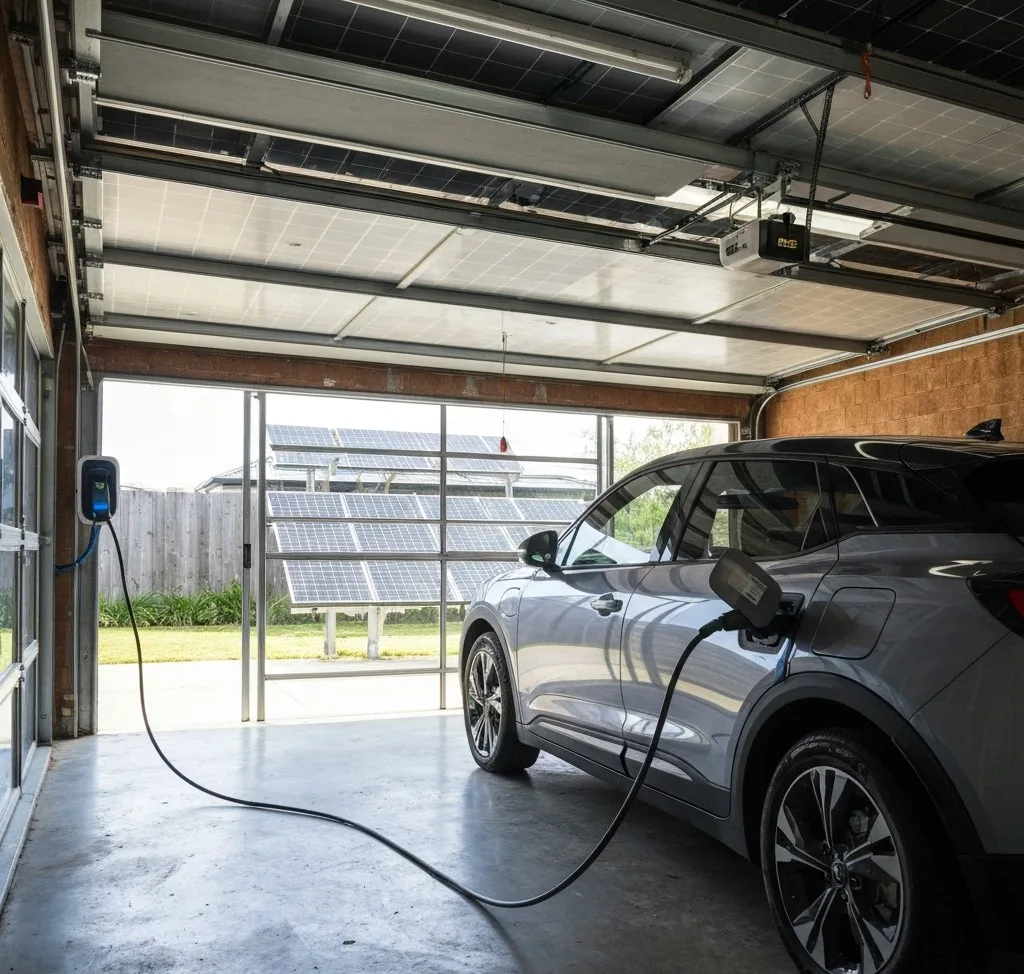
An electric vehicle adds a substantial new load to your home's energy consumption. A typical Australian EV (e.g., BYD Atto 3, Tesla Model 3, MG ZS EV) consumes roughly 15–25 kWh per 100 km of driving. For the average Australian who drives 50 km/day, that's 7.5–12.5 kWh of charging daily.
This additional demand fundamentally changes your solar and battery sizing calculation. A household that previously needed 6.6 kW of solar and a 10 kWh battery may now benefit from 10+ kW of solar and a larger battery to fully harness EV charging from their own generation.
Charging Strategy: Three Options
Option 1: Daytime Solar Charging
The simplest and most efficient approach: charge your EV directly from solar during the day while you're at work or at home. This requires a level 2 EV charger (7kW) and smart scheduling capability. Many EVs and chargers support solar diversion — the charger adjusts its rate to match available solar surplus.
Solar charging costs essentially nothing and maximises self-consumption. The limitation: if you need your car during the day and can't leave it plugged in for several hours, this doesn't always work.
Option 2: Battery-to-EV Charging
Charge the home battery from solar during the day, then use the battery to charge the EV in the evening or overnight. This is less efficient than direct solar charging (two conversion steps instead of one) but provides more flexibility in when you charge the car.
The economics depend on the spread between what your battery stores and what you'd otherwise pay for grid power at that time.
Option 3: Off-Peak Grid Charging
If you're on a TOU plan, overnight off-peak rates (often 15–22 cents/kWh) can be a cost-effective way to charge the EV — especially when solar and battery alone aren't meeting the demand. This works well as a backup strategy.
Battery Sizing When You Have an EV
For a household with one EV driving average distances:
- Non-EV overnight consumption: 8–12 kWh
- EV charging requirement: 8–15 kWh (depending on daily driving)
- Total storage need: 16–27 kWh
This pushes most households toward larger battery configurations — either a second Powerwall 3 (two units = 27 kWh), or a large modular setup like BYD HVM at maximum configuration. Alternatively, a single 13.5 kWh battery combined with TOU off-peak EV charging is a practical and economical middle ground.
Solar Sizing for EV + Battery Households
With an EV in the mix, aim for:
- Minimum: 10 kW solar (25 panels approximately)
- Ideal: 13 kW+ solar if your roof allows and you're on three-phase power
This sounds like a lot, but remember: every kWh of solar that charges your EV directly displaces fuel cost (effectively a value of 25–40 cents/km in petrol savings) plus grid electricity cost. The ROI on larger solar + EV combination is very strong.
Smart Charging: Getting the Automation Right
Modern EV chargers (Zappi, Tesla Wall Connector, Wallbox) have smart modes that prioritise solar charging, schedule charging windows, and integrate with home energy management systems. Getting this configured correctly is important and often overlooked.
Specifically:
- Configure the charger to prioritise solar surplus before drawing from grid or battery
- Set a minimum charge level (e.g., start charging only when solar surplus exceeds 1.4 kW for a 7 kW charger at minimum rate)
- Set backup charging windows at off-peak rates if the EV doesn't reach target charge from solar alone
Vehicle-to-Home (V2H) in 2026: Still Emerging
V2H — using your EV as a backup battery for your home — is technically available with some EVs (Nissan Leaf with CHAdeMO, some BYD models) and compatible bi-directional chargers. However, as of March 2026, V2H adoption in Australia remains limited by charger availability and export rate negotiations with DNSPs.
This is worth watching. In two to three years, V2H may meaningfully change the economics of battery ownership for EV households — potentially making a dedicated home battery less necessary for households with large-battery EVs.
Getting Your System Designed Properly
Solar + battery + EV integration is complex enough that a generic quote won't serve you well. You need an installer who understands load profiles, charger scheduling, and system integration — not just someone who sells batteries. PowerSmarter's vetted installers have experience with multi-technology setups and can model your specific driving pattern and energy usage properly.
Comments (0)
No comments yet. Be the first to share your thoughts!