
EV Charging at Home with Solar and Battery: The Best Setup for Aussie Drivers

An electric vehicle plus home solar and battery is the combination that makes the most sense economically — and increasingly, it's what Australian households are planning for. Done right, you can drive on near-free electricity generated from your own roof. Done wrong, your EV becomes a major electricity expense and your battery never gets a chance to charge.
Here's how to set this up properly.
The Opportunity: How Much an EV Adds to Your Energy Consumption
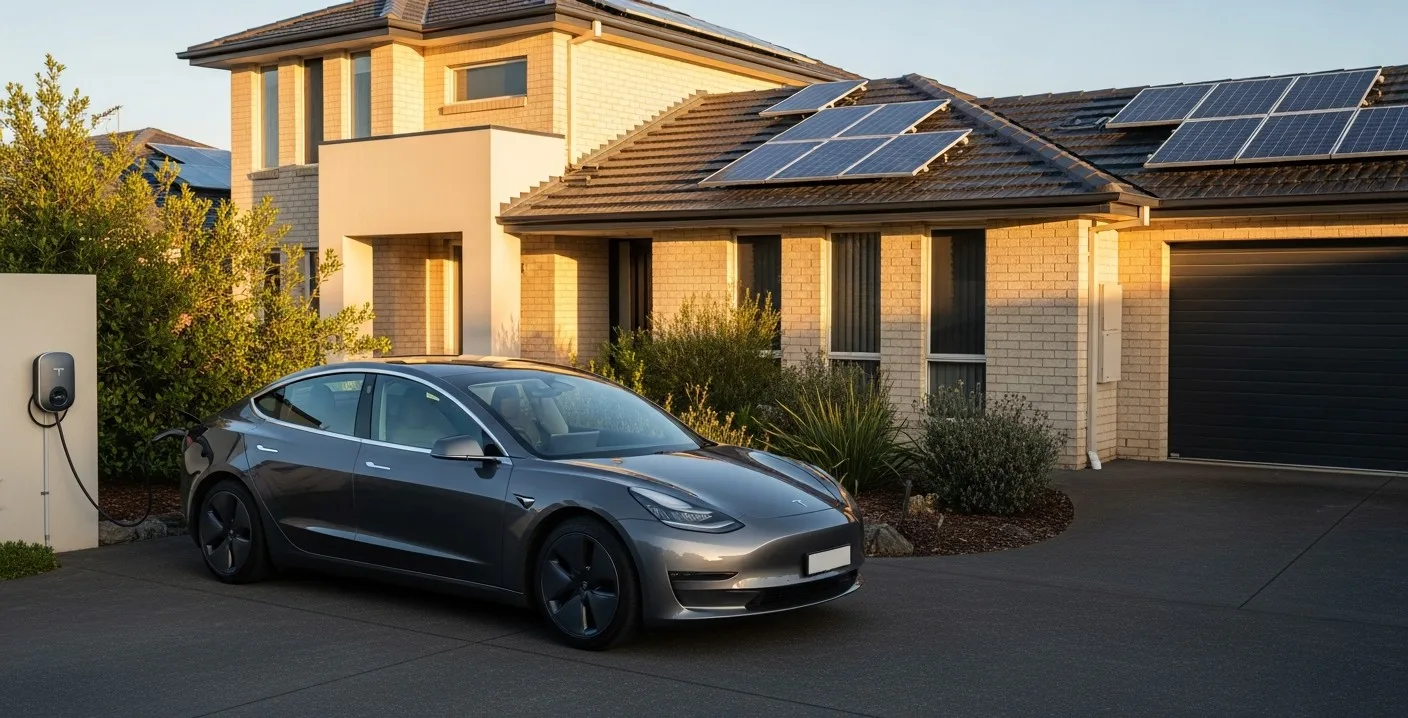
The average Australian drives around 13,000–15,000 km per year. A typical EV uses about 15–18 kWh per 100km. This means:
- Annual EV electricity consumption: approximately 2,000–2,700 kWh/year
- Equivalent daily average: 5.5–7.5 kWh/day
If you charge that from the grid at 33c/kWh, that's $660–$890/year in charging costs. If you charge from your own solar at effectively 0c, you save that entire amount — on top of whatever your house already saves from solar.
The EV charging cost is significant enough that it meaningfully changes the case for both solar and battery storage.
Two Approaches to Solar EV Charging
Approach 1: Charge the EV Directly from Solar (Daytime)
The simplest approach: schedule your EV charger to run only when solar is generating — typically 9am–4pm on clear days. Most EV chargers and smart car apps support time-scheduling.
Limitations:
- Your EV must be at home and plugged in during solar hours
- On cloudy days, solar may not generate enough to charge meaningfully
- Without smart solar diversion, you may still be drawing some grid power alongside solar
Approach 2: Solar → Battery → EV (Overnight)
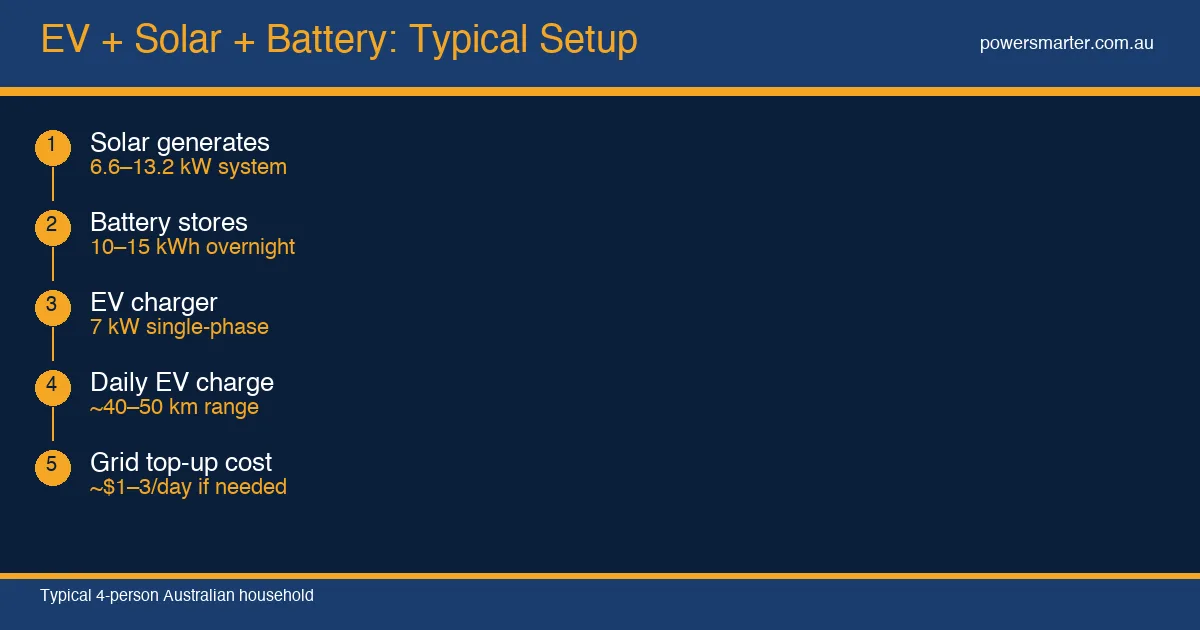
Solar charges the battery during the day. Battery charges the EV overnight. This adds a battery to the chain, which costs money but solves the timing problem — works even when you're not home during the day.
This approach has a key consideration: your battery needs to be large enough to handle both your overnight household load AND the EV charge. If your house uses 12 kWh overnight and your EV needs 8 kWh per charge, you need 20 kWh of battery storage — much larger than the standard 10–13.5 kWh systems most households install.
Solar + Battery System Sizing for EV Owners
Solar Panel Sizing
A good rule of thumb: add 2–3 kW of solar capacity for every EV charging from your system.
- Average household without EV: 6.6kW solar is typically adequate
- Same household with one EV (13,000 km/year): 10kW+ recommended
- Household with two EVs: 13.3–16.5kW recommended
More solar means more surplus to charge both the battery and the EV during daylight hours.
Battery Sizing
For EV-integrated setups, the calculus changes:
- EV owners who charge the EV directly from solar (daytime) and use the battery only for household overnight needs: standard 10kWh battery still works
- EV owners who want the battery to also supply EV charging: 20kWh+ is more appropriate — consider Tesla Powerwall 3 (13.5kWh, scalable), or BYD HVS stacked to 20.4kWh
Smart Charging Strategies
Solar Diversion Chargers
A solar diversion charger (also called a solar-optimised EV charger) detects excess solar generation in real-time and automatically adjusts the EV charge rate to match available surplus. Instead of charging your EV at a fixed rate that draws from both solar and grid, it dynamically throttles to match solar output.
Brands like Zappi, myEnergi, or ABB Terra AC with smart software support this. They're typically $1,500–$3,000 installed — worthwhile for EV owners with significant solar.
TOU Off-Peak Charging
For nights when the battery can't cover full EV charging demand, TOU off-peak rates (10pm–6am in many plans) can be 14–20c/kWh — half the daytime rate. Scheduling supplementary EV charging to off-peak hours minimises the grid charging cost when solar and battery aren't sufficient.
Battery Reservation Mode
Some battery systems (Tesla, sonnen, GoodWe) allow you to set a minimum state of charge reserved for household backup. This prevents the EV from drawing the battery below a threshold you've set — ensuring you retain overnight household coverage even on low-generation days.
Practical EV + Solar + Battery Scenarios
Scenario A: Work-From-Home EV Owner
EV is home most days, plugged in from 7am. Direct solar diversion charger (Zappi) tops it up during solar hours. Battery handles household overnight needs. No battery-to-EV needed.
Optimal setup: 10kW solar + 10kWh battery + Zappi charger
Estimated annual EV charging cost: Near-zero in summer, occasional off-peak grid charging in winter
Scenario B: Commuter with Long Hours Away
EV away from home 7am–7pm. Returns needing 30–40 km topped up. Solar can't charge EV directly. Battery needs to cover both household and some EV charging.
Optimal setup: 13.3kW solar + 20kWh battery (2 × BYD or Powerwall 3 stackable) + standard 7kW charger
Cost: Higher battery investment but dramatically reduced fuel/electricity costs vs petrol
The EV Battery Synergy: Why the Numbers Get Better
Adding an EV to a solar + battery household dramatically improves the financial case for both the solar and battery, because:
- The EV replaces petrol (at $2+/L) with solar electricity (effectively free) — typical annual petrol saving: $2,000–$3,500
- The larger solar system justified by EV charging also improves battery charging availability
- Combined payback on solar + battery + charger for an EV household is often faster than solar + battery alone
If you're planning to own or already own an EV, factor EV charging explicitly into your solar and battery sizing conversation. Most installers are familiar with the calculation — ask them to model it specifically for your driving pattern.
Comments (0)
No comments yet. Be the first to share your thoughts!