
EV Charger Types in Australia: Single-Phase vs Three-Phase
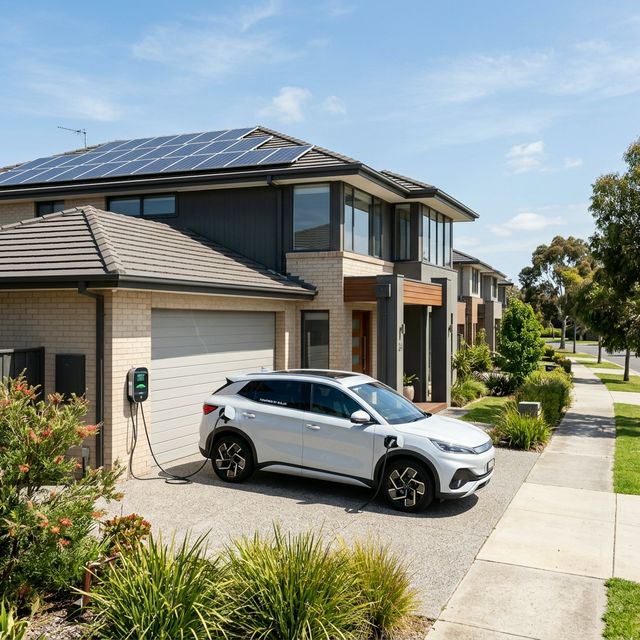
Choosing an EV charger for your home seems simple until you realise there are several different standards, speeds, and power configurations. Here's the practical guide to EV charger types in Australia — what the numbers mean and what you actually need.
How EV Charging Speed Works
EV charging speed is measured in kilowatts (kW). More kW = faster charging. The charging rate is limited by whichever is lower: your charger's rated power or your vehicle's onboard AC charging capability.
Common charging levels:
- Level 1 (3.6 kW): Standard single-phase 10A outlet with a Mode 2 cable. Available in every Australian home. Adds roughly 15–20 km/hour of range. Slow but fine for top-up charging.
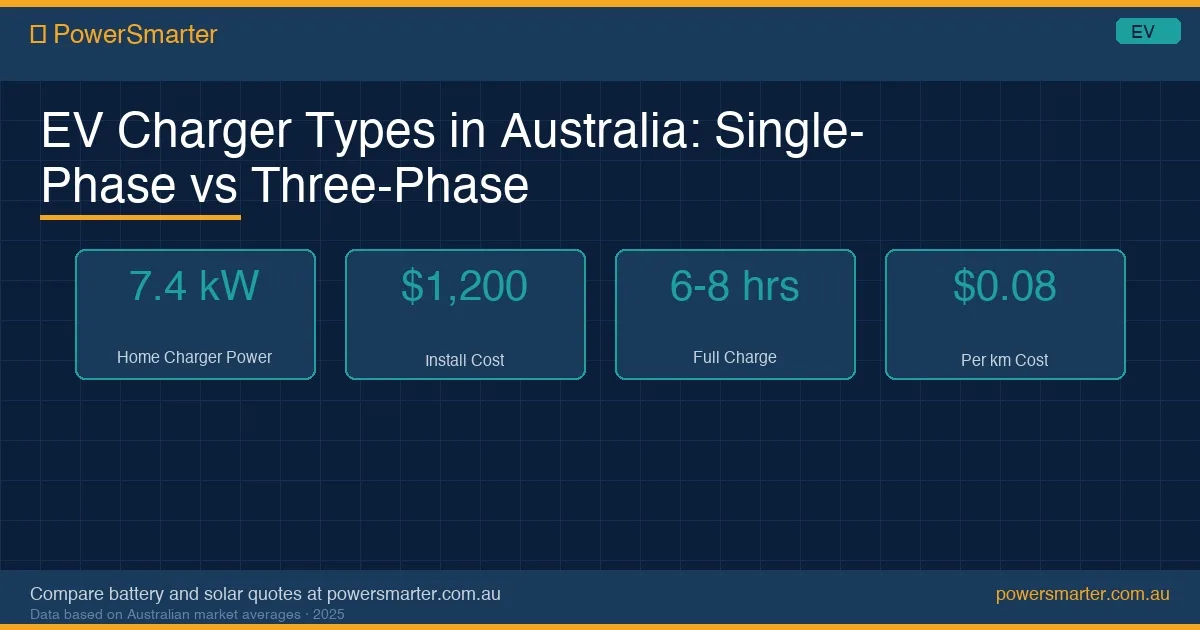
- Level 2 (7.4 kW): Single-phase 32A dedicated circuit. The standard home EV charger in Australia. Adds roughly 35–50 km/hour of range. Charges from empty to full in 6–12 hours.
- Level 2 (11–22 kW): Three-phase power. Adds 70–150 km/hour depending on vehicle capability. Useful if your vehicle supports three-phase charging and you have three-phase power at home.
- Level 3 DC Fast Charging: Not a home option — this is the 50–350 kW commercial fast charging at service stations. Not relevant for home installation.
Single-Phase vs Three-Phase: Which Do You Have?
Single-Phase Power
The most common residential connection in Australia. Limited to a maximum of approximately 7.4 kW at 32A for EV charging. For most daily driving (50 km/day average), a 7.4 kW charger overnight completely restores the battery in 1–3 hours — more than adequate.
Three-Phase Power
Available in some Australian homes (more common in newer or higher-spec properties). Three-phase connections support chargers of 11 kW (16A per phase) or 22 kW (32A per phase). If you have three-phase power and your EV supports three-phase charging (not all do — check your vehicle spec), you can use a faster charger.
How to Check
Look at your switchboard. Single-phase: one main circuit breaker at the top. Three-phase: three circuit breakers at the top, often labelled L1, L2, L3. If unsure, ask a licensed electrician or your DNSP.
Which Vehicles Charge at 11–22 kW?
Not all EVs support three-phase AC charging. As of 2026, Australian market examples:
- Three-phase supported (11 kW): Tesla Model Y/3 (11 kW with three-phase Wall Connector), Kia EV6 (11 kW), Hyundai Ioniq 5 (11 kW)
- Single-phase only (7.4 kW max): MG ZS EV, BYD Atto 3, Nissan Leaf (some variants)
- Check your vehicle spec: Look for "AC maximum charge rate" in the vehicle specifications
Popular EV Chargers in Australia
Tesla Wall Connector (Gen 3)
7.4 kW (single-phase) or 11 kW (three-phase). Integrates seamlessly with Tesla vehicles and the Tesla app. Works with other vehicles (Mode 3 cable required). Cost: ~$700–$900 installed.
Zappi (MyEnergi)
7.4 kW (single-phase) or 22 kW (three-phase) models. The best solar diversion functionality available — Eco mode and Eco+ mode adjust charging rate to match available solar surplus. Excellent for solar households. Cost: ~$1,200–$1,800 installed depending on model.
Wallbox Pulsar Plus
7.4 kW (single-phase) or 22 kW (three-phase). Smart scheduling, app control, solar integration. Popular choice for non-Tesla EV owners. Cost: ~$1,000–$1,500 installed.
Charge Point Home Flex
7.4 kW single-phase. Simple, reliable. Good app. Popular for households who want smart scheduling without the full solar diversion capability. Cost: ~$900–$1,300 installed.
Do You Need a Three-Phase Charger?
For most Australian households: no. A 7.4 kW single-phase charger is completely adequate for daily driving. The only reasons to invest in three-phase charging:
- You have three-phase power already
- Your vehicle supports 11+ kW charging
- You regularly need to fast-charge overnight (rare — most people overnight-charge from near-empty to full)
- You have two EVs that both need to be charged overnight on the same circuit
Solar Diversion: The Feature That Matters Most
If you have solar panels, the most valuable EV charger feature is solar diversion — the ability to match charging rate to available solar surplus. This effectively makes daytime EV charging free (using your own solar rather than grid power).
Zappi is the clear leader here. Tesla Wall Connector achieves similar functionality via the Tesla app if you have a Powerwall. Wallbox has developing solar integration capability.
Installation Requirements
All dedicated EV chargers in Australia require installation by a licensed electrician. Typical requirements:
- Dedicated 32A circuit from the switchboard to the charger location
- Suitable location (typically garage or carport)
- Earth leakage protection (RCBO typically)
Standard installation cost: $400–$900 depending on cable run length and switchboard condition.
Comments (0)
No comments yet. Be the first to share your thoughts!