
Solar Export Limits: Why They're Happening (and How Batteries Help)
More Australians than ever have solar. And more electricity distributors than ever are limiting how much of that solar you can export to the grid. If you've received a letter about export limits — or seen your solar monitoring showing "curtailed" generation — here's what's happening and what you can do about it.
What Are Solar Export Limits?
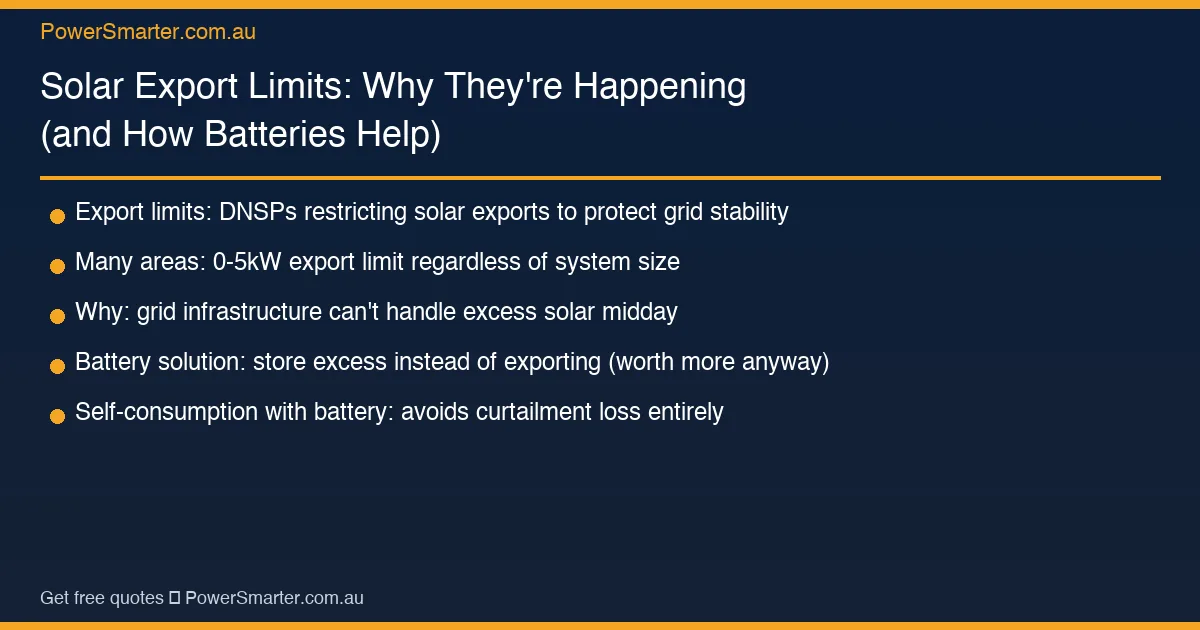
Your electricity distributor (DNSP — Distribution Network Service Provider) controls the local power lines that connect your home to the grid. They have the technical and regulatory authority to limit how much electricity you can export from your solar system.
Common limits in 2026: 5kW export in many suburban areas, regardless of your solar system size. Some areas have zero export approval for new systems.
Why Networks Are Doing This
The "solar surge" during midday hours has created real challenges for distribution networks:
- Too much solar flowing in one direction causes voltage rises that can damage appliances and network equipment
- Network infrastructure was built for one-way power flow (from generators to homes), not bidirectional
- At peak solar times (10am–2pm), some suburban feeders are overwhelmed with residential exports
Upgrading network infrastructure to handle unlimited solar export would cost billions — costs that ultimately flow back to electricity bills for all customers.
The Impact on Solar Owners
If you have a 10kW solar system but a 5kW export limit, you're losing the generation above 5kW during peak hours. On a good summer day, that could be 3–5kWh of generation that's curtailed — wasted, as your inverter is forced to reduce output.
At 3–5 cents/kWh FiT, this wasted export isn't worth much anyway. But the principle still matters.
How Batteries Solve This
A home battery converts the export limit problem into an opportunity:
- Solar generates during the day
- Battery absorbs excess before it would hit the export limit
- Battery dispatches stored energy in the evening at your full retail rate (30–40c/kWh)
- Net result: you capture generation that would otherwise be curtailed — and you capture it at retail rate, not FiT rate
A 10kWh battery easily absorbs the 3–5kWh daily curtailment gap on a 10kW system with a 5kW limit — and stores it for evening dispatch at full retail value.
The Regulatory Direction
Export limits are expanding, not contracting. AEMO's Distributed Energy Integration Plan and DNSP planning documents consistently point toward smarter export management — including dynamic export limits (real-time curtailment based on network conditions) becoming more common from 2026 onward.
Households with batteries are generally positioned better in this environment: network operators prefer battery-equipped homes because the battery helps manage local voltage, potentially qualifying for higher export allowances.
What to Do
If you have solar without a battery and have been notified of export limits: add storage. The combination captures curtailed generation at retail value, avoids the FiT undervaluation, and positions your home as an active grid participant rather than a passive exporter.
Comments (0)
No comments yet. Be the first to share your thoughts!