
Grid-Scale vs Home Batteries: What's the Difference?
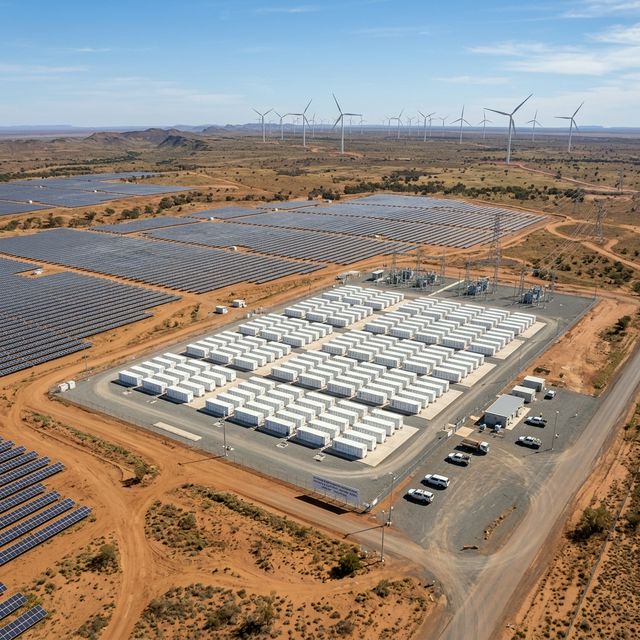
You've seen the headlines about big battery projects — the Hornsdale Power Reserve in SA, the Waratah Super Battery in NSW, the big Queensland projects. And you're thinking about a battery on your house. Are these the same thing, just different sizes? Here's the actual relationship between grid-scale storage and home batteries.
Grid-Scale Batteries: What They Are
Grid-scale battery energy storage systems (BESS) are utility-owned or commercially operated storage systems designed to serve the electricity network at scale. We're talking:
- Hornsdale Power Reserve (SA): 193.5 MW / 256.5 MWh
- Waratah Super Battery (NSW): 850 MW / 1,680 MWh
- Various projects across QLD, VIC, WA
These systems are typically Tesla Megapacks, BYD BESS systems, or similar at massive scale. They sit at transmission or distribution network connection points and provide services like frequency regulation, emergency reserves, and load shifting at a grid level.
Home Batteries: What They Are
A home battery is typically 5–20 kWh — roughly 1/10,000th the size of a grid-scale project. It's owned by the household, installed behind the meter, and primarily serves that household's own load-shifting and self-consumption needs.
Same core technology (lithium batteries, inverters, battery management systems) — but wildly different scale, purpose, and business model.
Do They Compete or Complement?
They're complementary, not competing. Grid-scale storage operates at the transmission level — managing large-scale frequency events and providing bulk storage services to the wholesale market. Home batteries operate at the distribution level — managing individual household consumption patterns, reducing peak demand on local networks, and through VPPs, providing aggregated demand response.
A home battery enrolled in a VPP is effectively providing a tiny piece of the same grid service as a grid-scale battery — but doing it through an aggregated fleet of tens of thousands of households. This is actually more flexible and distributed than relying on a single large installation.
Why Grid-Scale Batteries Have Reduced Wholesale Price Volatility
Grid-scale batteries respond to price signals in real time. When wholesale prices spike (during peak demand events), they discharge. This suppresses extreme price peaks. From a consumer perspective, this is generally good — it smooths the most extreme wholesale market volatility.
However, it also means the most dramatic arbitrage opportunities in wholesale prices are being captured by grid-scale players. The electricity market is becoming less volatile at the wholesale level (partly due to storage), even as retail prices remain high.
How This Affects Home Battery Economics
A common question: as grid-scale storage expands and smooths wholesale prices, will home batteries still be worth it?
The short answer: yes, for several reasons:
- Retail electricity prices are driven by network costs and retailer margins, not just wholesale generation costs. Grid-scale storage mainly impacts the wholesale component.
- Feed-in tariffs are declining regardless of grid-scale storage — the self-consumption value of home batteries is not affected by what happens at the wholesale level.
- The value of backup power (resilience) is independent of wholesale market dynamics entirely.
- VPP programs give home batteries access to grid service payments — participating in the same value streams as grid-scale storage, just aggregated.
The Distributed Vision
AEMO and most energy policy analysts see the future as a combination of large-scale storage (for bulk network needs) and distributed storage (home batteries providing flexible demand response at the local level). These aren't alternatives — they're different tools for different network challenges.
Home batteries, through VPPs, are becoming genuine grid assets, not just household appliances. The 3.6 million solar installations in Australia represent a distributed generation asset that the grid increasingly depends on. Adding storage to even a fraction of those transforms the flexibility of the energy system in ways that grid-scale projects alone can't replicate.
Comments (0)
No comments yet. Be the first to share your thoughts!