
With Fuel Supply Chains Under Pressure, Here's Why Australians Are Reconsidering Home Batteries
Somewhere over the past fortnight, the conversation about home batteries changed.
It used to be about payback periods and feed-in tariffs. People ran spreadsheets, debated whether a 10-year return justified the upfront cost, and checked if their solar feed-in rate had dropped again.
That's still the calculation — but now there's another one sitting next to it. Australia's fuel security is under genuine stress for the first time since most people can remember, and that changes the framing of what a home battery is actually for.
What's Actually Happening Right Now
The 2026 Strait of Hormuz crisis — triggered by escalating Middle East conflict — has blocked one of the world's most critical chokepoints for oil and gas. Around 20% of global oil supply has historically moved through that strait. Right now, it's effectively closed.
The immediate consequences for Australia are playing out in real time. Energy Minister Chris Bowen confirmed this week that 3.4% of service stations across the country have already run out of diesel. He also said fuel supply has been secured "into May" — which, if you think about that sentence for a moment, is not especially reassuring.
Australia currently holds about 39 days' worth of petrol reserves, 29 days' worth of diesel, and 30 days' worth of jet fuel. That's better than the nine days of liquid fuel reserves we held as recently as 2021 — the government quietly built those up — but it's still a finite buffer if the strait stays blocked.
Japan, South Korea, and Singapore have all given assurances that supply will continue at normal levels. Japan's Prime Minister Sanae Takaichi is reportedly planning a visit to Australia specifically to address the energy situation. The government has activated what PM Albanese described as a "triple-intervention" strategy to manage prices and supply. More than 50 fuel shipments are reportedly on their way to Australian import terminals.
So the acute crisis may be manageable. But the underlying vulnerability — that Australia refines almost no liquid fuel domestically and depends almost entirely on imports — hasn't gone anywhere.
What This Has to Do With Your Home Battery
On one level, nothing. Home batteries run on electricity, not diesel. If you're sitting in a blackout, your battery doesn't care what's happening to Brent crude.
But zoom out a little and the connections are real.
The fuel supply crunch is flowing into the electricity grid. Diesel is a backup fuel for peakers — the generators that switch on when grid demand spikes and renewables aren't covering it. Tighter diesel supply and higher prices put upward pressure on wholesale electricity costs. That feeds into your bill.
There's also the supply chain effect. Diesel powers the trucks that move food, the waste collection vehicles that local councils are currently scrambling to keep running, and the farm equipment that harvests food. Associate Professor Devika Kannan from Adelaide University has warned of potential food price rises of up to 50% if the supply chain disruption continues. That's an extreme scenario — but it illustrates how deep the dependencies run.
And then there are the grid outages. Extreme weather events — heatwaves, storms — are already straining the network. Add fuel supply volatility to the mix, and the grid's resilience looks less certain than it did a year ago.
What Solar + Battery Actually Protects You From
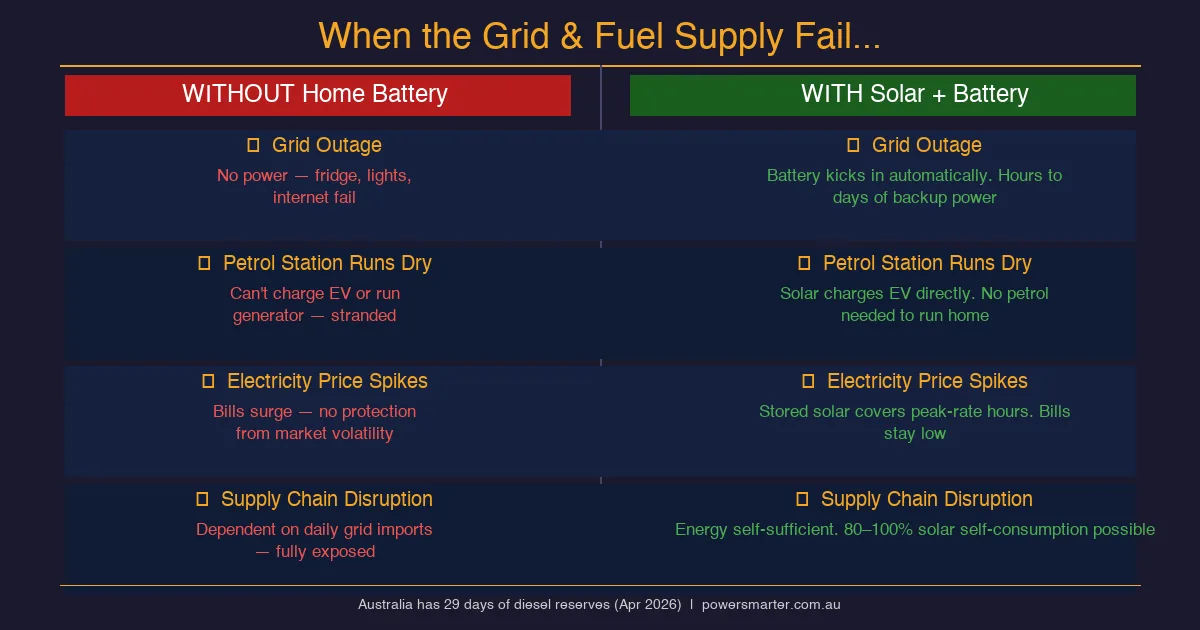
A home battery and solar system doesn't make you completely independent — most Australians with solar+battery still use the grid for overnight top-up and export excess power. But it does give you a meaningful buffer across a few different failure modes:
Grid outage: A battery with blackout protection (not all have it — check before you buy) switches to island mode automatically when the grid goes down. Depending on your battery size and consumption, you could run critical loads for a day or more without interruption.
Price spikes: When wholesale electricity costs surge — which they have been doing throughout 2026 — storing your own solar and drawing from it during peak-rate hours insulates you from the volatility. You're not buying from the grid at 3pm when everyone else is scrambling.
EV charging: If you drive an EV, your car is essentially a moving diesel replacement. In a scenario where petrol stations are running low, being able to charge from home solar — without needing fuel — is a genuine advantage. Some newer battery systems can also use your EV's battery for home backup, though the hardware for that is still rolling out.
Extended disruption: Most outages are hours, not days. But if fuel supply chains were disrupted for weeks rather than days, the households with energy storage would be in a very different position to those relying entirely on grid imports.
Is This Alarmist?
Probably worth asking.
Australia is not about to go dark. The government has been active, diplomatic relationships are holding, and multiple shipments are en route. The energy minister saying supply is secured "into May" is, to be fair, a statement about near-term certainty — not a warning that supply stops in May.
But the crisis has done something useful: it's made the concept of energy vulnerability legible to ordinary Australians in a way that technical arguments about grid resilience never quite managed. When petrol stations are running out of diesel and the news is running a segment titled "Five ways the fuel crisis is about to hit home," people pay attention.
The Australian Strategic Policy Institute has been flagging our liquid fuel vulnerability for years. The 2021 Parliamentary inquiry found Australia had less than two weeks of usable fuel reserves in the country at any point. Some of that has been addressed. A lot of it hasn't.
The Shift in How People Are Thinking About Batteries
What's changed, anecdotally at least, is that the conversation has moved from "is a battery worth it on the numbers?" to "what does energy independence actually mean for my household?"
Those are different questions with different answers. The first one is about ROI. The second is about risk tolerance and optionality.
A home battery system — even a modest 10 kWh unit — gives you options. You can ride out a short outage. You can avoid peak-rate electricity on volatile days. You can charge your car from your own roof. You're not entirely at the mercy of what happens at a chokepoint on the other side of the world.
Whether that's worth the upfront investment is still a personal calculation. Battery prices have fallen significantly — a quality 10 kWh system with installation now sits somewhere in the $10,000–$13,000 range before the federal rebate, which currently knocks around $3,100 off that. The economics are reasonable for high-consumption households.
But the value of resilience — the non-financial kind — is harder to quantify and easier to dismiss when everything is working fine. The last two weeks have made that a less abstract concept for a lot of Australians.
What to Look For If You're Considering a Battery Now
A few things worth checking before you sign anything:
- Blackout protection: Not every battery system includes it. Some require an additional switchboard upgrade. Ask specifically whether the battery will keep your home running if the grid drops.
- Battery size vs your consumption: Rule of thumb — a 10 kWh battery covers roughly 20–24 hours of essential load (fridge, lights, phone charging, some fans). More if you're careful; less if you run air con.
- VPP eligibility: Under the CHBP, your battery must be VPP-capable. Joining one is optional — but it can earn you credits for sharing stored energy to the grid during high-demand events.
- The federal rebate: Before 1 May, the rebate is at its highest for the year — around $311/kWh. After May 1, it drops to $244/kWh and moves to a tiered structure that disadvantages larger systems. If you're already close to deciding, timing matters.
The resilience argument for home batteries has always existed. Right now, it's just impossible to ignore.
Comments (0)
No comments yet. Be the first to share your thoughts!