
What Size Battery Does Your Home Actually Need? (It's Probably Not What You Think)
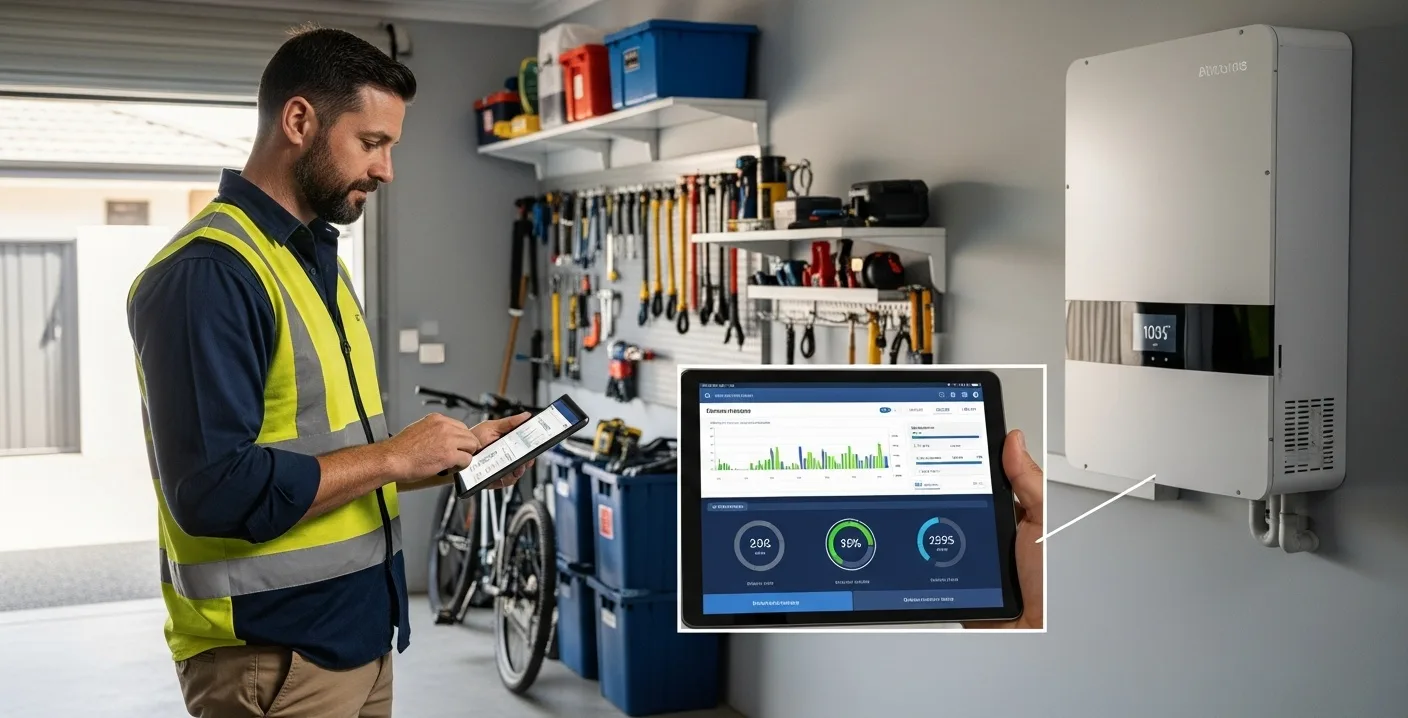
I've noticed that a lot of people default to "bigger is better" when thinking about home batteries. The reasoning makes sense intuitively — more storage, more backup, more self-sufficiency. But a battery that's too large for your solar system and usage patterns is a battery that's chronically undercharged, which isn't great for the economics or the long-term battery health.
On the flip side, too small and you run out of stored power by 10pm every night and still draw heavily from the grid.
So let's actually work this out.
Start With Your Night-Time Usage
The most useful number to find is how much electricity your household consumes between 6pm and 7am — roughly speaking, the window when your solar system isn't generating anything.
You can usually find this in your electricity retailer's app or portal, or on your bill (some bills break down time-of-use consumption if you're on a time-of-use tariff). If you're on a flat tariff, you might need to request interval data from your retailer.
As a rough guide for Australian homes:
- Small household (1–2 people): 5–8 kWh per night
- Average household (3–4 people): 8–14 kWh per night
- Larger household or heavy AC users: 14–20+ kWh per night
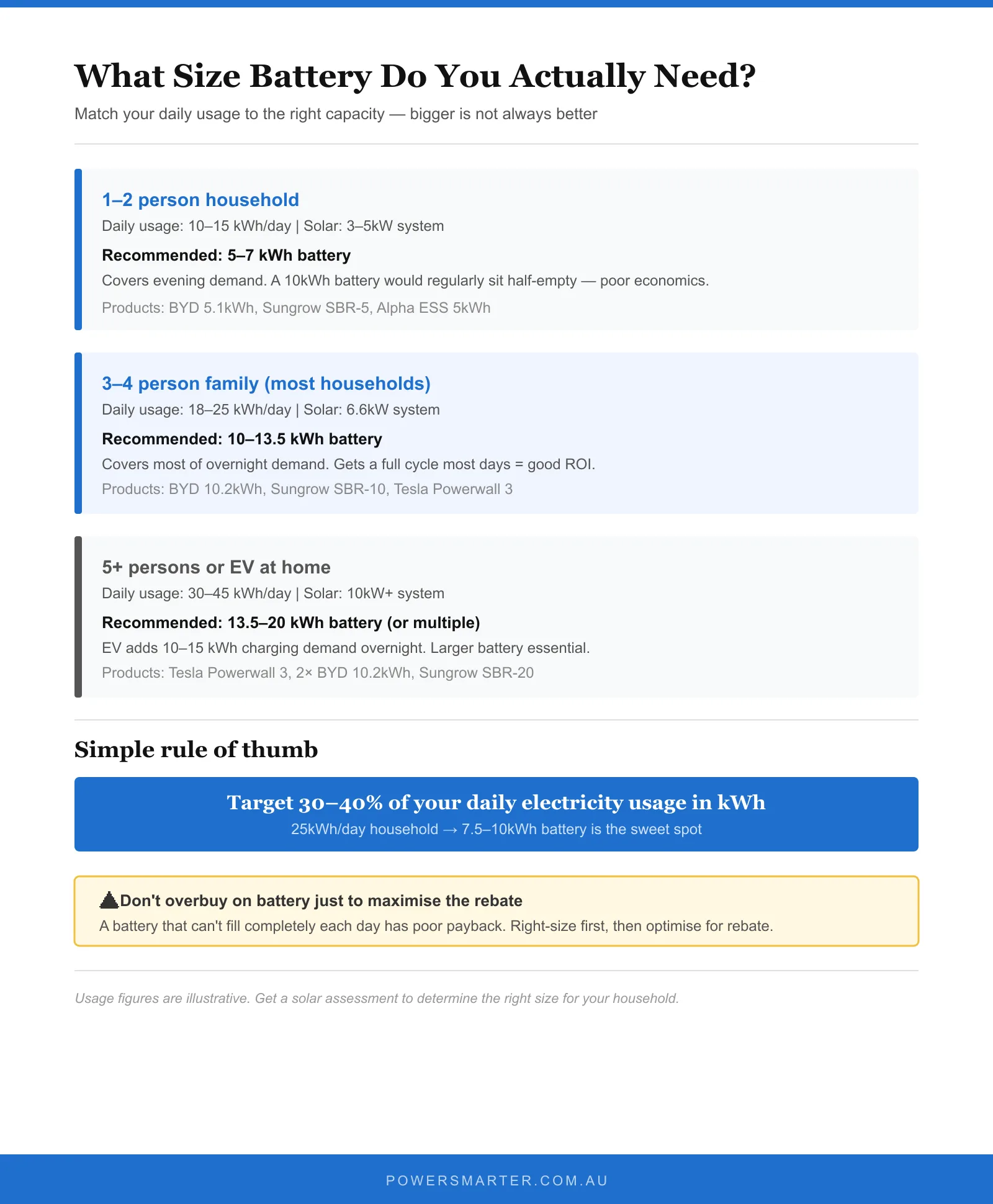
A battery needs to cover a meaningful portion of that overnight demand. You don't necessarily need to cover 100% of it — that gets expensive — but covering 60–80% is a reasonable target.
Factor In What Your Solar Actually Generates
A battery can only store what your solar produces. This sounds obvious but gets overlooked.
If your solar system generates 20 kWh on a good day but your battery is only 5 kWh, the battery fills up by mid-morning and you're back to exporting the rest for 4 cents a unit. Good for the grid, not great for your finances.
The general rule of thumb is that your battery capacity should be roughly 1–1.5x your solar system's rated output in kW. So a 6.6kW solar system pairs well with a 7–10kWh battery.
But this is a rule of thumb, not a law. In winter, a 6.6kW system in Melbourne might only generate 10–15 kWh per day (on a sunny day). In summer, it might generate 30+. Your battery needs to be useful year-round, not just in optimal conditions.
A Practical Sizing Example
Let's say you're a household of four in Brisbane:
- Night-time usage: about 12 kWh
- Solar system: 6.6kW (generating roughly 28 kWh/day average)
- Target: cover 70% of overnight usage from stored solar
You'd want around 8–10 kWh of battery capacity. A 10kWh battery would get you close to 100% coverage on most nights, with a bit of buffer.
A 13.5kWh Powerwall would cover you entirely and give you some reserve — worth considering if you're also thinking about backup during outages, or if you have high usage from an EV charger or pool pump.
A 5kWh battery would cover about half your nights and leave you drawing 6+ kWh from the grid overnight. It's not useless — it's cheaper and the CHBP still applies — but you'd want to be clear that you're not aiming for self-sufficiency.
What About Backup Power?
If blackout protection is part of why you want a battery, that changes the sizing conversation.
A 10kWh battery running essential circuits (fridge, a few lights, phone charging, maybe a router) can last 12–24 hours during an outage. That's enough for typical blackouts. If you want to run air conditioning through a blackout or support a home office for multiple days, you'd be looking at 15–20kWh or more — and not every battery supports whole-home backup.
Tesla Powerwall 3 and certain other models have full backup capability built in. Others only do partial backup or require additional hardware. Check this specifically before purchase.
The Budget Reality Check
Here's where most sizing decisions actually get made: what can you afford?
With CHBP and state rebates in play, the effective cost difference between a 10kWh and 13.5kWh system might be $2,000–$4,000 after all incentives are applied. For some people that's fine; for others it's a stretch.
If budget is tight: don't sacrifice quality for size. A 10kWh battery from a reputable brand with a solid warranty beats a 15kWh battery from an unknown manufacturer with sketchy after-sales support.
If budget is flexible: err on the side of slightly larger, particularly if you're planning to add an EV in the next few years. Charging an EV overnight dramatically increases your energy demand, and a battery you size today may not be sufficient in two years.
Quick Sizing Reference
| Household | Typical Night Usage | Suggested Battery Size |
|---|---|---|
| 1–2 people, small home | 4–7 kWh | 5–7 kWh |
| 3–4 people, average home | 8–13 kWh | 10–13.5 kWh |
| Large family, heavy usage | 14–20 kWh | 13.5–20 kWh |
| EV charger planned | Add 8–15 kWh to above | Size up significantly |
These are starting points. A good installer will analyse your actual consumption data before recommending a specific system — and you should expect them to.
Got questions about home batteries or solar? Use our free quote comparison tool to get matched with accredited local installers — no spam, no sales calls unless you want them.
Comments (0)
No comments yet. Be the first to share your thoughts!