
Top 5 Reasons Australians Are Buying Home Batteries in 2025–26
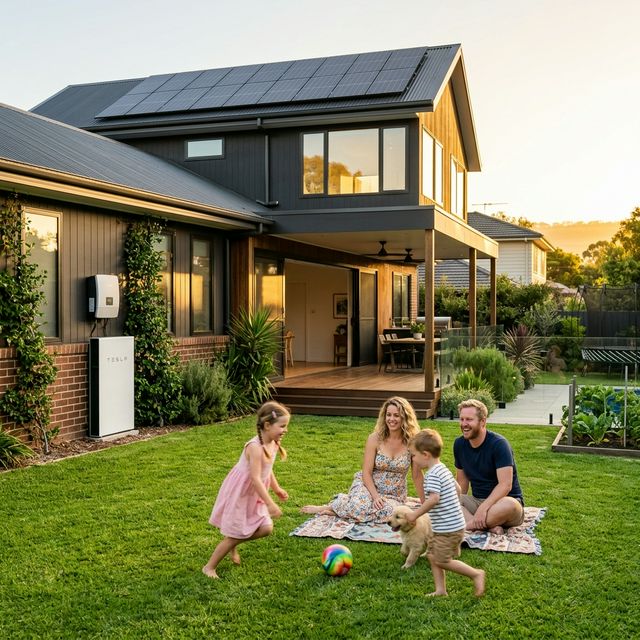
Home battery installation in Australia has surged in 2025–26. The CHBP rollout accelerated the market, but it's not the only driver. Here's what's actually pushing Australians over the line — and the data behind each reason.
1. The Federal Rebate Has Made the Maths Work
Before the Commonwealth Home Battery Program launched in July 2025, home battery economics were real but required patience. The typical payback period without rebates was 8–12 years — cutting close to or beyond the 10-year warranty window.
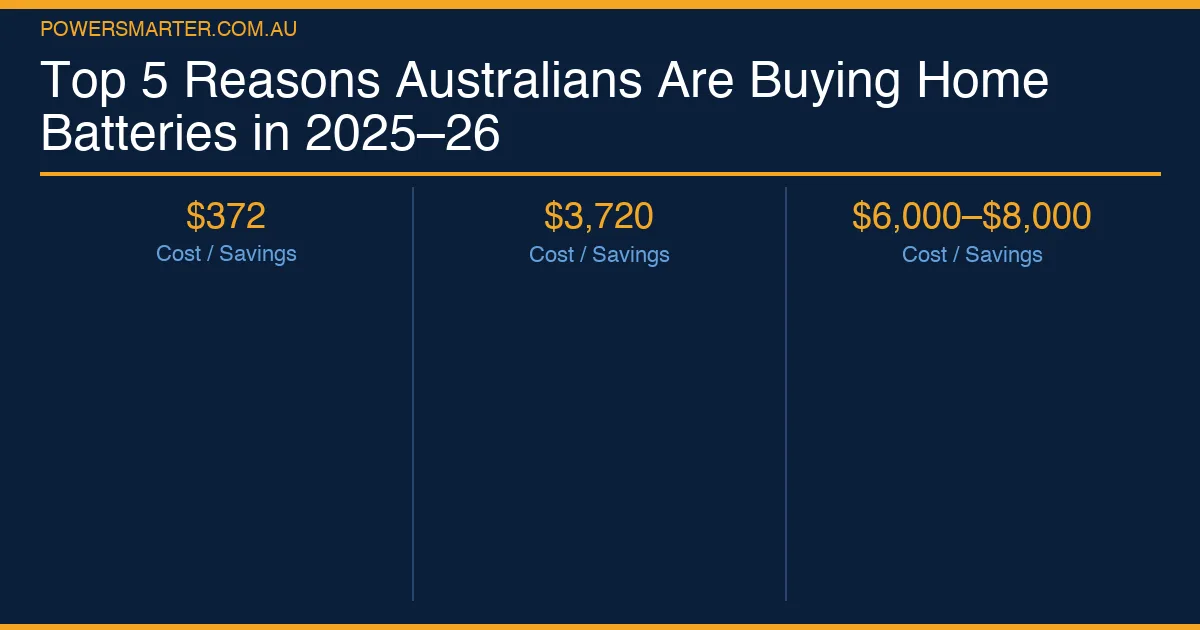
The CHBP changed that. At $372/kWh for the first 50 kWh of usable capacity, a 10 kWh battery comes with $3,720 off the price instantly. Stack a state rebate in VIC or QLD, and net cost can fall by $6,000–$8,000. Payback periods that were once 10+ years are now 4–7 years in many scenarios.
When the financial case becomes compelling rather than marginal, people act. This is the single biggest driver of the 2025–26 surge.
2. Electricity Prices Have Risen Sharply — and Show No Sign of Stopping
Australian electricity prices have climbed consistently since 2022. The average residential rate nationally now sits well above 30 cents/kWh in most states, with South Australia regularly above 40 cents. Every time your electricity rate increases, the value of every kWh your battery stores goes up.
This creates a compounding benefit: a battery that saves you $1,000/year at today's rates saves proportionally more if electricity prices rise by 10% in two years. Homeowners who understand this dynamic see the battery as a long-term hedge against energy price inflation — not just a short-term savings tool.
Feed-in tariffs, meanwhile, have been falling. The premium you receive for exporting solar has dropped from meaningful (20+ cents/kWh in some states a decade ago) to marginal (2–8 cents/kWh in most cases today). This widens the spread that a battery captures, making self-consumption increasingly attractive.
3. Blackout Anxiety Is Real — Especially After Weather Events
Australia's experience with extreme weather events — bushfires, cyclones, storms — has made power reliability a tangible concern for millions of households. A battery with whole-home backup capability keeps the lights on, the fridge running, and phones charged when the grid fails.
This isn't purely financial logic. For households with elderly residents, medical equipment, or remote properties, backup power has a safety dimension that transcends ROI calculations. And for most households, the peace of mind of knowing you have 10–14 hours of backup power has genuine value.
Brands like Tesla that include automatic Storm Watch mode — pre-charging the battery before forecast severe weather — have found this feature resonates strongly with Australian buyers.
4. VPP Income: Getting Paid for Your Battery
Virtual Power Plant programs have matured significantly. Programs from AGL, Origin, Tesla Energy, and several others pay battery owners for providing network support — essentially, you're getting paid to let the network operator briefly draw on your battery during peak grid demand.
The income varies by program (typically $200–$800/year for an active VPP participant), and participation requirements differ. But it adds a genuine additional revenue stream on top of self-consumption savings. For some homeowners, VPP income alone covers a significant portion of their battery repayment if they've financed the installation.
5. Energy Independence: A Philosophical Driver That's Become Practical
There's a subset of Australians for whom the motivation isn't primarily financial — it's about control. The desire to not be dependent on energy retailers, network operators, and their pricing decisions. To generate your own power, store your own power, and use it when you want.
This motivation has always existed, but it's become more mainstream as the technology has become more accessible and the political environment around energy pricing has become more fraught. Add the fact that a well-designed solar + battery system can meaningfully reduce grid dependence (not eliminate it entirely, but reduce it to 10–20% of previous consumption), and the independence argument has practical backing.
The Common Thread
What unites all five drivers is that they've converged at the same time. The rebate improved the finances. Rising prices increased the savings. Extreme weather highlighted the backup value. VPP programs added income. And energy independence became attainable rather than utopian.
For many Australian homeowners, 2025–26 is simply the year where enough boxes ticked at once. That's a real shift — and the installation numbers reflect it.
Comments (0)
No comments yet. Be the first to share your thoughts!