
Strata Bylaws & Solar/Battery Installations: Quick Guide
Strata Solar and Batteries: It Can Be Done
If you own a unit, apartment, or townhouse in a strata scheme and you're thinking about solar panels or battery storage, the first thing to know is: it's not impossible. The second thing is: it's more complicated than installing on a freestanding house, and the process varies meaningfully between states.
This guide covers the general framework. Strata law is state-specific, so anything here that touches on specific rules needs to be verified against your own state's strata legislation and, ideally, with a strata lawyer or manager who knows your jurisdiction.
The Core Issue: Common Property vs Lot Property
In a strata scheme, property is divided into lot property (what you own individually — your unit) and common property (shared areas like rooftops, external walls, gardens, corridors). The rules around what you can do unilaterally are very different for each.
Solar panels typically go on the roof — which is almost always common property. A battery inside your unit (in a garage or storage room that's part of your lot) is a different situation. So the installation type determines the approval pathway.
Getting Approval: The General Process
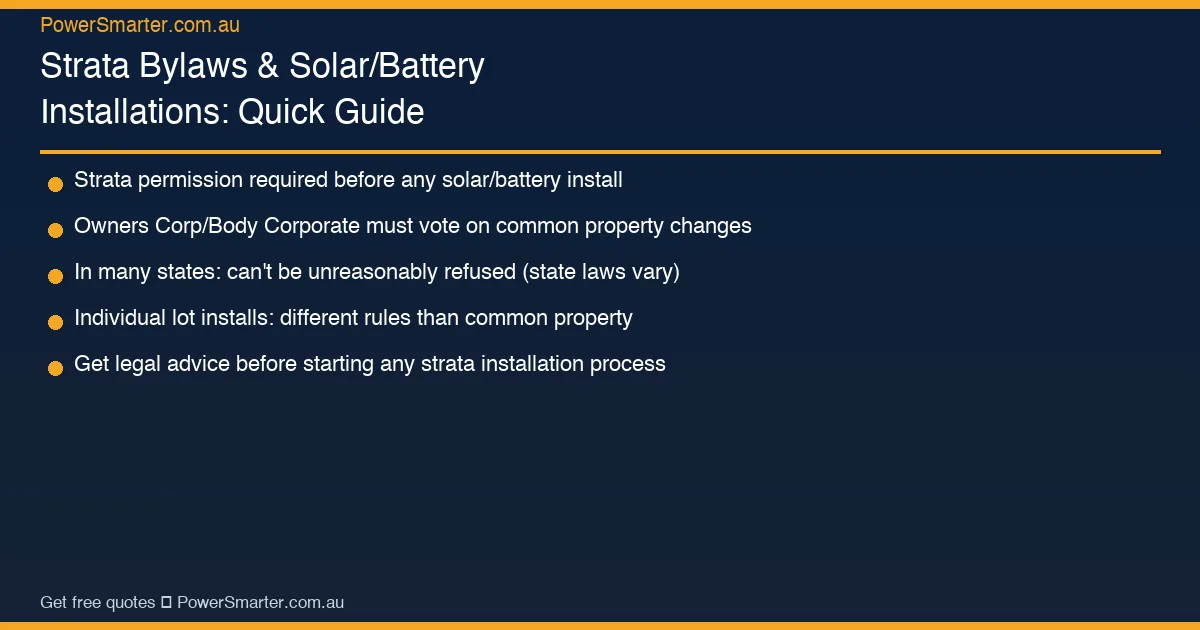
For common property installations (roof solar, external batteries), you'll need a resolution from the Owners Corporation or Body Corporate. The voting threshold varies: in most states, installations that benefit individual owners require a special resolution (75% in favour) rather than an ordinary resolution (simple majority). Some states have relaxed this for sustainability improvements.
The general process:
- Review your strata's existing bylaws for any relevant provisions (some strata schemes have already updated bylaws to specifically permit or address sustainability installations)
- Check your state's strata legislation for the specific voting requirements and any "cannot be unreasonably refused" provisions
- Submit a formal application to the Owners Corporation with your proposed installation plan, installer details, and any evidence of compliance with relevant standards
- The committee typically has 30–60 days to respond
- If approved, proceed with installation using the specific scope of works approved
State-by-State Differences
NSW: The Strata Schemes Management Act 2015 includes provisions around additions to common property. Amendments that improve environmental sustainability can sometimes proceed with an ordinary resolution rather than special resolution. Get specific legal advice.
VIC: The Owners Corporations Act 2006 and its subsequent amendments affect the threshold for approvals. Victoria has been increasingly progressive on sustainability-related strata provisions — worth checking recent amendments.
QLD: Body Corporate and Community Management Act 1997 governs the process. Queensland has specific provisions around body corporate response times for improvement applications.
SA, WA, TAS, ACT, NT: Each has its own legislation. The principles are similar but the specifics vary. In all cases, start with the strata manager for initial guidance, then get legal advice if you're hitting resistance.
When You Don't Need Common Property Approval
If you're installing a battery inside your lot (inside your unit's garage or storage space), you're dealing with your own property. You don't need Owners Corporation approval for changes to lot property, subject to any relevant bylaws your scheme has adopted.
Check your scheme's bylaws — some schemes have blanket appearance or modification bylaws that could be interpreted to require approval for anything on lot property that has external visibility. A battery in an enclosed garage is typically fine; a battery on an external-facing part of your lot (like a courtyard wall visible to common areas) might be treated differently.
Navigating Unreasonable Refusal
In several Australian states, legislation provides that an Owners Corporation cannot unreasonably refuse a request to make certain types of improvements. What counts as "unreasonable" is determined on a case-by-case basis, but a blanket "we don't do that here" response to a well-documented, standards-compliant solar or battery installation proposal is likely to be challengeable.
If your proposal is refused and you believe the refusal is unreasonable, you can generally apply to your state's strata disputes tribunal for a review. In NSW this is NCAT; in VIC it's VCAT; in QLD it's the Commissioner for Body Corporate and Community Management.
Practical Tips
Come prepared. A professionally documented proposal — including installer accreditation, equipment specifications, safety standards compliance (AS/NZS 5139 for batteries, relevant wiring standards), and a clear scope of works — is much more likely to succeed than a casual request.
Consider the other owners' perspective. Common concerns include structural impacts, aesthetics, insurance implications, and what happens if the installation is later removed. Addressing these proactively in your proposal reduces objections.
Talk to your strata manager early. Even informally, they can tell you what the committee's general attitude is, whether similar requests have succeeded before, and what information they'll want to see in a formal application.
If you're buying into a strata property specifically because you want to install solar or batteries, do this research before you buy. Vendor disclosure documents and strata reports will tell you about existing bylaws, and you can ask direct questions about past approval decisions.
Comments (0)
No comments yet. Be the first to share your thoughts!