
Solar Battery for a 3-Bedroom Home: Size & Cost to Expect
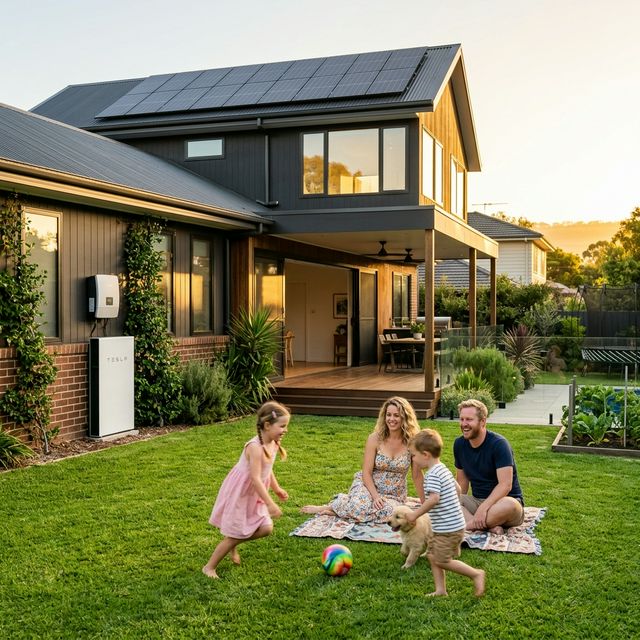
A three-bedroom home is probably the single most common household type in Australia — so if you're trying to figure out what size battery you need and what it'll cost, you're asking the right question for the median Aussie property. Here's the real picture.
Typical Energy Profile: What a 3-Bedroom Home Uses
Australian three-bedroom homes typically consume between 15–25 kWh per day, depending on occupancy, climate, appliances, and whether there's a pool or EV charger.
A rough breakdown by situation:
- 2 adults, no children, moderate usage: 12–18 kWh/day
- Family of four, typical appliances: 18–25 kWh/day
- Family of four with pool and/or EV: 25–40 kWh/day
For battery sizing, what matters is the overnight and morning portion of consumption — the times when solar isn't generating. For a typical 3-bedroom household, this is roughly 8–14 kWh.
What Size Battery Is Right?
The Common Recommendation: 10–13.5 kWh
For most three-bedroom households with a 6.6 kW solar system, a 10–13.5 kWh battery is the practical sweet spot. It's enough to cover most of the evening and overnight consumption without over-speccing the system.
Popular options in this range:
- Tesla Powerwall 3: 13.5 kWh — covers almost all overnight consumption for most 3BR households
- Sungrow SBR: 9.6 or 12.8 kWh depending on module configuration
- BYD Battery-Box HVM: 8.28–11.04 kWh (4 modules)
- Alpha ESS SMILE-B3 Plus: 11.4 kWh
Going Smaller: 5–7 kWh
If budget is the primary constraint, a smaller battery still delivers real value. A 5–7 kWh battery will cover most of the evening peak hours (3pm–9pm), even if it doesn't fully cover overnight consumption. You'll still import some power, but significantly less. For households on TOU plans, the peak-hour savings alone can deliver reasonable ROI.
Going Larger: 15–20 kWh
For households with an EV charger, pool, or ducted air conditioning running overnight, sizing up to 15–20 kWh may be justified. The economics need careful modelling — a larger battery costs proportionally more and may not deliver proportionally more savings if you don't actually need the extra capacity every night.
Solar System Sizing: Don't Skimp Here
A battery only earns its keep if it's being consistently charged by solar. For a 10 kWh battery in a 3-bedroom home:
- Minimum recommended solar: 6.6 kW (16–18 panels)
- Better for year-round reliability: 8–10 kW (20–25 panels)
If you're installing new, go as large as your roof and network connection allow. More solar charges the battery faster, leaves less surplus to export at low FiT rates, and improves your overall self-sufficiency.
What Will It Cost?
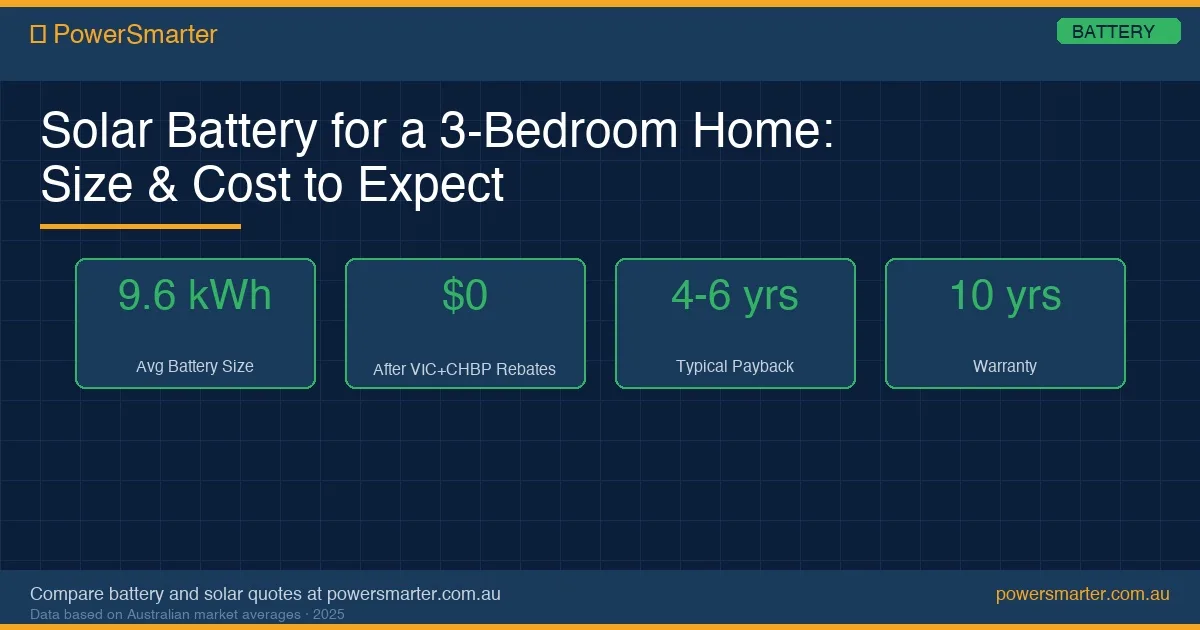
Installed costs for a solar + battery system for a typical 3-bedroom home in March 2026, after CHBP rebate:
| Configuration | Pre-Rebate Cost | CHBP Rebate | Net Cost |
|---|---|---|---|
| 6.6kW solar + 10kWh battery | $18,000–$24,000 | $3,720 | $14,280–$20,280 |
| 6.6kW solar + Powerwall 3 (13.5kWh) | $22,000–$28,000 | $5,022 | $16,978–$22,978 |
| Battery only (adding to existing solar, 10kWh) | $11,000–$14,000 | $3,720 | $7,280–$10,280 |
| Battery only (Powerwall 3, retrofit) | $14,000–$18,000 | $5,022 | $8,978–$12,978 |
These are indicative ranges. Actual quotes will vary by state, installer, and property-specific factors (roof type, switchboard condition, single vs three-phase, distance from switchboard).
Expected Savings
For a typical 3-bedroom household with a 10 kWh battery:
- Electricity bill reduction: $1,000–$1,800/year depending on tariff and usage pattern
- Payback period with CHBP (battery retrofit): 5–9 years
- Payback with CHBP + state rebate (VIC/QLD): 3–6 years
The Bottom Line
A 3-bedroom home is well-suited to a home battery. The size sweet spot is 10–13.5 kWh, with 6.6 kW of solar minimum. Post-CHBP, the economics are meaningfully better than they were two years ago. The financial year ends June 30 — getting installed before then keeps your options open on financial year rebate timing.
Comments (0)
No comments yet. Be the first to share your thoughts!