
Powerwall 3 vs Sungrow SBR: Mid-Premium Battery Comparison
The Battle at the $15,000 Mark
There's a particular price point in the Australian battery market where things get interesting. Below about $10,000 after rebates, you're in BYD and Alpha ESS territory — solid products, no complaints. Above $20,000, you're looking at premium configurations with multiple battery units or whole-home backup setups. But right in the middle, the $12,000–$18,000 range after CHBP, Tesla Powerwall 3 and Sungrow SBR go head to head for a lot of homeowners.
They're genuinely different products in some important ways, and the choice between them often comes down to what you value most.
What You're Getting with Powerwall 3
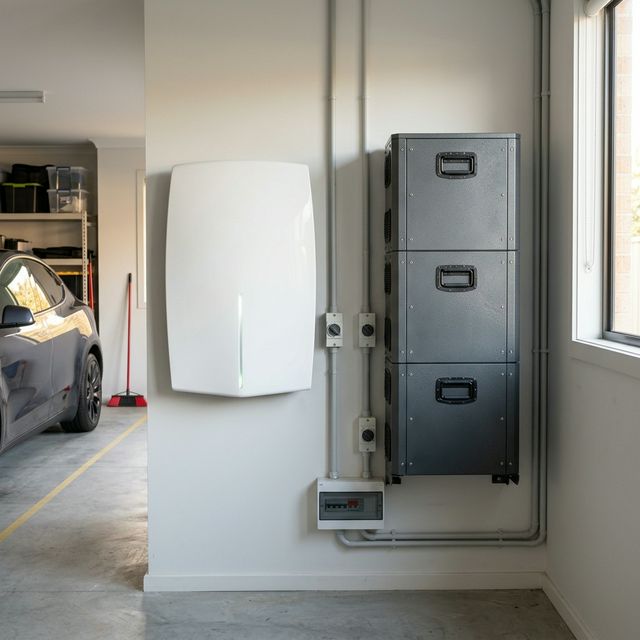
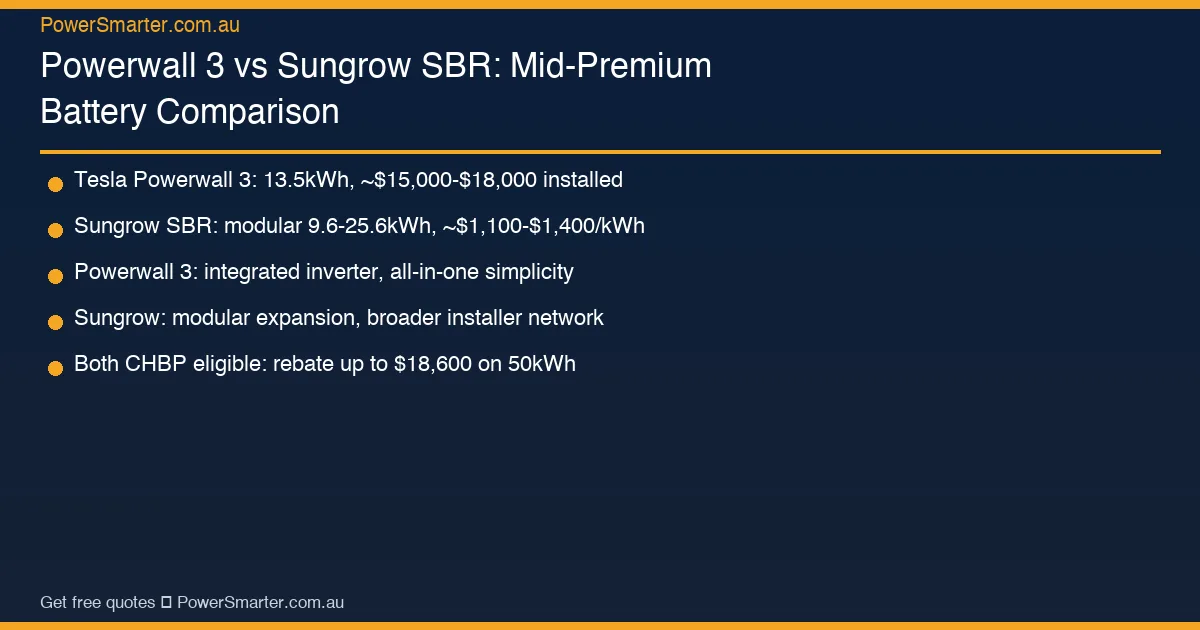
The Powerwall 3 is a 13.5kWh battery with a built-in hybrid inverter — it handles both solar and battery functions in a single unit. That integration is the key selling point. Instead of separate solar inverter + battery inverter + battery, you get one box (well, one tall rectangular unit) that does everything.
This matters for a few reasons. Fewer components means fewer failure points. The installation is cleaner. And the Tesla app ecosystem is genuinely excellent — probably the best monitoring and scheduling interface of any battery brand available in Australia right now. The app shows real-time power flows, lets you set charging windows, and integrates with Tesla EVs if you have one.
The installed price for a single Powerwall 3 typically runs $15,000–$18,000 before rebates. After CHBP ($372/kWh × 13.5kWh = $5,022 back), you're looking at $9,978–$12,978 net. That's not cheap, but for a 13.5kWh system with integrated inverter, it's defensible value.
The limitation: if you have an existing solar inverter you want to keep, Powerwall 3 works best as a full system replacement, not a bolt-on addition. For retrofit situations, it can work but requires more careful system design.
What You're Getting with Sungrow SBR
Sungrow's SBR series is modular — each module is 3.2kWh, and you can stack between 3 and 8 modules for a range of 9.6kWh to 25.6kWh. The flexibility to start smaller and expand later is a genuine advantage if your budget or energy needs might change.
Sungrow as a company is the world's largest solar inverter manufacturer by shipments. They're not a startup or a niche player. The SBR battery works seamlessly with Sungrow's hybrid inverters (SH series), and Sungrow has the largest installer network of any battery brand in Australia — partly because their inverters are already in hundreds of thousands of Aussie homes.
Installed cost for a 9.6kWh SBR system (3 modules + Sungrow hybrid inverter) typically runs $11,000–$14,000. After CHBP ($3,571 back on 9.6kWh), that's $7,429–$10,429 out of pocket. Scale up to 19.2kWh and you're looking at $18,000–$22,000 installed, with a CHBP rebate of $7,142.
The Installer Network Factor
This is where Sungrow has a real advantage. Because the company dominates solar inverter sales in Australia, there's a massive pool of installers who know the product intimately. You're likely to find experienced Sungrow installers in almost any metro or regional area.
Tesla's installer network is more concentrated. They work through authorised partners, which maintains quality control but limits geographic reach. In Sydney, Melbourne, Brisbane, and Perth you'll have options — in regional areas, it gets trickier, and you might have an installation crew travelling from the nearest city, which adds cost.
The Monitoring Experience
Tesla wins this category. The Powerwall app is polished, intuitive, and provides genuinely useful information in a format that non-technical homeowners can actually understand. Sungrow's iSolarCloud platform is functional but requires more familiarity to get the most out of it.
That said, for most homeowners who'll check their app once a week rather than once an hour, the difference isn't life-changing. Both platforms give you the data you need to manage your system.
Which One Actually Makes More Financial Sense?
Run the numbers on your specific situation. If you have an existing solar system with a compatible inverter, a Sungrow SBR retrofit might give you more usable capacity for similar money. If you're starting fresh or replacing an ageing inverter anyway, the Powerwall 3's integrated design could save on system complexity.
The honest answer is that both are good products from credible manufacturers. At this price point, the quality of the installer and the completeness of the system design matter more than brand preference. A well-installed Sungrow will outperform a poorly-installed Powerwall, and vice versa.
Get quotes for both from separate installers, ask each one to explain the specific system design for your home, and compare the total installed cost against the usable kWh you'll actually get. That comparison will tell you more than any review article can.
Comments (0)
No comments yet. Be the first to share your thoughts!