
Off-Grid vs Grid-Connected Battery: Which System Is Right for You?
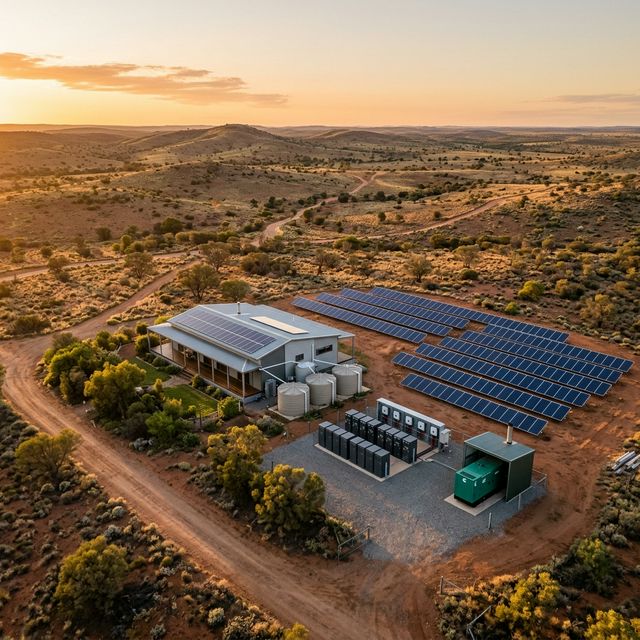
"Off-grid" has a certain appeal — the idea of being completely disconnected from electricity retailers and their ever-rising prices. But for most Australians, off-grid isn't actually the right choice. Here's the honest comparison of off-grid vs grid-connected battery systems, and how to determine which makes sense for your situation.
What "Off-Grid" Actually Means
A true off-grid system is completely disconnected from the electricity distribution network. Your home generates all its own power (typically from solar, sometimes wind or hydro) and stores it in a large battery bank. When the battery runs low, a backup generator kicks in.
No grid connection, no electricity retailers, no network access charges — but also no grid as a backup when your system falls short. And it falls short more than people expect.
What "Grid-Connected" Battery Means
A grid-connected battery system remains connected to the electricity network. Your battery charges primarily from solar and discharges at night, but the grid remains available as a backup for extended overcast periods, high consumption days, or any time your battery is depleted. You're paying for grid power only when you actually need it.
The Economics: Off-Grid Is Usually More Expensive
Off-grid systems are significantly more expensive than grid-connected, for two reasons:
Sizing for Worst-Case Scenarios
A grid-connected battery needs to cover your typical overnight consumption. If the battery runs out, the grid covers the rest.
An off-grid system must cover worst-case scenarios: a week of heavily overcast weather, unusually high consumption, seasonal solar reduction. To ensure reliable supply without the grid backstop, you need substantially more battery capacity and solar generation than a grid-connected system.
A grid-connected home might manage well with 10 kWh of storage and 6.6 kW of solar. The equivalent off-grid system might need 30–50 kWh of storage and 10–15 kW of solar, plus a generator. The cost difference is $20,000–$50,000.
No Grid Backup During System Issues
If your inverter fails, your battery degrades unexpectedly, or unusual weather reduces generation: grid-connected households have the network as a backstop. Off-grid households have no backup unless they have a generator. The reliability cost is real.
When Off-Grid Makes Genuine Sense
Despite the higher cost, off-grid makes financial and practical sense in specific situations:
Remote Properties Without Grid Access
If there's no electricity grid within practical connection distance, off-grid is the only option. Rural and remote properties more than 1–2 km from the nearest line typically face very high grid connection costs (often $5,000–$50,000+ depending on distance), making off-grid competitive or even cheaper than connecting.
Properties With High Grid Connection Costs
Even in areas with grid access, new connections can be expensive. If the cost to connect to the grid exceeds $20,000, off-grid may be the more economical path.
Very Unreliable Grid (Some Regional Areas)
If your grid connection is so unreliable that you're already running a generator most of the time, transitioning to a solar + battery off-grid system may actually improve reliability and reduce fuel costs.
The Hybrid Option: Grid-Connected With Backup Depth
For most households who want more energy security without going fully off-grid, the practical answer is a well-designed grid-connected system with backup capability:
- 13–27 kWh of battery storage
- Configured for automatic backup during outages (islanding capability)
- Whole-home backup for typical outage durations (4–24 hours)
- Grid still available when the battery depletes in extended events
This hybrid approach gives you most of the independence benefit at a fraction of the cost of true off-grid. And with the CHBP rebate reducing battery costs, the economics of this approach have never been better.
The Decision Framework
| Situation | Recommended Approach |
|---|---|
| Metro or suburban home with grid access | Grid-connected solar + battery |
| Regional home with grid access, high outage risk | Grid-connected + large battery with backup |
| Rural home, grid connection cost above $20,000 | Off-grid solar + battery + generator |
| No grid access within reach | Off-grid only option |
| Very unreliable grid, already running generator | Off-grid or partial off-grid hybrid |
If You're Considering Off-Grid
Get specialist advice — off-grid system design is significantly more complex than grid-connected design. Finding an installer with genuine off-grid experience (not just a solar panel installer who's done one or two) is important. The battery sizing, generator selection, and system configuration must be right from the start.
Comments (0)
No comments yet. Be the first to share your thoughts!