
Electricity Bill Optimisation: TOU, Solar, Battery and VPP for Australian Households
Having solar panels and a battery doesn't automatically mean you're getting the best outcome. The households getting the most value from their systems are the ones who've deliberately connected the four levers that determine electricity costs: the right retail plan, smart TOU management, effective battery scheduling, and — where appropriate — VPP participation.
Here's how to align all four.
Lever 1: Choosing the Right Retail Electricity Plan

Your electricity retail plan is the foundation. Choose wrong here, and no amount of smart battery scheduling will fix it.
For Solar-Only Households (No Battery)
Your goal: maximise export income. Look for plans with high feed-in tariffs. The trade-off: plans with higher FiTs sometimes have higher import rates. Do the maths for your specific usage profile — export value vs import cost.
For Solar + Battery Households
Your goal shifts: maximise self-consumption value. Since you're exporting less (storing more), a high FiT matters less. A time-of-use plan with high peak rates (and low off-peak/shoulder rates) allows your battery to maximise its arbitrage value — charging when rates are low (overnight or shoulder) and discharging when rates are high (evening peak).
TOU plans to consider:
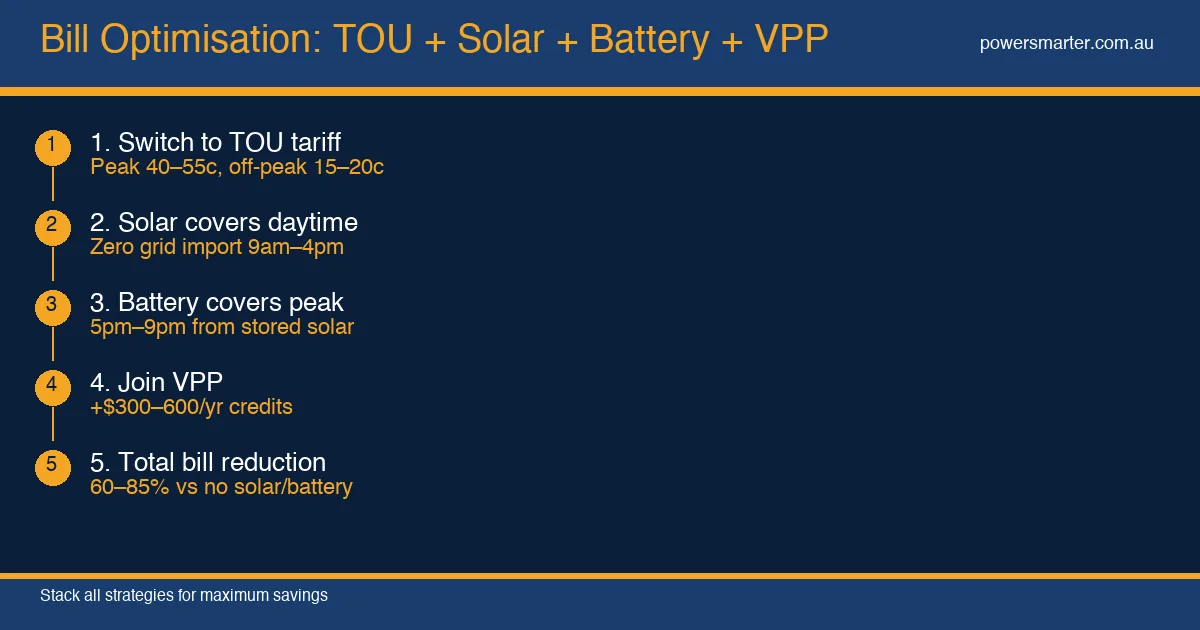
- Plans with peak rates of 40–55c/kWh in evening (4pm–9pm) paired with off-peak at 15–22c/kWh overnight — your battery earns the rate spread
- Amber Electric: pass-through wholesale pricing with smart battery integration — higher risk/reward, best for engaged users with smart home automation
- Retailers with VPP enrolment available: include this in plan comparison if VPP participation interests you
The Comparison Mistake to Avoid
Don't compare plans on headline FiT rate alone if you have a battery — you're not exporting much. And don't compare on peak rate alone — the daily supply charge and shoulder rates matter too for your total bill. Run an annual cost estimate using your actual hourly consumption data if your retailer or distributor provides it.
Lever 2: TOU Tariff Strategy
If your retail plan has time-of-use pricing, battery scheduling becomes financially powerful:
The Basic Arbitrage Strategy
- Overnight off-peak (10pm–6am): If rates are 15–20c/kWh, this is when to draw any grid electricity you need
- Morning shoulder (6am–10am): Solar starts generating; battery supplements as needed
- Midday solar peak (10am–3pm): Solar covers loads and charges battery; minimise grid imports
- Evening peak (4pm–9pm): Your battery dispatches stored energy; avoid grid imports at 40–55c/kWh
A battery that prevents 8 kWh of peak grid imports daily saves:
8 kWh × (48c − 18c) × 365 days = $876/year in rate arbitrage alone
Advanced: Charging From Grid at Off-Peak
For households with very high peak rates and very low off-peak rates, it can make sense to partially charge the battery from grid electricity at off-peak rates on days when solar charging isn't sufficient. This is an optimisation worth considering if:
- Peak rate is 50c+ and off-peak is 15c or less
- Your battery has spare capacity overnight
- Your software allows scheduled grid charging
Lever 3: Battery Scheduling and Optimisation
Modern battery systems offer scheduling controls — use them:
Self-Consumption Mode vs TOU Mode
Self-consumption mode: Battery charges from solar and discharges to household load automatically. Best for flat-rate tariffs where there's no peak/off-peak benefit.
TOU mode / Time-based control: Battery is programmed to charge from off-peak grid or solar at set times, and discharge only during peak rate periods. Best for TOU tariffs. Not all batteries offer this — confirm before purchasing.
Storm Watch / Forecasting
Tesla Powerwall and some other batteries have weather-aware charging — they pre-charge to maximum capacity when severe weather is forecast, ensuring backup is available. Ensure this feature is enabled if it's available on your battery.
Export Limit Management
If your DNSP limits your solar export (common in Ausgrid and some other network zones), ensure your battery's export limit settings are correctly configured. An incorrectly configured battery can either fail to capture curtailed solar or exceed network limits and trigger compliance issues.
Lever 4: VPP Participation
Virtual Power Plant programs layer additional income on top of your self-consumption savings:
How VPP Works in This Context
VPP operators dispatch your battery during high grid demand events — typically coinciding with peak pricing periods. From a TOU strategy perspective, there's a potential tension: your battery might be dispatched for VPP during an evening peak period when you also wanted it to cover your own household load.
Good VPP programs manage this through:
- Minimum SoC reservation: You set a level (e.g., 20%) that VPP never dispatches below
- Load awareness: Some programs won't dispatch if your household consumption is above a threshold
- Compensation for use: The payment for VPP dispatch should compensate for the grid power you import if your battery is partially depleted
The financial case: VPP programs typically pay $150–$600/year depending on dispatch frequency and program. This is additive to self-consumption savings.
Putting It All Together: A Day in an Optimised Household
Here's what an optimised solar + battery + TOU + VPP household looks like on an average day:
- Midnight–6am: Battery charged to a base level from overnight off-peak grid (18c/kWh). Household drawing minimal load.
- 6am–10am: Solar kicks in, battery supplements household loads. Grid import minimal.
- 10am–3pm: Solar covers 100% of household loads and charges battery to full. Excess exported at FiT rate.
- 3pm–4pm: Battery fully charged. Solar still covering household loads.
- 4pm–9pm (peak): Battery dispatches to household — zero grid imports at 48c/kWh. VPP may dispatch for 30 mins around 6pm during high grid demand event.
- 9pm–midnight: Battery providing residual household loads. As SoC approaches reserve, switches to off-peak grid.
Annual bill estimate for a 4-person household with this setup in NSW: $200–$600/year, compared to $2,800+/year without solar or battery.
The Bottom Line
Hardware matters. But so does how you configure and use it. The highest-performing battery households have:
- A TOU retail plan matched to their battery's scheduling capabilities
- Battery scheduled in TOU mode to avoid peak rates and capitalise on off-peak
- VPP enrolment if their battery brand supports it in their state
- Solar sized to consistently fill the battery and provide surplus
If you're not sure whether your current plan and battery configuration are optimised, that's worth investigating before upgrading hardware.
Comments (0)
No comments yet. Be the first to share your thoughts!