
Battery Warranties Explained: What Australian Buyers Must Know
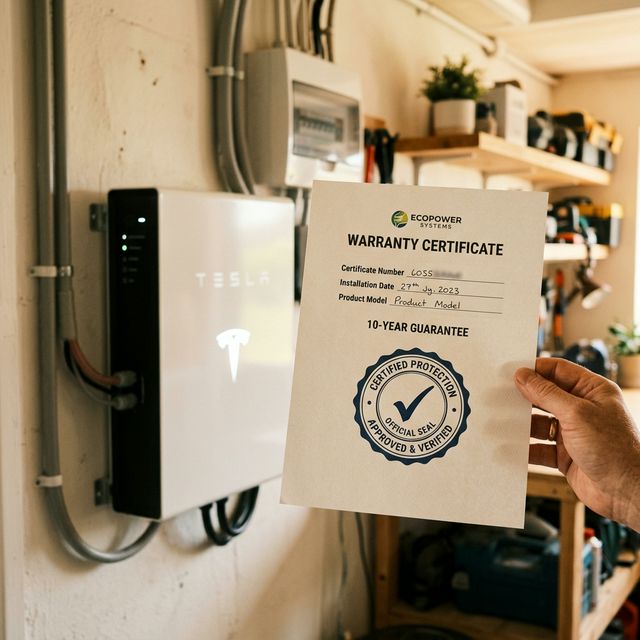
Every battery manufacturer offers a "10-year warranty." What most buyers don't realise is that the practical meaning of those 10 years varies enormously between brands — and some battery warranties are structured in ways that make claiming them genuinely difficult.
Here's how to read warranty documents properly, what to look for, and which brands offer the strongest protection.
The Two Main Types of Battery Warranty

1. Defect Warranty (Product Warranty)
This covers hardware failures — if your battery stops working due to a manufacturing defect, the manufacturer replaces or repairs it. This is analogous to a standard product warranty. All reputable brands offer this for 10 years.
But "covers hardware failure" needs unpacking. Some warranties require that the failure occur under specific operating conditions. Extremes of temperature, incorrect installation, or failure to comply with maintenance requirements can void the warranty. Always read the exclusions section.
2. Performance/Capacity Warranty
This guarantees minimum usable capacity at the end of the warranty period. This is where the meaningful differences between brands appear.
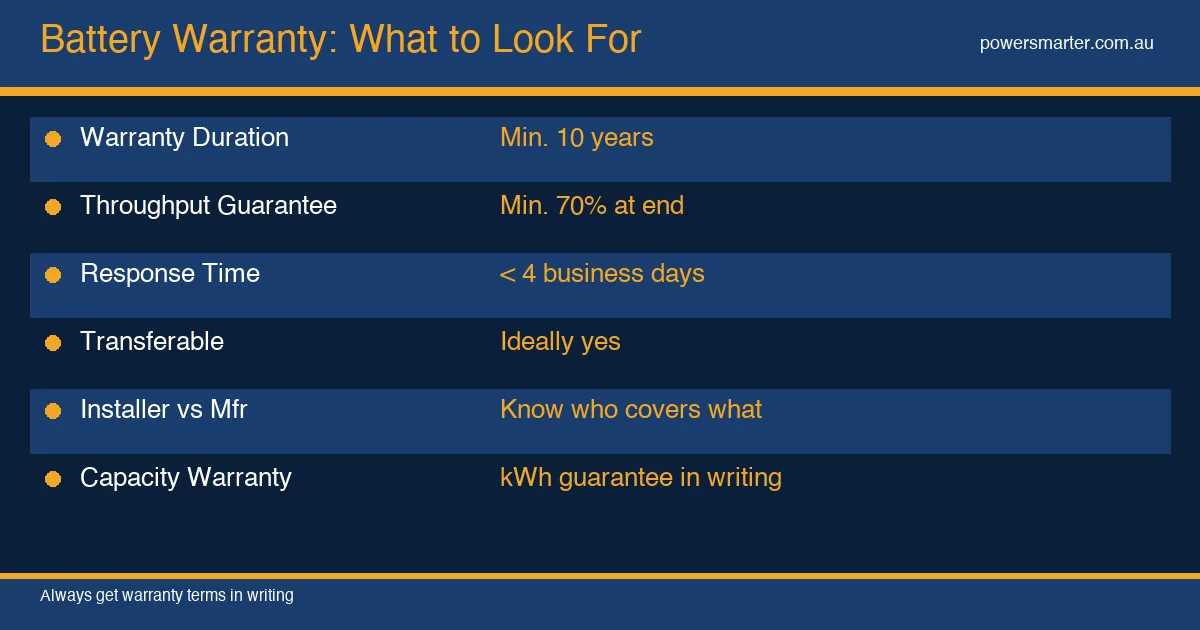
Example: A battery warranted to retain 70% capacity at 10 years means that if a 10kWh battery degrades below 7kWh usable, the manufacturer owes you action — typically repair, replacement, or compensation.
The capacity guarantee percentage matters:
- Tesla: 70% capacity at 10 years
- BYD: 60% capacity at 10 years
- Enphase: 70% capacity at 15 years
- sonnen: 70% capacity, 10 years or 10,000 cycles
- Sungrow: 60% capacity at 10 years
The practical reality: LFP battery chemistry (used by all reputable brands) typically degrades to only 75–85% capacity over 10 years under normal use — better than most warranties guarantee. The warranty is a floor, not the expected outcome.
Who Actually Backs the Warranty?
This is one of the most important questions to ask, and one that's rarely discussed in marketing materials.
Battery warranties can be backed by:
- The manufacturer directly — Tesla, sonnen, Enphase back their own warranties through their Australian operations
- The Australian distributor — for some brands (Alpha ESS, BYD, etc.), the Australian distributor is technically responsible for warranty service. If the distributor changes or the relationship ends, warranty service can become complicated.
- The installer — some warranties require the original installer to handle claims, which becomes problematic if the installer business closes
What to ask: Who is my primary contact for warranty claims — manufacturer, distributor, or installer? What happens to my warranty if the installer company closes?
Cycle Count Warranties vs Time-Based Warranties
Most warranties are purely time-based ("10 years"). Some also specify a minimum number of charge cycles before the warranty expires — whichever comes first.
sonnen's "10 years or 10,000 cycles" structure is notable: 10,000 cycles represents cycling the battery twice daily for 14 years. In practice, residential users cycling once per day won't hit 10,000 cycles in 10 years — so the cycle limit is non-restrictive for most users.
Be cautious of warranties structured as "10 years OR X cycles" where X is a small number. A warranty of "10 years or 3,000 cycles" is effectively a 8-year warranty for a household cycling daily — the cycle count expires the warranty early.
Red Flags in Battery Warranty Fine Print
Red Flag 1: "Replacement at manufacturer's discretion"
Some warranties allow the manufacturer to choose between repair, replacement with a refurbished unit, or partial compensation. This gives them significant flexibility to provide lesser remedies. Look for warranties that specify new-for-new replacement as the primary remedy.
Red Flag 2: "Excludes consequential losses"
This is standard in almost all product warranties, but worth noting. If your battery fails and you suffer electricity bills as a result (no backup, no solar capture), you can't claim those costs under the product warranty.
Red Flag 3: Geographic Restrictions
Some warranty documents have been written for the US or European market and include geographic restrictions or exclusions. Confirm that your specific Australian installation is covered under Australian warranty terms.
Red Flag 4: "Installer must be original installer"
If your warranty requires all claims to go through the original installing company, you're exposed if that company closes. Ask what happens to your warranty if the installer ceases trading.
Red Flag 5: Maintenance Requirements
Some warranties require annual inspections or firmware updates to remain valid. These requirements are often not communicated clearly at the point of sale. Ask specifically what maintenance obligations must be met to preserve warranty validity.
How to Actually Make a Warranty Claim
The warranty claim process varies by brand:
- Tesla: Contact Tesla Support directly through the app or website. They manage claims through their certified installer network.
- BYD: Contact your installer first. They escalate to the BYD Australian distributor if required.
- Enphase: Contact Enphase support — they have an Australian technical team. Claims are managed through the Enlighten platform.
- sonnen: Contact sonnen Australia directly. Local team manages the process.
- Alpha ESS, Sungrow: Contact your installer. Claims escalate to the Australian distributor.
Practical advice: Keep your installation documentation in a safe place — specifically the system commissioning certificate, warranty certificate, and installer details. You'll need these if you make a claim years later.
What Good Warranty Terms Look Like
The strongest battery warranty currently available in Australia for residential buyers is Enphase IQ Battery — 15 years. For brands with 10-year warranties, the strongest terms combine:
- 70% capacity retention guarantee
- New-for-new replacement (or equivalent) as primary remedy
- Manufacturer-backed (not just installer-backed)
- Australian-specific terms
- Clear process for claims regardless of installer status
The Practical Takeaway
Don't let warranty marketing numbers fool you. "10-year warranty" doesn't tell you what you're actually covered for. Read the capacity guarantee percentage, understand who backs the warranty, and ask your installer what happens to your warranty if they close their business.
For most reputable brands with LFP batteries, the battery will likely outlast its warranty period in any case — degradation is slow and the products are well-engineered. But buying a battery with strong warranty terms from a brand with local support infrastructure is insurance worth paying a modest premium for.
Comments (0)
No comments yet. Be the first to share your thoughts!