
Battery-Only Installations (No Solar): Does It Ever Make Sense?
Most home battery articles assume you also have solar panels — or plan to get them. But what if you don't have solar and don't plan to install it? Can a battery-only installation still make financial sense?
The honest answer: sometimes, but the maths is much tighter than solar + battery. Here's exactly when it works and when it doesn't.
How a Battery-Only System Makes Money
Without solar, a battery can only earn through one mechanism: grid arbitrage — charging at cheap overnight off-peak rates and discharging during expensive peak hours.
The financial gain is the spread between:
- What you pay to charge the battery (off-peak rate)
- What you save by discharging instead of buying peak power (peak rate)
- Minus round-trip efficiency losses (typically 10–15% for modern LFP batteries)
Example Calculation
- Battery: 10 kWh usable, 90% round-trip efficiency = 9 kWh of useful energy from each charge cycle
- Off-peak charge rate: 18 cents/kWh × 10 kWh = $1.80 to fill the battery
- Peak savings: 9 kWh × 45 cents/kWh = $4.05 avoided peak bill
- Net gain per cycle: $4.05 − $1.80 = $2.25/day
- Annual gain: $2.25 × 365 = $821/year
At an installed cost of $12,000 (no CHBP — CHBP requires the property to have or be installing solar), payback period: 14.6 years. That's outside the 10-year warranty period. The maths doesn't work unless conditions are ideal.
When It Can Work
Large Peak/Off-Peak Spread
South Australia has some of the widest peak/off-peak spreads in Australia. At 45 cents/kWh peak and 18 cents/kWh off-peak, the spread is 27 cents. In states with smaller spreads (VIC flat tariff users with 28 cents all hours), the economics are much weaker.
Battery-only arbitrage works best when: peak rates are above 40 cents AND off-peak rates are below 20 cents AND the spread exceeds 25 cents/kWh after round-trip losses.
Very High Current Bills
Households with very high electricity consumption (30+ kWh/day) have more peak consumption to displace. A larger battery cycling daily against high peak rates can deliver annual savings of $1,500+, which improves the business case substantially.
Backup Power as Primary Motivation
If backup power is the primary reason — not savings — then battery-only makes sense regardless of the arbitrage economics. For households with medical equipment, rural properties with frequent outages, or businesses with critical power needs, the backup value justifies the cost independent of grid arbitrage.
Rental Property or Situation Where Solar Isn't Feasible
If you can't install solar (apartment, unsuitable roof, rental), a battery-only system is the only hardware option. The economics may be marginal, but it's still better than nothing if backup is valuable.
Why CHBP Doesn't Apply
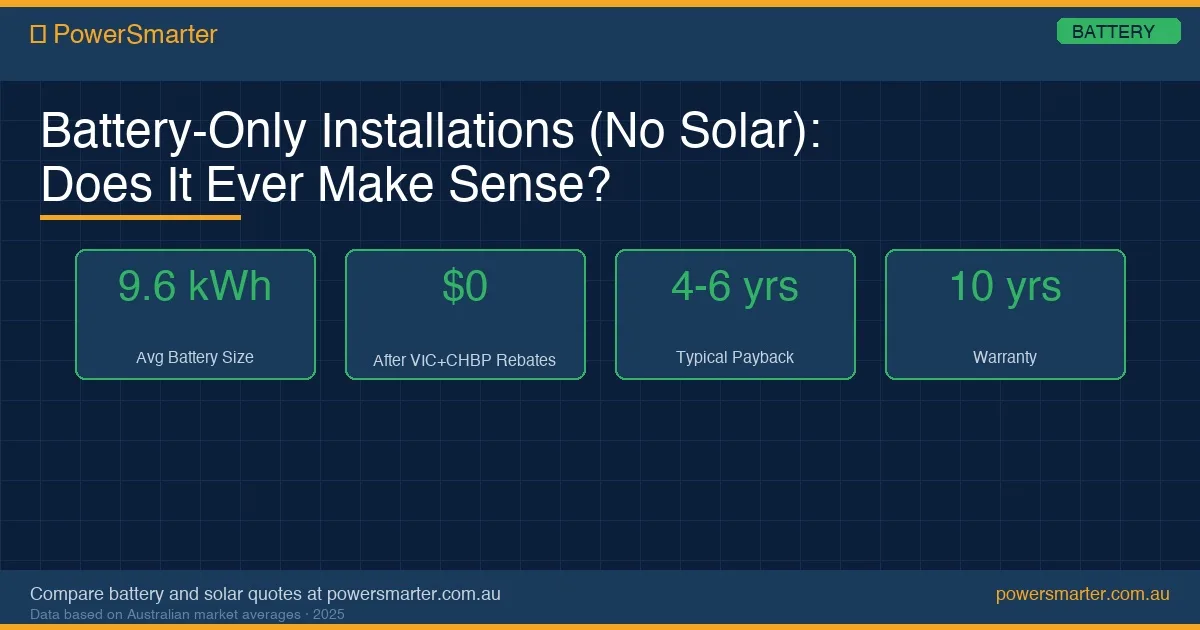
The Commonwealth Home Battery Program requires the property to have solar installed or be installing solar at the same time as the battery. A battery installed without solar is not CHBP eligible. This significantly affects the financial case: without the $3,720+ rebate, the upfront cost is higher and payback is longer.
The Recommendation
If you don't have solar and are considering a battery:
- Model the arbitrage maths for your specific tariff (peak and off-peak rates)
- Consider whether getting a solar system simultaneously would unlock CHBP and improve the overall economics
- If backup is the primary driver and arbitrage savings are secondary: battery-only may still be justified
- If pure arbitrage economics with no CHBP don't pencil out in a 10-year payback: the battery is a backup power purchase, not an investment — evaluate it accordingly
Comments (0)
No comments yet. Be the first to share your thoughts!